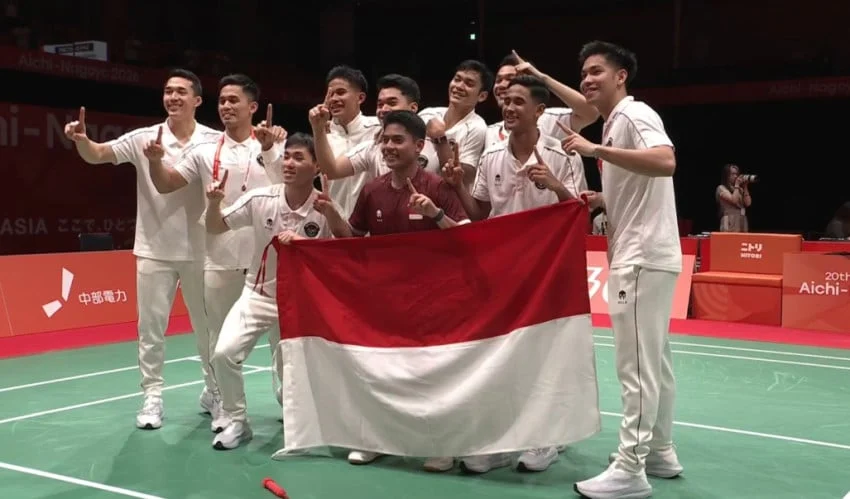
The Indonesian men’s badminton team achieved a historic milestone at the 2026 Asian Games in Aichi-Nagoya, Japan, securing the gold medal in a dramatic 3-2 comeback victory against powerhouse China. The final, held at the Ichinomiya City Municipal Gymnasium on Thursday, September 24, 2026, served as a testament to the resilience and strategic depth of the Indonesian squad. While the team faced an initial deficit, the eventual triumph was cemented by a stellar performance from rising star Moh. Zaki Ubaidillah, affectionately known as Ubed, whose composure in the deciding fifth match captivated spectators and sports analysts alike.
A Dramatic Turn of Events: The Path to Gold
The final encounter between Indonesia and China was a rollercoaster of momentum, characterized by shifting fortunes and high-pressure tactical exchanges. China, traditionally dominant in the badminton circuit, signaled their intent early by securing the first two points of the tie. Indonesia’s prospects appeared dim as the early matches slipped away, placing immense pressure on the remaining players to prevent a sweep.
The momentum shifted significantly in the third match. Indonesia’s Alwi Farhan, displaying remarkable technical precision, secured a crucial victory that breathed life into the team’s campaign. Following this, the world-class duo of Leo Rolly Carnando and Daniel Marthin delivered a masterful performance in the fourth match, leveling the overall score at 2-2. This set the stage for the final showdown, where the gold medal hung in the balance.
Moh. Zaki Ubaidillah stepped onto the court to face China’s Weng Hong Yang. Despite the overwhelming atmosphere and the stakes involved in a major continental final, Ubed exhibited a maturity well beyond his years. He successfully neutralized his opponent’s offensive strategies, clinching the first game in a tight 23-21 battle before dominating the second game 21-13. His victory not only secured the gold medal but also solidified his reputation as a key figure in the future of Indonesian men’s singles.
The Rise of a New Generation
The 2026 Asian Games victory is being heralded as a changing of the guard for Indonesian badminton. For years, the Indonesian men’s team has relied on seasoned veterans to carry the mantle at international events. However, the Aichi-Nagoya campaign has demonstrated that the talent pipeline is robust and capable of performing under extreme scrutiny.
Analysts have pointed to the strategic integration of young talents like Ubed and Alwi Farhan as a masterstroke by the coaching staff. By exposing these players to high-stakes tournament environments early in their careers, the national federation has effectively accelerated their development. The fact that the gold medal was won by the younger contingent suggests that Indonesia is well-positioned to maintain its competitive edge in the regional and global rankings for the next Olympic cycle.
Chronology of the Final Match
- Match 1: China draws first blood, establishing an early lead in the tie.
- Match 2: China doubles their advantage, leaving Indonesia in a must-win situation for the remaining three matches.
- Match 3: Alwi Farhan initiates the comeback with a clinical performance, reducing the deficit to 1-2.
- Match 4: The pair of Leo Rolly Carnando and Daniel Marthin secures a convincing win, forcing a decider at 2-2.
- Match 5: Moh. Zaki Ubaidillah delivers the decisive victory, overcoming Weng Hong Yang to finalize the 3-2 scoreline.
Social Media Sentiment and Public Reaction
The narrative surrounding Ubed’s performance has extended beyond traditional sports reporting, finding significant traction on digital platforms. Fans and observers have praised the 19-year-old for his tactical acumen and mental fortitude. On platforms such as X (formerly Twitter), the hashtag #MenyalaUbed began trending shortly after the final, with users highlighting the contrast between his aggressive playstyle and his calm demeanor under pressure.
One prominent commentator remarked, "Ubed’s ability to remain composed during the high-stakes points of the first game was the defining moment of the final. While many expected a nervous performance, he played with the tactical maturity of a veteran. The synergy between him and Alwi Farhan provides a promising outlook for the future of the sport in Indonesia."
This surge in public support underscores the cultural importance of badminton in Indonesia. As a national sport, badminton often carries the weight of national pride, and the ability of a young athlete to handle this burden has resonated deeply with the public.
Technical Analysis: Beyond the Win
From a technical perspective, the Indonesian team’s victory in Aichi-Nagoya can be attributed to their adaptability. During the first two matches, the Chinese players utilized a high-tempo, attacking style that caught the Indonesians off guard. However, the mid-tie adjustments—specifically the focus on defensive stability and controlled net play—allowed the Indonesian players to dictate the pace in the final three matches.
The victory over China is particularly significant given the latter’s depth in talent. China’s badminton program is arguably the most well-funded and structurally organized in the world. To defeat them in a team format requires not just individual brilliance, but superior team chemistry and coaching intervention. The tactical shift in the fourth and fifth matches reflected a high level of preparation and an intimate understanding of the opponents’ tendencies.
Broader Implications for the Asian Games
The 2026 Asian Games serve as a pivotal precursor to the 2028 Olympic Games in Los Angeles. Success in Aichi-Nagoya is not merely about the medal count; it is about establishing a psychological advantage over regional rivals. By defeating China, the Indonesian team has sent a clear message to other regional powers, including Japan, South Korea, and Malaysia, that the Indonesian men’s squad has entered a new phase of dominance.
Furthermore, the financial and logistical investment in the Indonesian badminton training center in Cipayung appears to be yielding tangible results. With the successful transition of young players into the senior team, the national federation is likely to continue its current trajectory of talent development. The focus will now shift toward maintaining consistency in the BWF World Tour circuit, where the points accumulated will determine seeding for upcoming world championships and the next Olympic qualification process.
Official Responses and Future Outlook
While formal statements from the national federation are expected in the coming days, the initial reactions from the coaching staff have been overwhelmingly positive. Sources close to the team noted that the coaching staff emphasized "mental resilience" as the core philosophy during the training camp leading up to the Games.
The victory at the Ichinomiya City Municipal Gymnasium will likely be remembered as the moment when the "new guard" of Indonesian badminton officially arrived. For Ubed and his teammates, the challenge now lies in managing the expectations that come with such a significant victory. With the eyes of the badminton world now fixed upon them, the team must navigate the pressure of maintaining their status as the kings of Asian badminton.
As the Indonesian delegation celebrates this gold medal, the focus will soon turn to the individual categories. However, the team event remains the most prestigious indicator of a nation’s collective badminton strength. By clinching this gold, Indonesia has not only upheld its storied legacy in the sport but has also paved a clear, optimistic path toward future successes on the global stage. The victory is a reminder that in the volatile and high-speed world of professional badminton, talent is essential, but it is the composure of individuals like Moh. Zaki Ubaidillah that ultimately determines the color of the medal hanging around their necks.