
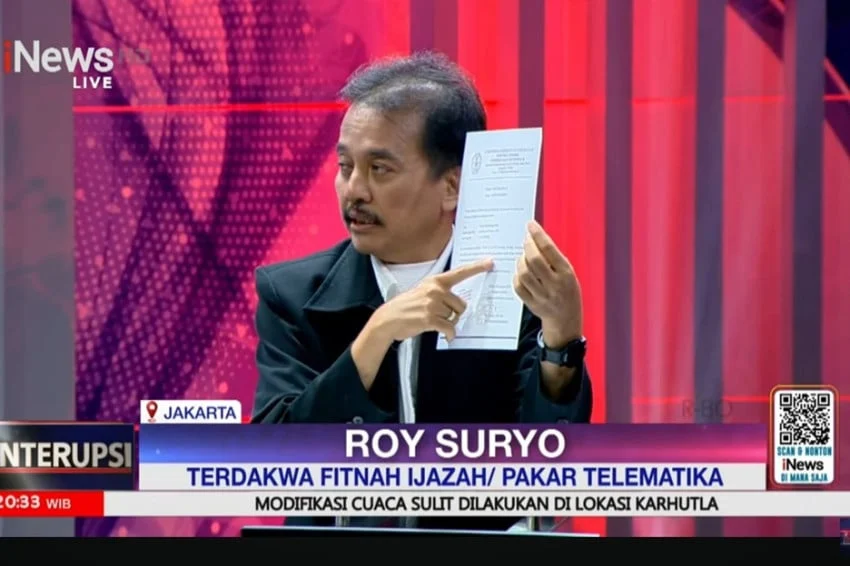
The ongoing public discourse surrounding the educational background of Indonesian Vice President Gibran Rakabuming Raka has taken a new turn following claims made by prominent critic and telematics expert Roy Suryo. During a recent media appearance, Roy stated that he personally traveled to Australia to investigate Gibran’s academic history at UTS Insearch, an institution linked to the University of Technology Sydney. According to Roy, his inquiries yielded no evidence of Gibran’s attendance during the specified timeframe, fueling a broader national debate regarding the authenticity and transparency of the credentials held by high-ranking government officials.
The controversy over Gibran Rakabuming Raka’s educational credentials is not an isolated incident but rather part of a larger pattern of scrutiny that has followed him throughout his political career, particularly leading up to and following the 2024 Indonesian presidential election. Questions regarding academic histories of public figures often emerge in the landscape of Indonesian politics, where educational achievements serve as a significant metric of qualification and public trust.
Investigation Details and Methodology
Speaking on a current affairs program, Roy Suryo detailed the steps he allegedly took to verify the Vice President’s academic claims. He asserted that he visited the campus of UTS Insearch in Australia to cross-check records and speak with individuals who were enrolled at the institution between 2004 and 2007, the period during which Gibran is officially stated to have undertaken his preparatory or pathway studies.
Roy claimed that after interviewing numerous alumni and individuals associated with the institution during those academic years, he could not find anyone who recognized Gibran or remembered him as a fellow student. In investigative journalism and civic auditing, personal testimonies from contemporaries are often utilized as secondary or tertiary forms of verification, though official institutional registries remain the definitive standard of proof.
However, Roy acknowledged a single exception during his inquiries. He mentioned a prominent Indonesian expatriate living in Australia, Ikhsan Katonde, who reportedly crossed paths with Gibran abroad. According to Roy’s narrative, while Ikhsan did meet with Gibran in Australia, this encounter was unrelated to the UTS Insearch academic program. Instead, Roy claimed that the meeting occurred when Ikhsan assisted or accompanied Gibran during an official or personal visit facilitated by his father, Joko Widodo (Jokowi), who was serving in a prominent political office at the time.
Context of the Educational Credentials Dispute
The debate over the educational history of the nation’s leaders has historical precedents in Indonesia. In recent years, educational verification has become a common legal and political battleground. Critics and political opponents frequently scrutinize the diplomas, certificates, and institutional attendance records of elected officials to challenge their legitimacy or administrative qualifications.
Gibran Rakabuming Raka’s academic journey has previously been a subject of public discussion, particularly concerning his transition from preparatory programs abroad to his subsequent endeavors. Educational institutions like UTS Insearch typically offer pathway programs designed to help international students meet the linguistic and academic requirements necessary to enter undergraduate degree courses at mainstream Australian universities.
In response to previous allegations and legal challenges regarding the validity of the Vice President’s candidacy and qualifications, former President Joko Widodo and representatives of the administration have routinely defended the family’s educational background. Official statements and documentation previously released by the family indicate that Gibran successfully completed educational milestones abroad before returning to Indonesia to pursue entrepreneurial and political ventures.
Chronology of Events and Public Scrutiny
The timeline of scrutiny surrounding the Vice President’s education spans several key phases:
- 2004–2007: The purported timeframe during which Gibran Rakabuming Raka attended UTS Insearch in Australia for foundational or pathway studies.
- Pre-2024 Election: Heightened public interest and occasional social media discourse questioning the exact nature of qualifications obtained by political candidates, including the current Vice President.
- Post-Election Legal Challenges: Various civil lawsuits and formal petitions filed by critics questioning the administrative validity of Gibran’s candidacy, which frequently touch upon educational prerequisites and documentation.
- Recent Claims by Roy Suryo: The public declaration by the former minister detailing his independent trip to Australia and his assertions regarding the lack of corroborating student testimonies at the institution.
Broader Implications for Governance and Transparency
The persistence of debates concerning official credentials highlights a critical challenge in modern Indonesian governance: the growing demand for absolute transparency from public servants, balanced against the potential weaponization of personal data and misinformation in the political sphere.
From a political science perspective, allegations of this nature can have a dual effect. On one hand, they cater to a segment of the electorate that demands rigorous accountability and unblemished transparency from its leaders. On the other hand, without definitive documentation from the institutions themselves or legally verified counter-evidence, such claims risk deepening political polarization and distracting from substantive policy discussions.
Educational institutions in foreign jurisdictions operate under strict privacy laws, such as Australia’s Privacy Act, which generally prohibit universities and educational providers from releasing student records to third parties without explicit consent from the individual concerned. Consequently, independent investigators like Roy Suryo often rely on circumstantial evidence, qualitative interviews, and public appearances rather than official administrative files, which leaves ample room for differing interpretations and prolonged public debate.
As the discourse continues, institutional responses and official clarifications from the Vice President’s office or the educational institutions involved remain pivotal in resolving factual disputes and maintaining public confidence in the integrity of the nation’s leadership.
