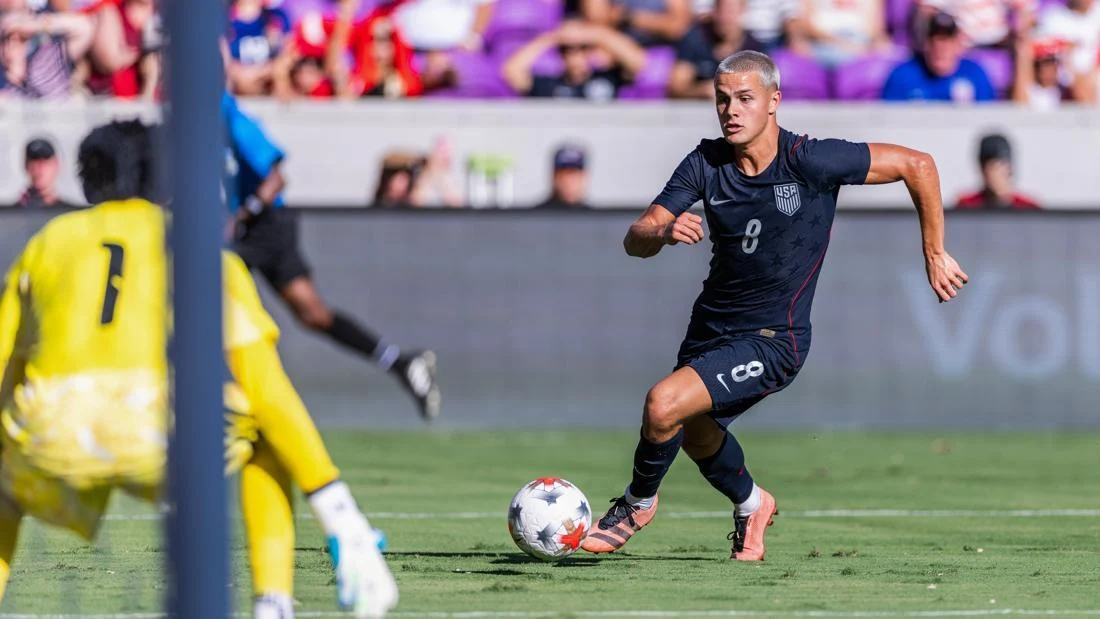
The landscape of American soccer underwent a significant generational shift this past Sunday as Cavan Sullivan etched his name into the annals of United States Men’s National Team (USMNT) history. In a decisive 4-1 friendly victory over Peru at Exploria Stadium in Orlando, Florida, the 16-year-old prodigy became the second-youngest player to ever start a match for the Stars and Stripes. This milestone, occurring on September 27, 2026, marks the beginning of a new chapter for a national program currently navigating the aftermath of a disappointing Round of 16 exit at the 2026 FIFA World Cup, where the U.S. was eliminated by Belgium.
Sullivan, who earned his call-up following a meteoric rise within the Major League Soccer (MLS) ranks with the Philadelphia Union, took the pitch at the age of 16 years and 362 days. His inclusion in the starting XI was a clear signal from the coaching staff that the post-World Cup rebuild would prioritize emerging talent and long-term development. While the match served as a tactical test against a resilient Peruvian side, the narrative was dominated by the composure displayed by the teenager throughout his 62-minute appearance.
The Statistical Context of a Historic Debut
To understand the magnitude of Sullivan’s achievement, one must look at the historical benchmarks of the U.S. national program. According to data provided by ESPN and historical federation archives, only Mike Slivinski, who debuted in 1991, holds the record for being a younger starter for the senior team. Sullivan’s appearance also carries the weight of a legacy comparison; he is the youngest player to earn a senior cap for the United States since the legendary Freddy Adu, who famously made his debut in January 2006 at the age of 16 years and 234 days.
While Sullivan did not register a goal or an assist during his hour on the field, his presence provided a tactical balance that allowed the more seasoned attackers to exploit the Peruvian defense. His ability to hold possession under pressure and transition the ball from the midfield to the final third demonstrated a maturity that belies his chronological age. For a player who has already navigated the high-intensity environment of MLS, the transition to the international level appeared, at least on the surface, to be a natural progression.
Match Chronology: A Victory of Emerging Stars
The friendly match against Peru served as a showcase for the depth of the U.S. talent pool. The scoring opened just four minutes into the contest when Justin Ellis, making his own senior international debut, capitalized on an early defensive lapse by the Peruvian backline to put the U.S. ahead 1-0. The goal injected immediate confidence into the young squad.
Peru, however, displayed their technical prowess shortly thereafter. In the 15th minute, Gianluca Lapadula restored parity with a clinical finish, silencing the home crowd momentarily and reminding the American side that international competition—even in a friendly setting—remains unforgiving.
The second half shifted momentum decisively toward the United States. A pivotal moment occurred when Mathis Albert was brought down inside the penalty area, forcing the referee to point to the spot. Malik Tillman, stepping up with the poise of a veteran, converted the penalty to reclaim the lead. The floodgates opened thereafter. Julian Hall, another promising prospect, extended the lead to 3-1 in the 72nd minute, effectively ending any hopes of a Peruvian comeback. Sebastian Berhalter provided the final exclamation point in the closing minutes of the match, curling a sophisticated strike from outside the box to seal a comprehensive 4-1 victory.
From Philadelphia to the National Stage
Sullivan’s trajectory is inextricably linked to his exceptional form with the Philadelphia Union. Throughout the 2026 MLS season, the teenager has recorded seven goals and 12 assists in 24 appearances. These statistics are not merely impressive for a 16-year-old; they represent a high level of efficiency that rivals established veterans within the league.
His development in Philadelphia has been meticulously managed, balancing the physical demands of professional football with the necessary academic and personal milestones of his age group. The Union’s willingness to grant Sullivan significant playing time has paid dividends, effectively fast-tracking him into the senior national team setup. For the national coaching staff, Sullivan represents a prototypical modern midfielder: technically gifted, tactically aware, and capable of operating in tight spaces—an attribute that has historically been the primary challenge for U.S. midfield units.
Official Reactions and Player Perspective
Speaking to TNT Sports immediately following the match, Sullivan reflected on the gravity of the moment. "I have dreamed of this day my entire life, and it is a tremendous honor to be here and represent my country," Sullivan stated. "I am trying to learn every single day, to continue to get better, to do more things, to learn from the more senior players, and to enjoy every moment."
His comments reflect a grounded approach to a career that has already invited significant external pressure. Observers note that the USMNT coaching staff has been careful to integrate Sullivan into a locker room culture that emphasizes mentorship. By surrounding him with players like Tillman and Berhalter, the staff has created an environment where Sullivan can focus on his tactical assignments rather than the media spotlight.
Implications for the Future of USMNT
The decision to feature Sullivan in a starting capacity is not without long-term strategic implications. As the U.S. looks toward the next major tournament cycle, the integration of players like Sullivan, Ellis, and Hall suggests a pivot toward a more fluid, possession-based style of play.
There are, however, valid questions regarding the sustainability of this approach. Historically, the burden of expectation placed on young American talents—such as the aforementioned Freddy Adu—has occasionally hindered their development. The national team’s medical and technical staff are reportedly monitoring Sullivan’s physical workload closely to prevent burnout. The "Sullivan model"—a blend of club-level prominence and early international exposure—will likely become the benchmark for how the U.S. handles its top-tier prospects moving forward.
Furthermore, this win against Peru provides a much-needed psychological boost for the program. Following the heartbreak of the 2026 World Cup, there were concerns that the team’s morale might suffer during the transitional period. By defeating a South American side with such historical pedigree, the U.S. has signaled that its depth chart remains competitive, regardless of the departure or retirement of older core players.
Analytical Outlook: The Road Ahead
As the dust settles on the Orlando friendly, the focus shifts to the upcoming international window. The coaching staff faces the complex challenge of balancing the need to win matches with the necessity of experimenting with the roster. Sullivan’s performance has likely cemented his place in future squads, but he will face increasing scrutiny from opposing teams who now have a scouting report on his tendencies.
The maturity Sullivan displayed in his 62 minutes of play suggests that he is not merely a "prodigy" but a functional, high-level professional. His decision-making—when to drive the ball, when to lay it off, and how to track back defensively—indicated a player who has internalized the demands of professional football.
In the broader context of CONCACAF and global football, the emergence of a 16-year-old starter is a rare occurrence that usually signals a shift in a nation’s footballing philosophy. For the United States, the investment in youth academies, which began in earnest over a decade ago, is finally yielding a consistent stream of talent capable of contributing immediately to the senior team.
The match against Peru will be remembered as the night Cavan Sullivan stepped out of the shadows of the youth leagues and into the spotlight of international football. While the road to global relevance for the USMNT remains long and arduous, the presence of players like Sullivan provides a foundation of optimism. Whether he becomes the face of a new generation or simply a key component of a larger machine remains to be seen, but for now, the records have been broken, the victory has been secured, and the future of the U.S. Men’s National Team looks significantly younger—and brighter—than it did only a few days ago.