The transition from a professional sports career to the high-stakes arena of national politics is rarely achieved with seamless success, yet few figures in modern history have bridged these disparate worlds quite like George Tawlon Manneh Oppong Ousman Weah. Long before he assumed the presidency of Liberia in December 2017, Weah captured the global imagination as a generational football talent, etching his name into sports history as the first and only African player to win both the FIFA World Player of the Year and the prestigious Ballon d’Or in 1995. His journey from the sandy, makeshift football pitches of Monrovia to the opulent halls of European football stadiums, and ultimately to the Executive Mansion of his war-torn homeland, stands as a testament to unparalleled athletic prowess, relentless determination, and an enduring commitment to public service.
Early Life and the Genesis of a Football Prodigy
Born on October 1, 1966, in Monrovia, the capital city of Liberia, George Weah grew up in an environment characterized by economic hardship and political instability. Raised largely by his grandmother in the Gibraltar section of Monrovia, a working-class neighborhood, Weah discovered his passion for football at an early age. In the absence of professional training facilities or structured youth academies, he honed his natural athletic abilities on dusty, uneven terrain. These formative years forged a remarkable physical resilience and technical adaptability that would later confound professional defenders across Europe.
Weah’s raw talent soon caught the attention of local scouts. He began his organized football journey playing for several domestic clubs in Liberia, including Invincible Eleven, Mighty Barolle, Bongrange Bonguine, and Young Survivors from Claretown. Even as a teenager, his leadership qualities and extraordinary impact on the pitch were evident. Most notably, he propelled Young Survivors—a team operating entirely without the benefit of a professional coach—to a remarkable promotion into the nation’s top football division. This early success was not merely a reflection of individual brilliance, but an early indicator of Weah’s capacity to elevate those around him under adverse conditions.
The African Breakthrough and European Ascendancy
The pivotal turning point in Weah’s early career occurred in 1987 when he secured a transfer to Tonnerre Yaoundé, a prominent club in Cameroon. Stepping onto a larger regional stage, Weah wasted no time demonstrating his elite capabilities. In his debut season with the club, he played an instrumental role in capturing the Cameroonian championship, firmly establishing himself as one of the most promising young strikers on the African continent.
His explosive speed, imposing physical stature, exceptional ball-control skills, and clinical finishing did not go unnoticed by international scouts. Later in 1987, French club AS Monaco, competing in the elite tier of French football, acquired the 21-year-old forward. Under the tutelage of visionary managers, Weah quickly adapted to the tactical rigor and physical demands of European football. Over five productive seasons with Monaco, spanning from 1987 to 1992, Weah netted 57 goals across all competitions, terrorizing defenses with his blistering counter-attacks and powerful long-range shooting. His tenure in the principality culminated in a major team milestone when Monaco lifted the French Cup in 1991, validating his rapid ascent to European prominence.
By the early 1990s, Weah’s reputation as an unstoppable offensive force was firmly cemented. His uncompromising work ethic, technical finesse, and physical dominance made him a coveted asset in the transfer market, leading to a high-profile move to Paris Saint-Germain (PSG) in 1992.
Conquering European Football: PSG, AC Milan, and Historic Accolades
During his spell with Paris Saint-Germain, Weah reached the upper echelons of the sport. Operating on the grandest stages of European club football, he became a central figure in PSG’s domestic dominance and European ambitions. He spearheaded the club to victory in the French Cup, secured a Ligue 1 league title, and memorably guided the Parisian side to the semifinals of the UEFA Champions League in the 1994–1995 season, finishing the tournament as its top scorer. Across 123 appearances for PSG in France’s top flight, Weah registered 37 goals and numerous decisive assists, solidifying his status as a world-class striker.
His stellar performances in France prompted Italian giants AC Milan to secure his services in the summer of 1995. It was in the historic red and black jersey of the Rossoneri that Weah achieved the undisputed peak of his athletic career. Playing in Serie A—widely regarded at the time as the most tactically demanding and competitive football league in the world—Weah adapted seamlessly. In his debut season in Italy, he helped propel AC Milan to the Serie A title, a feat he would repeat during the 1998–1999 campaign.
The pinnacle of individual recognition arrived in late 1995. In a historic sweep, Weah was awarded the prestigious Ballon d’Or by France Football, followed shortly thereafter by the FIFA World Player of the Year accolade. To date, he remains the only African-born player to achieve this double honor, a distinction that elevated him to legendary status across the globe and turned him into a national hero in Liberia. Over 114 appearances for AC Milan, Weah scored 51 goals, delivering memorable moments of individual brilliance, most notably his iconic individual-effort goal against Verona in 1996, where he dribbled the length of the pitch past nearly the entire opposing team.
Following his successful tenure in Italy, Weah enjoyed brief stints in the English Premier League with Chelsea and Manchester City, as well as a return to France with Marseille and a concluding spell in the United Arab Emirates with Al-Jazira. He officially announced his retirement from professional football in 2003, closing the chapter on an illustrious athletic career that yielded numerous domestic and international trophies.
The Transition from Sports Icon to Political Activism
Even at the height of his football career, Weah maintained a deep, abiding connection to his homeland, which was being systematically devastated by two successive civil wars (1989–1996 and 1999–2003). While international media often focused on his exploits on the pitch, Weah utilized his personal wealth, global platform, and Goodwill Ambassador status with UNICEF to provide humanitarian aid, fund medical clinics, and sponsor educational initiatives for disadvantaged children in Liberia.
As the guns finally fell silent and the nation began the arduous process of national reconciliation and reconstruction following the departure of former President Charles Taylor, Weah made the momentous decision to pivot from humanitarian advocacy to institutional politics. Recognizing that his immense popularity and unifying appeal could be harnessed to drive systemic change, he founded the Congress for Democratic Change (CDC) political party and announced his candidacy for the 2005 presidential election.
The 2005 election represented a crucial democratic milestone for Liberia, serving as the nation’s first post-war presidential contest. Weah entered the race as a formidable populist candidate, garnering immense enthusiasm among the country’s impoverished youth who viewed him as a self-made man who understood their struggles. Although he won the initial round of voting, Weah was ultimately defeated in the subsequent runoff election by Ellen Johnson Sirleaf, a Harvard-trained economist and former high-ranking official at the World Bank and United Nations.
Political Evolution and the Path to the Presidency
Despite the initial setback in 2005, Weah demonstrated a long-term commitment to democratic processes and statecraft. Critics at the time questioned his formal educational background, prompting Weah to return to his studies. He subsequently earned a high school diploma and pursued higher education in the United States, ultimately graduating with a degree in business administration from DeVry University in Miami, complemented by subsequent graduate studies.
Weah’s political persistence paid dividends over the ensuing decade. He built robust political alliances, expanded his party’s organizational infrastructure, and demonstrated a willingness to work within the legislative framework. In 2014, he ran for a seat in the Liberian Senate representing Montserrado County—the nation’s most populous electoral district. Weah decisively won the senatorial race, defeating Robert Sirleaf, the son of the sitting president. This legislative tenure provided Weah with vital governance experience, allowing him to navigate policy debates, draft legislative proposals, and build credibility as a serious political actor rather than merely a symbolic figurehead.
By the time the 2017 general elections approached, the political landscape had shifted significantly. The incumbent administration faced mounting public scrutiny over economic stagnation, currency depreciation, and systemic challenges in public healthcare and infrastructure. Weah positioned himself as the standard-bearer of change, running on a platform centered on economic diversification, infrastructural development, anti-corruption measures, and free education.
Electoral Triumph and the Mandate for Reform
The October 2017 presidential election witnessed high voter turnout and intense national scrutiny from international election observers. Weah finished first in the initial ballot, securing approximately 38.4% of the vote, ahead of Vice President Joseph Boakai, who garnered 28.8%. Because neither candidate secured the constitutionally mandated absolute majority, a runoff election was scheduled.
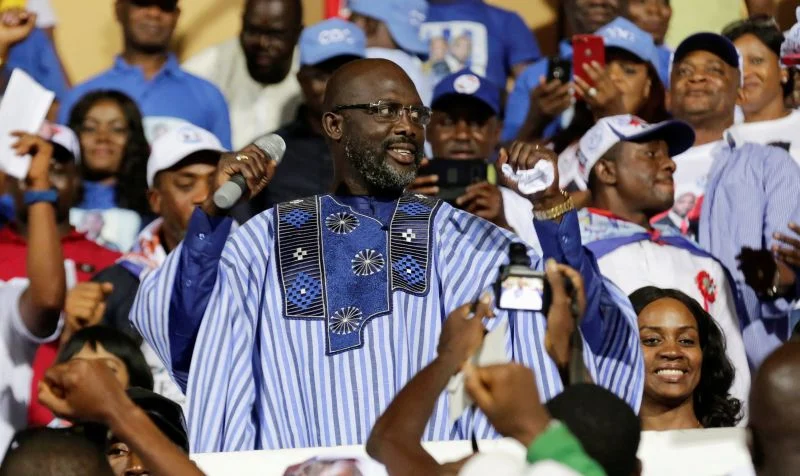
Following a fiercely contested campaign marked by vibrant rallies and intensive political maneuvering, the runoff election was held in December 2017. The official election results confirmed a decisive victory for George Weah, who captured over 61% of the total vote across Liberia’s 15 counties. The peaceful transfer of power marked a historic milestone for Liberia: it was the first democratic transition of power between two democratically elected presidents in the country in over 70 years.
Reactions and International Implications
The election of George Weah elicited widespread reactions from the international community, regional organizations, and domestic stakeholders. Global leaders, including heads of state from across Africa, the United States, and the European Union, commended Liberia for conducting a largely peaceful and transparent electoral process, reinforcing the nation’s fragile democratic institutions.
Economists and political analysts noted that Weah’s sweeping victory reflected a profound desire among the Liberian electorate for generational renewal and socio-economic transformation. Supporters celebrated his rise as a triumph of the common citizen, proving that an individual born in the most modest circumstances could ascend to the highest office through talent, perseverance, and democratic participation.
However, political analysts also highlighted the formidable challenges awaiting the incoming administration. Inheriting an economy heavily reliant on foreign aid and primary commodity exports, alongside widespread youth unemployment and infrastructural deficits, Weah faced the immense burden of translating his immense personal popularity into effective public policy. Financial institutions and international donors emphasized the critical necessity of implementing robust fiscal reforms, strengthening anti-corruption mechanisms, and improving the ease of doing business to attract sustainable foreign direct investment.
Legacy and Broader Impact
The journey of George Weah—from a barefoot youth playing on the sandy lots of Monrovia, to the glamorous stadiums of Milan, Paris, and London where he was crowned the king of world football, and finally to the Executive Mansion as President of Liberia—remains one of the most remarkable personal narratives of the modern era.
His life story transcends sports and politics, serving as a powerful symbol of hope, resilience, and ambition. By successfully navigating the transition from a global sporting icon to a democratically elected head of state, Weah demonstrated that the dedication required to achieve excellence on the football pitch can be redirected toward the complex, often arduous task of nation-building. As his legacy continues to be evaluated by historians and political scientists alike, Weah remains an enduring embodiment of the extraordinary heights achievable through persistent endeavor and an unwavering commitment to public service.