
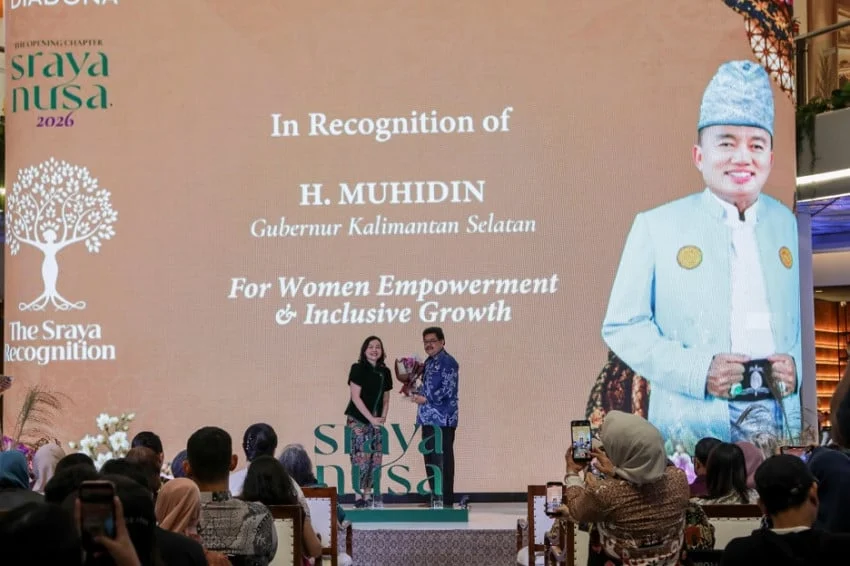
The provincial administration of South Kalimantan has achieved a significant national milestone, reflecting its sustained dedication to fostering an equitable, accessible, and progressive society. Governor H Muhidin was officially honored with the prestigious Sraya Recognition for Women Empowerment and Inclusive Growth award during the Apresiasi Perempuan Berpengaruh (APB) Sraya Nusantara 2026 summit held in Jakarta. This high-profile event brings together regional leaders, policymakers, civil society organizations, and national stakeholders to evaluate, recognize, and promote exceptional leadership models that successfully integrate marginalized groups into the broader socio-economic framework of Indonesia.
The accolade specifically targets male regional leaders who have demonstrated visionary governance by implementing structural policies that yield measurable, positive impacts on women, children, and vulnerable communities. Under Governor Muhidin’s administration, South Kalimantan has systematically aligned its regional development master plan with the principles of gender mainstreaming, poverty alleviation, educational equity, and comprehensive social protection. By treating women empowerment not as a supplementary initiative, but as a core driver of sustainable development, the provincial government has established a benchmark for regional autonomy and inclusive governance in the archipelago.
Chronology of Recognition and the APB Sraya Nusantara 2026 Summit
The road leading to the recognition in Jakarta on Friday, September 11, 2026, spans years of targeted policy implementation, legislative alignment, and grassroots execution across South Kalimantan’s thirteen districts and municipalities. The APB Sraya Nusantara committee, comprising independent policy analysts, gender equality advocates, and academic researchers, conducted a rigorous multi-month evaluation process starting in late 2025. This evaluation assessed regional budgetary allocations, the effectiveness of maternal and child health programs, the growth rate of female-led micro, small, and medium enterprises (MSMEs), and the enforcement of protective regulations against violence directed at women and children.
Governor Muhidin, unable to attend the Jakarta ceremony in person due to pressing regional obligations, designated the Head of the South Kalimantan Communication and Information Office, Muhamad Muslim, to receive the award on his behalf. Upon accepting the accolade, Muslim conveyed the administration’s core philosophy, emphasizing a collaborative and holistic approach to regional progress.
“Many priority programs initiated by Governor H Muhidin focus intensely on women, particularly within the sectors of education, health, and micro-enterprises,” Muslim stated during the ceremony. “This national recognition serves as tangible proof of our unwavering commitment to developmental policies that elevate women, perfectly encapsulating our guiding spirit: Working Together, Embracing Everyone.”
Comprehensive Policy Frameworks Driving Inclusive Growth
The recognition awarded to Governor Muhidin is deeply rooted in a multifaceted policy framework designed to dismantle structural barriers that hinder women and vulnerable populations from fully participating in the regional economy. South Kalimantan’s approach recognizes that true economic resilience cannot be achieved without addressing the foundational needs of households, where women traditionally shoulder the primary burdens of caregiving and domestic management.
A cornerstone of this strategy is the deliberate integration of women into the provincial economic revitalization agenda, specifically through the modernization and digital transformation of MSMEs. Recognizing that a significant majority of home-based enterprises and small-scale trading ventures in South Kalimantan are owned or operated by women, the provincial government has channeled targeted financial literacy programs, subsidized micro-credits, and digital marketing workshops directly to these demographics. These initiatives have allowed female entrepreneurs to scale their operations, transition from informal survivalist businesses to sustainable commercial entities, and secure independent financial futures.
Complementing these economic interventions are robust public health initiatives aimed at improving the quality of life for mothers and infants across both urban centers and isolated rural enclaves. The provincial health budget has been systematically optimized to expand prenatal care, reduce stunting rates through community-based nutritional interventions, and upgrade regional health outposts (puskesmas). By lowering the physical and financial barriers to maternal healthcare, the administration has successfully improved life expectancy indices and maternal survival rates, directly addressing health disparities that disproportionately affect rural women.
Educational Equity and Infrastructure Development
Education serves as the great equalizer in South Kalimantan’s development blueprint, with specific emphasis placed on ensuring that historical gaps in educational attainment between genders are decisively closed. Beyond formal schooling, the provincial administration has heavily invested in alternative learning systems, notably through the expansion of the Paket A (equivalent to primary school), Paket B (junior high school), and Paket C (senior high school) equality education programs.
These programs have provided a vital second chance for adults—particularly women in remote, agrarian, and riverine communities who dropped out of school due to early marriage, economic hardship, or geographical isolation—to complete their foundational education. By acquiring formal certification, these women gain enhanced employability, greater civic participation, and the cognitive tools necessary to navigate modern administrative and economic landscapes.
Simultaneously, the administration’s macro-infrastructure projects are deliberately designed to unlock economic potential in previously isolated regions. A prime example is the construction and integration of the Pulau Laut Bridge, a mega-infrastructure project engineered to connect mainland South Kalimantan to Kotabaru Island. Beyond solving long-standing logistical bottlenecks, the bridge project has been strategically framed as an economic catalyst. By bridging geographical divides, the initiative drastically reduces transportation costs, accelerates the flow of goods, and opens up new consumer markets for local fishermen, farmers, and female-led micro-enterprises operating in the island territories.
Pioneering Digital and Physical Protection for Women and Children
While economic empowerment and educational access form the bedrock of South Kalimantan’s inclusive growth strategy, the provincial government recognizes that development remains incomplete without stringent security and legal protections. In an era marked by rapid digital transformation, the vulnerabilities faced by women and children have evolved beyond physical spaces into complex virtual environments.
Addressing this modern threat matrix, the provincial government achieved a critical milestone on July 27, 2026. In a landmark collaborative effort, the South Kalimantan Provincial Government, the regional police force (Polda Kalsel), the Ministry of Religious Affairs, relevant technical agencies, and a coalition of 21 regional universities signed a comprehensive memorandum of understanding (MoU). This agreement established a unified inter-institutional forum dedicated to the prevention and handling of violence, abuse, and cybercrimes targeting women and children within academic institutions, general schools, and Islamic boarding schools (pesantren).
The urgency of this multi-sectoral alliance stems from the alarming rise of digital harassment, online grooming, data privacy violations, and cyberbullying directed at young students and women across academic settings. By uniting law enforcement agencies, educational authorities, and religious institutions under a single operational umbrella, the forum ensures that victims have immediate, confidential, and trauma-informed access to legal aid, psychological counseling, and protective intervention.
Governor Muhidin emphasized the proactive nature of this initiative, noting that physical enforcement must be paired with comprehensive educational outreach. “We want to provide proactive education to the younger generation regarding the dangers of violence as well as the risks associated with the misuse of digital technology,” Muhidin asserted, highlighting the dual focus on deterrence and digital literacy.
Broader Implications and Socio-Economic Impact
The national recognition bestowed upon Governor H Muhidin at the APB Sraya Nusantara 2026 summit carries profound implications not only for South Kalimantan, but for regional governance models across Indonesia. It challenges the conventional, legacy paradigm of regional development that prioritizes heavy industrial output and macro-GDP growth at the expense of human capital development and social equity.
By demonstrating that economic resilience, infrastructure expansion, and digital safety can be seamlessly integrated with gender mainstreaming and child protection, South Kalimantan offers a replicable blueprint for other provincial administrations. Data from regional economic monitors indicate that provinces prioritizing female economic inclusion experience higher household savings rates, improved childhood nutritional baselines, and faster recovery rates from macroeconomic shocks.
Furthermore, the institutionalization of inter-agency task forces for cyber safety and anti-violence establishes a legal deterrent that fosters a safer environment for human capital accumulation. When women and children are liberated from the systemic threats of physical abuse and digital exploitation, their capacity to contribute meaningfully to the regional workforce expands exponentially.
As South Kalimantan continues to roll out its strategic development goals, the recognition in Jakarta serves as both validation of past achievements and a catalyst for future responsibilities. The alignment of educational expansion, infrastructural connectivity, targeted MSME empowerment, and advanced legal protections ensures that the province’s growth is not merely quantitative, but deeply inclusive—leaving no community behind in the pursuit of regional prosperity.
