
The Indonesian Communist Party (Partai Komunis Indonesia, or PKI) remains one of the most polarizing and significant subjects in modern Indonesian historiography. From its inception in the early 20th century to its systematic dissolution in 1966, the party’s trajectory serves as a window into the complex socio-political evolution of the nation. Understanding the PKI requires a multidimensional approach that balances documented facts, state-sanctioned narratives, and evolving historical interpretations based on declassified archives from Indonesia, the United States, and Japan.
Roots of Radicalism: The ISDV and the Early PKI
The intellectual origins of communism in the Dutch East Indies can be traced back to 1914 with the establishment of the Indische Sociaal-Democratische Vereeniging (ISDV) by Henk Sneevliet. By 1920, this organization evolved into the Perserikatan Komunis di Hindia, eventually adopting the name Partai Komunis Indonesia (PKI).
In its nascent stage, the party sought to mobilize the burgeoning labor movement against colonial exploitation. This culminated in the 1926 uprisings against the Dutch colonial government. The rebellion, which lacked unified strategic planning, was swiftly suppressed by Dutch authorities. The ensuing crackdown led to the imprisonment, execution, and exile of thousands of party members to the Boven-Digoel camp in West Papua. This period of intense repression relegated the communist movement to the political underground for the duration of the colonial era.
The 1948 Madiun Affair: A Defining Fracture
Following the declaration of Indonesian independence in 1945, the PKI re-emerged as a potent political entity. However, the internal struggle for the ideological direction of the new republic reached a violent crescendo in 1948. On September 18, 1948, the "Madiun Affair" broke out, characterized by an armed confrontation between the government of the Republic of Indonesia and the Front Demokrasi Rakyat (FDR)—a coalition of leftist parties including the PKI.
The proclamation of a "Soviet Republic of Indonesia" in Madiun served as the catalyst for a short-lived but intense civil conflict. The national government, led by Sukarno and Hatta, viewed the move as an attempt to undermine the republic during the critical negotiations for independence from the Dutch. Within months, the rebellion was crushed by loyalist forces. The aftermath saw the execution of top leadership, including Musso and Amir Sjarifuddin, which effectively neutered the party’s organizational structure for several years.
The 1950s Resurgence and Parliamentary Success
The mid-1950s marked a remarkable organizational recovery for the PKI. Under the pragmatic leadership of D.N. Aidit, Lukman, and Njoto, the party shifted its strategy toward "mass line" politics. By focusing on the grievances of the rural peasantry and the urban proletariat, the PKI successfully rebranded itself as a defender of the common man.
The 1955 General Election served as a barometer for this resurgence. According to data from the Komisi Pemilihan Umum (KPU), the PKI secured 6,179,914 votes, translating to 16.36 percent of the national tally. This victory granted them 39 seats in the DPR, placing them as the fourth-largest political force in the country behind the PNI, Masyumi, and the Nahdlatul Ulama (NU). This success underscored the party’s deep penetration into the grassroots level of Indonesian society, making it a central pillar in the nation’s parliamentary democracy.
Nasakom and the Demise of Parliamentary Politics
The transition to "Guided Democracy" following President Sukarno’s decree on July 5, 1959, fundamentally altered the Indonesian political landscape. As power became increasingly centralized around the presidency, the competition between the military, nationalist, religious, and communist factions intensified.
Sukarno’s concept of Nasakom (Nasionalisme, Agama, Komunisme) was intended to balance these competing interests. However, the policy effectively provided the PKI with a platform for institutional influence. By the early 1960s, the party had expanded its reach through massive civil society organizations such as BTI (farmers), SOBSI (labor), and Gerwani (women). This growth, however, fueled profound anxiety within the military, particularly the Angkatan Darat (Army), leading to constant friction over agrarian reforms and the potential creation of an "Armed Fifth Force" composed of peasants and workers.
The G30S Crisis: Historiography and Contention
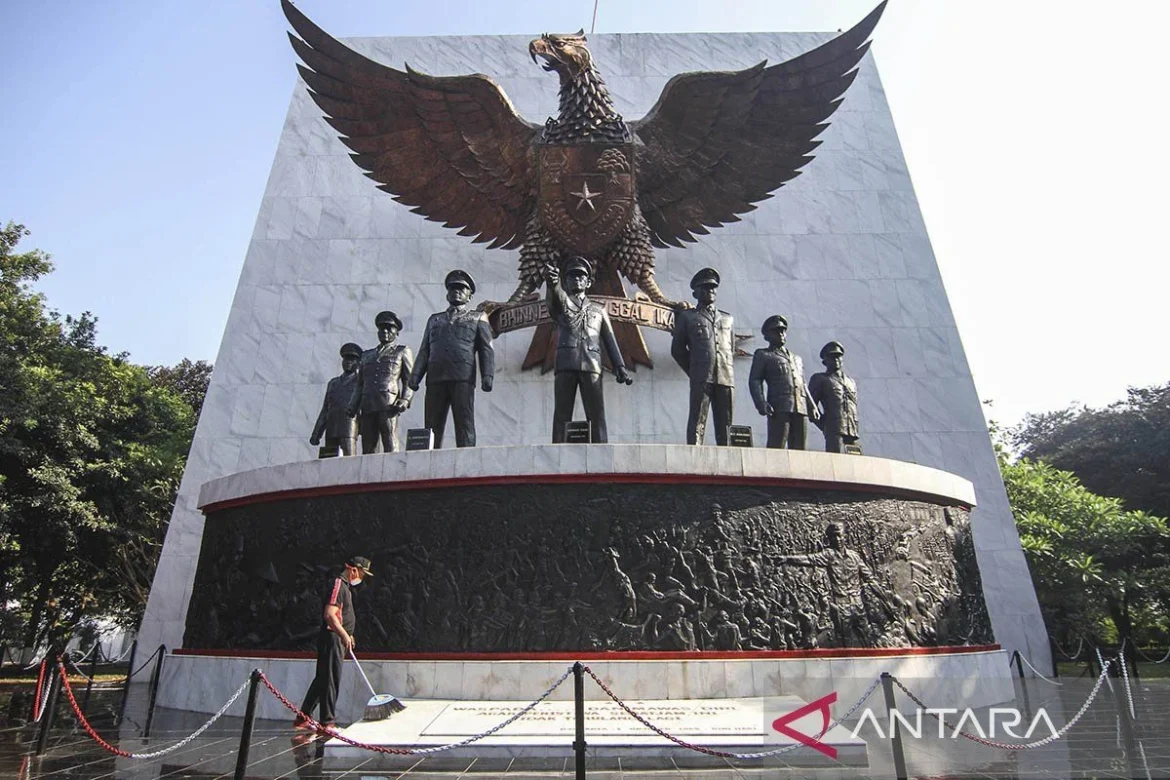
The night of September 30 to October 1, 1965, remains the most contested date in Indonesian history. The kidnapping and subsequent execution of six Army generals and one lieutenant at Lubang Buaya triggered the event known as the Gerakan 30 September (G30S).
For decades, the official state narrative under the New Order regime maintained that the PKI was the sole mastermind behind the coup attempt. In the post-reform era, researchers have utilized a broader range of sources to analyze the event. While the National Archives of the Republic of Indonesia (ANRI) acknowledges the historical weight of the official narrative, it also emphasizes that contemporary scholars must weigh diverse international perspectives, including American and Japanese intelligence records, to discern the complex web of actors involved.
The Great Purge and Systematic Dissolution
The failure of the G30S provided the impetus for a massive, state-led campaign against the PKI. Under the leadership of Major General Soeharto, the military initiated a systematic purge of suspected party members, sympathizers, and affiliates.
The human cost of this period was immense. Investigations by the National Commission on Human Rights (Komnas HAM) have documented widespread human rights violations between 1965 and 1966, including extrajudicial killings, forced disappearances, torture, and mass detention without trial. These events led to the complete dismantling of the PKI’s organizational infrastructure across the archipelago.
On March 12, 1966, Soeharto issued a decree that formally banned the PKI. This was later codified into law via TAP MPRS No. XXV/1966, which prohibited the party and the dissemination of Marxist-Leninist ideologies. This decree remains part of the Indonesian legal framework to this day, though its application has been subject to ongoing debates regarding democracy and the rule of law.
Implications and Historical Memory
The dissolution of the PKI in 1966 did more than remove a political party; it facilitated a complete shift in the Indonesian political order. The vacuum left by the PKI’s collapse allowed for the rise of the New Order, a military-backed regime that would govern Indonesia for over three decades until 1998.
The legacy of 1965 continues to permeate contemporary Indonesian society. Discussion of the era often involves a delicate negotiation between historical truth-seeking and the maintenance of national stability. For modern historians, the study of the PKI is not merely an exercise in cataloging past grievances, but a necessary process for understanding the nation’s democratic trajectory and its commitment to human rights.
A Call for Archival Transparency
As of 2024, institutions like ANRI continue to stress that the historical record is far from closed. The integration of international archives is vital to providing a holistic view of the era. The reliance on singular, state-driven narratives has increasingly been challenged by the need for objective, source-based research that considers the testimonies of survivors and the declassified records of the Cold War era.
Ultimately, the story of the PKI is a stark reflection of the volatility of 20th-century political movements. From its idealistic origins to its violent conclusion, the history of the party remains a fundamental pillar of Indonesian studies. As the nation moves further from the events of 1965, the importance of maintaining a nuanced, fact-based dialogue—grounded in primary source evidence rather than political mythology—becomes increasingly paramount for the integrity of Indonesia’s historical consciousness.
