
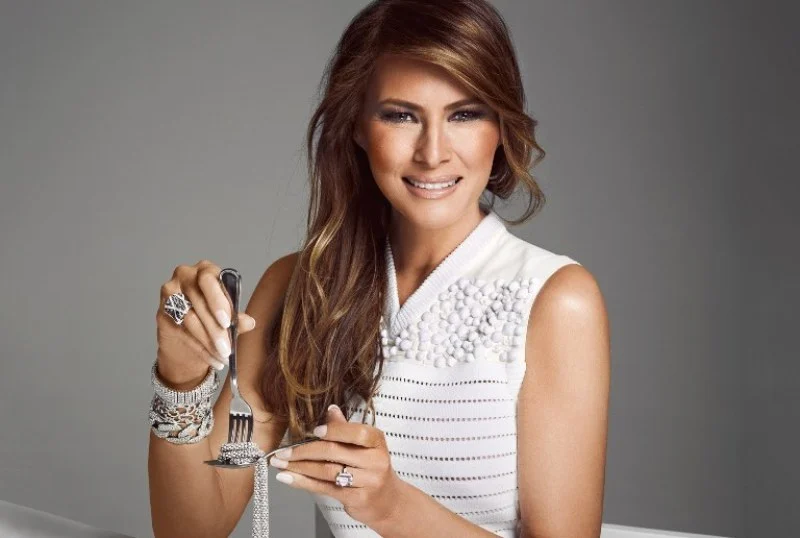
The dramatic conclusion of the 2016 United States presidential election fundamentally altered the geopolitical and social landscape of the nation, securing a historic victory for Republican nominee Donald Trump. With his successful campaign and subsequent transition to the presidency, succeeding Barack Obama for the 2016–2020 term, the office of the First Lady welcomed a figure unlike any of her predecessors. Melanija Knavs, universally known as Melania Trump, stepped into the global spotlight as the new First Lady of the United States. Her ascent to this prominent role is marked by a unique personal history, setting her apart from nearly every other woman to ever hold the title in American history.
Born on April 26, 1970, in the industrial river town of Sevnica within the Socialist Republic of Slovenia—then a part of the communist federation of Yugoslavia under the authoritarian rule of President Josip Broz Tito—Melania Trump’s early life unfolded against the backdrop of the Cold War. As the third wife of Donald Trump, she achieved a distinct biographical milestone: becoming the first American First Lady to have been born and raised in a communist-governed nation. While Melania herself was never a member of the Communist Party and grew up detached from the active ideological struggles of the era, the geopolitical reality of her formative years in the Eastern Bloc represents a fascinating contrast to the traditional upbringing of American political spouses. Her path from the quiet landscapes of Central Europe to the opulent towers of Manhattan and, ultimately, to the White House is a quintessential modern immigrant success story intertwined with the highest echelons of American political power.
Early Beginnings and the Genesis of a Modeling Career
Melania’s introduction to the world of aesthetics and commerce began in her youth, heavily influenced by her family background. Her mother, Amalija Knavs, worked as a pattern maker for a state-owned children’s clothing manufacturer, instilling in young Melania an early appreciation for textiles, design, and fashion. Meanwhile, her father, Viktor Knavs, managed car parts for a state-owned vehicle manufacturer and was a member of the League of Communists of Yugoslavia—a standard professional requirement for ambitious individuals in business and municipal management at the time.
By the time she reached her mid-teens, Melania’s striking height, classic facial structure, and poised demeanor caught the attention of fashion professionals. At the age of 16, she embarked on what would become a prolific international modeling career. She initially worked in her home region before capturing the attention of renowned Slovenian fashion photographer Stane Jerko, who famously discovered her during a fashion show in Ljubljana.
The transition from a small-town European upbringing to the rigorous demands of the international fashion capitals was swift. By the time she turned 18, Melania had secured representation with a major modeling agency in Milan, Italy—one of the fashion world’s primary epicenters. Working in Milan and later Paris, she navigated the competitive European fashion circuit during the late 1980s and early 1990s, developing a reputation for professionalism, discipline, and a strong work ethic. Despite her early success on the runways of Europe, Melania prioritized her education, taking a hiatus from full-time modeling to enroll at the University of Ljubljana, where she studied architecture and design for a year before fully committing to her international career.
The Move to New York and the American Dream
The pivotal turning point in Melania’s professional and personal trajectory occurred in 1996, when she made the decision to relocate to New York City, the undisputed capital of American fashion and media. Moving to the United States opened doors to higher-profile commercial campaigns and editorial spreads. Throughout her career in the American market, her face graced the covers and pages of prestigious publications, including Vogue, Harper’s Bazaar, Ocean Drive, Avenue, InStyle, and New York Magazine.
As a high-fashion model working in the competitive New York environment during the late 1990s, Melania established an independent life and career. Her transition to permanent residency in the United States was methodical and legally rigorous. In 2001, she achieved the status of a U.S. permanent resident, commonly known as holding a green card. Continuing her integration into American society, she pursued formal naturalization through the standard legal channels, officially taking the oath of citizenship to become a naturalized American citizen in 2006—just one year after her marriage to Donald Trump.
The Intersection of Fashion, Business, and Politics

Melania’s marriage to real estate developer and media personality Donald Trump in January 2005 thrust her into the upper echelons of New York society and tabloid culture. The high-profile wedding at Bethesda-by-the-Sea Episcopal Church in Palm Beach, Florida, attended by prominent political and entertainment figures, signaled her entry into a world of immense wealth and public scrutiny. Following the birth of their son, Barron William Trump, in 2006, Melania balanced her roles as a mother, entrepreneur—launching her own line of jewelry and skin-care products—and the wife of a prominent businessman.
When Donald Trump announced his candidacy for the presidency of the United States in June 2015, Melania’s role shifted dramatically from private socialite to political spouse. Throughout the grueling 2016 primary and general election campaigns, she maintained a measured and selective public profile. While her husband dominated news cycles with bombastic rallies and unfiltered social media usage, Melania largely remained in the background, focusing on raising their young son and selectively appearing at major campaign milestones, such as the Republican National Convention in July 2016.
Her convention speech, though subsequently marred by a minor controversy regarding similarities to a previous address by Michelle Obama, introduced her to the broader American electorate as a poised, elegant, and fiercely loyal partner. She articulated her husband’s vision for the country through the lens of the American Dream, frequently emphasizing her own immigrant journey as a testament to the opportunities afforded by the United States.
Historical Significance and the Transition to the White House
The victory of Donald Trump over Democratic nominee Hillary Clinton in November 2016 set the stage for Melania Trump to assume the responsibilities of the First Lady. Her background provided a fascinating historical footnote: she became only the second foreign-born First Lady in U.S. history, following Louisa Catherine Johnson Adams, the English-born wife of sixth President John Quincy Adams, who served in the 1820s. However, Melania was entirely unique as the first First Lady whose formative years were spent under a communist regime during the height of the Cold War.
Political analysts and historians noted that Melania’s unique background could influence her approach to international diplomacy and public representation. Having lived through the dissolution of Yugoslavia and the subsequent geopolitical realignment of Central Europe, she brought a global perspective to the White House that transcended traditional American insularity. Furthermore, her fluency in multiple languages—reportedly speaking Slovenian, English, French, Italian, and German—positioned her as a potentially sophisticated asset in international diplomatic settings.
Implications and the Road Ahead
As the 2016 election results solidified, political commentators and cultural observers began analyzing the potential implications of Melania Trump’s tenure as First Lady. Unlike many of her predecessors who arrived in Washington with extensive backgrounds in public policy, law, or political activism, Melania’s roots were firmly planted in the worlds of high fashion, design, and international commerce.
Her public statements during the campaign indicated a desire to focus her platform as First Lady on issues affecting children, including cyberbullying and the welfare of youth development, encapsulated by her eventual "Be Best" initiative. Yet, the immediate focus remained on the monumental transition from her private life in Trump Tower to the heavily scrutinized fishbowl of the executive mansion in Washington, D.C.
The elevation of Melania Trump to the role of First Lady symbolized a modern evolution of the office—one that bridged the gap between old-world European heritage and contemporary American ambition. As she prepared to step into the East Wing, her journey from the riverside town of Sevnica to the pinnacle of American political power cemented her status as one of the most singular and cross-culturally fascinating figures to ever occupy the office of the First Lady of the United States.
