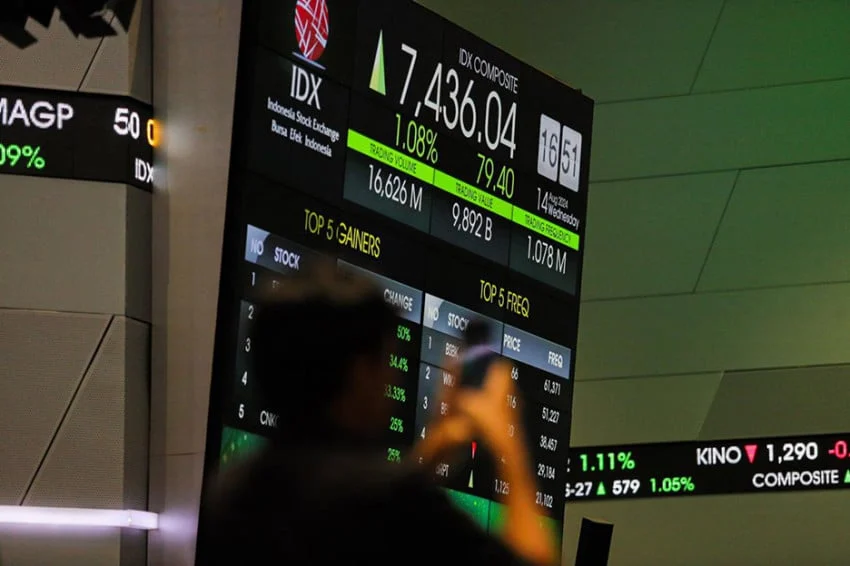
The Jakarta Composite Index (IHSG) is predicted to remain entrenched in a consolidation phase throughout the trading week of April 20-24, 2026, exhibiting a tendency for sideways movement coupled with heightened volatility. This outlook is primarily driven by the lingering dominance of global geopolitical sentiments and a discernible lack of consistent return of foreign capital to Indonesian equities. Market analysts highlight critical technical levels, with 7,773 serving as an immediate and crucial resistance point. A decisive breach of this level could potentially pave the way for further upward momentum. Conversely, sustained failure to surpass this threshold necessitates caution against potential pullbacks. On the downside, the 7,308 mark stands as a pivotal support level, expected to provide a crucial anchor should market pressures intensify, particularly in response to adverse global developments.
Current Market Dynamics and Technical Outlook
Equity Analyst Imam Gunadi from PT Indo Premier Sekuritas (IPOT) elucidated the prevailing market sentiment, stating, "Overall, the movement of the IHSG will likely remain within this defined range, with the market generally exhibiting a reactive posture to external developments." This assessment underscores the fragile balance within the Indonesian equity market, where domestic fundamentals are constantly being weighed against a backdrop of complex international events.
Technically, the IHSG’s position between 7,308 and 7,773 delineates a trading range characteristic of consolidation. In technical analysis, consolidation refers to a period where an asset’s price neither continues a trend nor reverses it, but instead trades within a confined range. This often occurs after a significant price move, as the market takes a "breather" before deciding on its next direction. The term "sideways" perfectly describes this horizontal price movement, indicating a temporary equilibrium between buying and selling pressures. "Volatile" suggests that even within this range, price swings can be abrupt and unpredictable, driven by news flow and investor sentiment rather than a clear directional trend.
The resistance level at 7,773 represents a price point where selling interest is expected to be strong enough to prevent the price from rising further. For the IHSG to break out of its consolidation phase and embark on a sustained upward trend, it would need to overcome this psychological and technical barrier with significant buying volume. Conversely, the support level at 7,308 signifies a price point where buying interest is anticipated to be sufficient to halt a decline. A breach below this support could signal a weakening of market confidence and potentially trigger further sell-offs, especially if accompanied by negative global news. Traders and institutional investors closely monitor these levels to inform their entry and exit strategies, as they provide critical indicators of potential trend reversals or continuations.
Recent Performance and Foreign Capital Exodus
Despite the cautious near-term outlook, the IHSG had a notable performance in the preceding week, rallying significantly to close at 7,634, marking a substantial gain of 2.35%. This upward movement, however, presented a perplexing divergence when juxtaposed with foreign capital flows. Data from the previous week revealed a net distribution by foreign investors amounting to Rp 2.4 trillion, with a predominant focus on the banking sector. This indicates that while domestic buying might have propelled the index higher, foreign institutional investors were actively divesting, particularly from some of the market’s largest and most liquid constituents.
The phenomenon of a rising index amidst foreign outflows is not uncommon in emerging markets. It often suggests robust domestic institutional or retail participation offsetting foreign selling pressure. However, sustained foreign outflows can be a cause for concern, as they may signal a loss of confidence in the market’s long-term prospects or a reallocation of global capital towards less risky or more lucrative assets elsewhere. The specific concentration of foreign selling in the banking sector is particularly noteworthy. Indonesian banks typically represent a significant portion of the IHSG’s market capitalization and are often considered bellwethers for the broader economy. Foreign investors might be reducing their exposure due to various factors, including concerns over global interest rate trajectories, potential impacts of geopolitical instability on economic growth, or specific domestic policy uncertainties that could affect bank profitability. This divergence between headline index performance and underlying foreign investor behavior warrants close scrutiny for the coming weeks.
Geopolitical Headwinds: The US-Iran Standoff
The primary global sentiment driving market anxieties, as highlighted by Gunadi, continues to be the escalating geopolitical dynamics, specifically the intricate and volatile conflict between the United States and Iran. "The situation tends to be unstable, and we have observed rapid narrative shifts even in the very near term," Gunadi emphasized. He cited instances of contradictory reports, such as initial statements regarding the reopening of the Strait of Hormuz, swiftly followed by reports of disruptions and even gunfire targeting vessels.
Chronology of Escalation (Inferred up to April 2026):
The US-Iran conflict has deep historical roots, stemming from the 1979 Iranian Revolution, the hostage crisis, and decades of mutual distrust. By April 2026, the situation would have likely seen several flashpoints and periods of heightened tension:
- Early 2020s: Continued sanctions by the US against Iran, particularly targeting its oil exports and financial sector, following the US withdrawal from the Joint Comprehensive Plan of Action (JCPOA) in 2018. Iran, in response, gradually scaled back its commitments under the nuclear deal.
- Mid-2020s: A series of proxy conflicts and regional skirmishes intensified, particularly in the Persian Gulf, Yemen, Syria, and Iraq. Attacks on oil tankers and infrastructure in the Gulf region became more frequent, attributed by some to Iran or its proxies.
- Late 2025 – Early 2026: A critical escalation point. This period might have been characterized by increased naval activity in the Strait of Hormuz, a vital chokepoint for global oil supplies. Reports of alleged drone attacks or missile incidents in the region would have circulated, raising the specter of direct military confrontation. Diplomatic efforts might have intermittently flared up, offering brief glimmers of hope for de-escalation, only to be quickly overshadowed by new incidents or bellicose rhetoric from either side.
- March-April 2026: The immediate precursor to the current market apprehension. This timeframe would have seen a peak in tensions, possibly triggered by a significant incident such as a direct confrontation between naval forces, or a major cyberattack. The "rapid narrative shifts" mentioned by Gunadi likely refer to conflicting official statements, intelligence leaks, and media reports regarding the status of shipping lanes, the safety of commercial vessels, and the readiness of military forces. For instance, an initial announcement of a "de-escalation agreement" or "safe passage corridor" in the Strait of Hormuz might have been almost immediately contradicted by reports of new hostilities, creating extreme uncertainty for global markets.
Implications of the Geopolitical Conflict:
The Strait of Hormuz, connecting the Persian Gulf with the Arabian Sea, is arguably the world’s most critical oil transit chokepoint. An estimated one-fifth of global petroleum consumption and one-third of the world’s liquefied natural gas (LNG) transits through this narrow waterway. Any disruption, even perceived, can send shockwaves through global energy markets, leading to:
- Oil Price Volatility: Increased risk premiums on crude oil futures, pushing prices higher. This directly impacts oil-importing nations like Indonesia, increasing their import bills and potentially fueling domestic inflation.
- Shipping Costs: Higher insurance premiums and rerouting expenses for vessels, affecting global trade and supply chains.
- Investor Risk Aversion: A flight to safety, where investors move capital out of riskier assets like emerging market equities and into safe havens such as gold, the US dollar, or government bonds.
- Global Economic Slowdown: Higher energy costs and supply chain disruptions can dampen global economic growth, impacting demand for exports from countries like Indonesia.
Broader Economic Context and Supporting Data for Indonesia
While geopolitical factors dominate external sentiment, Indonesia’s domestic economic landscape also plays a crucial role.
- Inflation and Monetary Policy: Bank Indonesia (BI) would likely be navigating a delicate balance. If global oil prices surge due to geopolitical events, imported inflation could become a significant concern. BI’s monetary policy decisions, particularly on interest rates, would be closely watched. Higher inflation could force BI to maintain a tighter monetary stance or even raise rates, potentially dampening domestic economic activity and making Indonesian assets less attractive compared to higher-yielding alternatives elsewhere. Conversely, a stable rupiah and contained inflation would provide more room for BI to support growth.
- Rupiah Performance: The Indonesian Rupiah’s stability against major currencies, especially the US Dollar, is highly sensitive to foreign capital flows and global risk sentiment. A strengthening US Dollar, driven by safe-haven demand amidst geopolitical uncertainty, would put depreciation pressure on the Rupiah, further exacerbating imported inflation and potentially triggering more foreign outflows.
- Trade Balance: As a significant commodity exporter (coal, palm oil, nickel), Indonesia benefits from higher global commodity prices. However, a spike in oil prices could offset these gains, especially if the country remains a net oil importer. The overall trade balance would provide insights into the resilience of the external sector.
- Fiscal Position: Government spending and revenue generation are vital. The Indonesian government’s ability to manage its budget, especially in the face of potential increases in energy subsidies or other social safety nets due to higher commodity prices, would be a key factor for investor confidence.
- Domestic Consumption and Investment: These are typically the primary drivers of Indonesia’s GDP growth. While domestic demand has historically shown resilience, prolonged global uncertainty could eventually dampen consumer confidence and corporate investment plans.
Inferred Expert Reactions and Broader Implications
Beyond Imam Gunadi’s specific comments, the broader analyst community would likely be offering similar cautious perspectives.
- Investment Banks: Analysts from major investment banks like Goldman Sachs, JP Morgan, or UBS would likely issue research notes advising clients on increased portfolio hedging strategies for emerging market exposure. They would probably highlight the sensitivity of IHSG to commodity price fluctuations and the Rupiah’s exchange rate. Their recommendations might lean towards defensive sectors or specific companies with strong domestic demand exposure and minimal reliance on imported inputs.
- Economic Think Tanks: Indonesian economic think tanks, such as the Centre for Strategic and International Studies (CSIS) or Institute for Development of Economics and Finance (INDEF), would likely publish analyses on the potential impact of sustained geopolitical tensions on Indonesia’s economic growth targets. They might project revised GDP growth figures, inflation rates, and trade balances under different geopolitical scenarios. They would also likely call for prudent fiscal management and policies to enhance domestic resilience against external shocks.
- Government Officials (Inferred): While not directly quoted in the original text, government officials, particularly from the Ministry of Finance or Bank Indonesia, would likely be making statements aimed at reassuring markets and maintaining economic stability. These statements might emphasize the strength of Indonesia’s macroeconomic fundamentals, its foreign exchange reserves, and its commitment to prudent fiscal and monetary policies. They might also highlight ongoing efforts to attract foreign direct investment (FDI) as a more stable form of capital compared to portfolio flows. For instance, a representative from Bank Indonesia might state, "We are closely monitoring global developments and stand ready to take necessary measures to ensure price stability and financial market stability." Similarly, a finance ministry official might add, "The government is committed to maintaining a robust fiscal posture and fostering a conducive investment climate, even amidst global uncertainties."
Looking Ahead: Potential Scenarios and Investor Strategies
Given the complex interplay of factors, several scenarios could unfold for the IHSG in the coming weeks and months:
- Base Case (Prolonged Consolidation): The most likely scenario, as predicted, where the IHSG continues to trade sideways within the defined range (7,308-7,773). This would be characterized by intermittent rallies and pullbacks, highly sensitive to geopolitical news and foreign flow patterns. Domestic investors might continue to provide some support, but without a clear catalyst, a strong breakout would be unlikely.
- Upside Scenario (Breakout to Higher Levels): This would require a significant de-escalation of the US-Iran conflict, leading to a reduction in global risk aversion and a consistent return of foreign capital to emerging markets. Positive domestic news, such as stronger-than-expected corporate earnings or favorable government policies, could also act as catalysts. A decisive break above 7,773 could signal the start of a new upward trend, potentially targeting higher resistance levels.
- Downside Scenario (Breach of Support): A substantial escalation of geopolitical tensions, particularly any disruption to the Strait of Hormuz, or a significant negative surprise in domestic economic data, could trigger a sharp sell-off. A breach below the 7,308 support level would indicate weakening market sentiment and could lead to further declines, potentially testing lower support zones.
For investors, the current environment demands a cautious and selective approach. Value investing in fundamentally strong companies with resilient earnings, particularly those less exposed to global commodity price fluctuations or currency volatility, might be preferred. Diversification across sectors and a keen eye on technical indicators for entry and exit points will be crucial. Furthermore, maintaining liquidity and being prepared for rapid market shifts will be key strategies in navigating the volatile landscape of the Indonesian equity market in April 2026. The coming weeks will undoubtedly test the resilience of the IHSG against a backdrop of complex global forces, with market participants eagerly awaiting clearer signals from both geopolitical fronts and the trajectory of foreign capital flows.