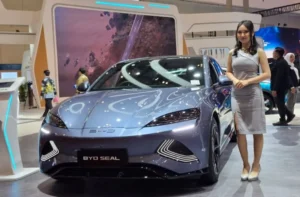
The landscape of the Indonesian automotive industry underwent a significant transformation in August 2026, as electric vehicles (EVs) secured unprecedented positions at the top of the national sales charts. Data released for the month reveals that the BYD Atto 1 has firmly established itself as the best-selling vehicle in the country, recording a total wholesales volume of 5,560 units. This performance not only marks a milestone for the Chinese manufacturer but also serves as a bellwether for the shifting preferences of Indonesian consumers who are increasingly moving away from internal combustion engine (ICE) vehicles.
The rise of the BYD Atto 1 has effectively unseated the long-reigning market leader, the Toyota Avanza. During the same period, the Avanza—a staple of the Indonesian family vehicle segment—recorded 3,442 units, falling into second place. Even more striking is the fact that the third spot was also claimed by an electric newcomer, the Jaecoo J5 EV, which saw 3,214 units distributed to dealerships. This data indicates a structural shift in the market, where the traditional dominance of multi-purpose vehicles (MPVs) is being challenged by high-tech, sustainable alternatives.
Market Dynamics and the EV Transition
The rapid adoption of electric vehicles in Indonesia is no longer a niche trend but a significant market force. For years, the Indonesian automotive sector was defined by the success of affordable, fuel-efficient MPVs. However, the aggressive expansion of charging infrastructure, combined with government-backed incentives, has made EVs a viable option for the urban middle class.
The performance of the BYD Atto 1 in August 2026 is a result of several strategic factors. Firstly, the price point of the Atto 1 has been positioned to compete directly with high-end ICE vehicles, offering superior technology and lower long-term operational costs. Secondly, the brand’s commitment to establishing a localized service network has bolstered consumer confidence, alleviating the "range anxiety" that historically hindered EV adoption in the archipelago.

The presence of the Jaecoo J5 EV in the top three is equally telling. Jaecoo, focusing on a more premium, rugged SUV aesthetic, has successfully tapped into the demographic of tech-savvy professionals who prioritize both performance and sustainability. By securing 3,214 units in a single month, the brand has signaled that the Indonesian market is receptive to diverse EV segments, ranging from family hatchbacks to lifestyle-oriented SUVs.
A Comparative Look at Sales Rankings
While the top of the list is dominated by EVs, the mid-tier market remains a bastion for traditional manufacturers. The August 2026 sales figures show a clear bifurcation in consumer loyalty.
Following the top three, Toyota continues to maintain a strong footprint with the Calya, which moved 3,001 units to secure the fourth position. The Daihatsu Sigra, a close cousin to the Calya in the low-cost green car (LCGC) segment, followed closely with 2,746 units. These figures demonstrate that while the upper-middle class is migrating toward EVs, the entry-level segment remains heavily reliant on affordable, proven ICE technology.
The Toyota Innova Zenix took the sixth spot with 2,579 units. The Zenix, particularly its hybrid variant, serves as a bridge for many consumers who are not yet ready to commit to a full battery electric vehicle (BEV). The remaining top-twelve list includes:
- Toyota Veloz: 2,267 units
- Toyota Rush: 1,880 units
- Honda Brio: 1,670 units
- Daihatsu Terios: 1,650 units
- Mitsubishi Xpander: 1,610 units
- Geely EX2: 1,595 units
This distribution suggests that while the market is evolving, the demand for traditional MPVs and SUVs remains resilient. However, the presence of the Geely EX2 at number twelve—another Chinese EV—further reinforces the trend of international manufacturers making deep inroads into a market that was once exclusively dominated by Japanese conglomerates.

Historical Context and Strategic Implications
The trajectory of the Indonesian automotive market has been carefully steered by government policy. Over the past five years, the Ministry of Industry has implemented a series of tax breaks, luxury tax exemptions for EVs, and subsidies for local production. These policies were designed to catalyze the transition to greener mobility and to position Indonesia as a global hub for battery manufacturing, leveraging its vast nickel reserves.
The August 2026 sales surge represents the culmination of these efforts. Industry analysts suggest that the "tipping point" for EV adoption in Indonesia has arrived. Previously, market penetration was hampered by high entry prices and limited model availability. The arrival of mass-market, competitively priced EVs has effectively lowered the barrier to entry, triggering a wave of fleet upgrades and individual purchases.
From a manufacturing perspective, the success of these brands creates a ripple effect. Competitors are now under immense pressure to localize production. It is widely expected that Japanese manufacturers will accelerate the launch of their own dedicated BEV platforms in Indonesia to regain lost market share. The competitive landscape is now defined by who can provide the most robust battery warranty, the most advanced software integration, and the fastest charging capability.
Economic and Environmental Impact
The shift toward electric mobility carries significant macroeconomic implications. As Indonesia transitions away from fossil-fuel-dependent transportation, the pressure on fuel subsidies is expected to decrease over the long term. Furthermore, the growth of the EV sector aligns with the country’s commitments to reach Net Zero emissions.
However, the rapid growth also presents infrastructure challenges. The national electricity grid must undergo upgrades to handle the increasing load of charging stations, particularly in high-density urban areas like Jakarta and Surabaya. Furthermore, the recycling of lithium-ion batteries has emerged as a new industrial necessity, prompting calls for more stringent waste management regulations.

Industry observers also point to the employment sector. The shift from ICE vehicles to EVs requires a different set of technical skills. Vocational training centers and automotive engineering programs across the country are currently in the process of updating their curricula to ensure that the workforce is prepared for a future where internal combustion engines are no longer the primary focus of the industry.
Looking Ahead: The Final Quarter of 2026
As we look toward the final quarter of 2026, the battle for the top spot is expected to intensify. Analysts anticipate that traditional players like Toyota and Honda will introduce aggressive promotional campaigns and new hybrid models to stabilize their market share. Meanwhile, the momentum behind brands like BYD and Jaecoo shows no signs of waning.
Supply chain stability will be the deciding factor for the remainder of the year. Any disruption in the availability of imported components could impact the delivery times for these popular EV models. Conversely, those manufacturers who have already established local assembly plants or have finalized local content requirements (TKDN) will likely hold a distinct advantage.
In conclusion, the August 2026 sales data provides a definitive snapshot of an industry in the midst of a profound transformation. The dominance of the BYD Atto 1 and the success of the Jaecoo J5 EV are not merely statistical anomalies; they are the result of a deliberate, long-term shift toward a sustainable automotive future. While traditional internal combustion vehicles still hold a significant portion of the market, the narrative has shifted toward electrification. For stakeholders, policymakers, and consumers alike, the message is clear: the era of the electric vehicle in Indonesia has officially arrived, and it is here to stay.