The Theatre of Dreams turned into a nightmare for Mauricio Pochettino as his tenure as Manchester United manager began in calamitous fashion. In a high-stakes Premier League encounter at Anfield on Sunday, November 22, 2026, Liverpool dismantled a struggling Manchester United side with a clinical 4-0 victory. The result, which will undoubtedly dominate the back pages of the British press, serves as a harsh introduction for the Argentine tactician to the intensity of the North West Derby.
From the opening whistle, the tactical gulf between the two sides was evident. While Liverpool operated with a fluidity and high-pressing intensity synonymous with their recent identity, Manchester United appeared disjointed, struggling to cope with the sheer pace and movement of the hosts. The match, intended to be a fresh start for the visitors, instead highlighted the deep-seated defensive fragilities that have plagued the club for several seasons.
A Chronology of the Anfield Collapse
The defining moment of the match arrived barely eight minutes into the first half. A lapse in concentration from the United backline allowed Liverpool’s Alexander Isak to break through on goal. In a desperate bid to intervene, defender Leny Yoro committed a professional foul that resulted in a straight red card. This dismissal not only reduced United to ten men for the remainder of the contest but also forced Pochettino to abandon his tactical blueprint before the game had truly settled.
The repercussions were instantaneous. Just two minutes after the red card, Dominik Szoboszlai punished the visitors with a perfectly executed free-kick that curled beyond the reach of the United goalkeeper. The Anfield crowd, sensing blood, roared their support as the momentum shifted entirely to the home side.
Before the traveling contingent could regroup, the deficit doubled. In the 13th minute, an exquisite cross from the teenage sensation Rio Ngumoha found Florian Wirtz, whose clinical volley nestled into the back of the net. To be down 2-0 after only thirteen minutes against a side as organized as Liverpool was, for all intents and purposes, a death knell for United’s hopes of securing a result.
Recognizing the tactical imbalance, Pochettino reacted in the 22nd minute by sacrificing Bryan Mbeumo to introduce Harry Maguire, shifting the formation to a five-man defensive block. While this adjustment prevented further humiliation in the first half, it effectively surrendered any attacking ambition from the Red Devils, who retreated into a low block for the remainder of the opening period.
The Second Half: Dominance and Degradation
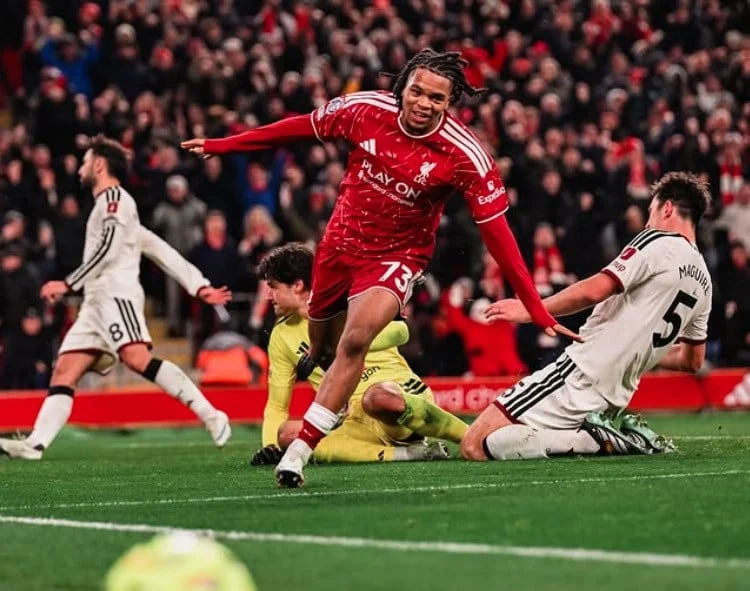
As the second half commenced, Liverpool maintained their high-intensity approach, seemingly uninterested in protecting their two-goal cushion. The relentless pressure eventually forced another defensive error. In the 66th minute, Bradley Barcola delivered a precise pass to Rio Ngumoha, who capped a stellar individual performance by slotting home the third goal of the afternoon.
The final nail in the coffin was hammered in during the 82nd minute. Substitute Victor Munoz, capitalizing on the exhaustion and lack of cohesion within the United defense, added the fourth goal. The sequence was a testament to Liverpool’s collective fluidity, leaving the Manchester United backline looking static and disorganized. By the time the final whistle blew, the 4-0 scoreline felt like an accurate reflection of the disparity on display.
Supporting Data and Statistical Breakdown
The statistical narrative of the match underscores the lopsided nature of the proceedings. Liverpool commanded 68% of the possession throughout the 90 minutes, a figure that reflects their control of the midfield battle. Despite having ten men for over 80 minutes, Manchester United’s expected goals (xG) figure was negligible, totaling less than 0.3, indicating that they rarely threatened the Liverpool goal.
Furthermore, the defensive metrics for United in this match paint a bleak picture. They conceded 22 shots, 11 of which were on target, while their passing accuracy in the final third hovered at a dismal 62%. Conversely, Liverpool completed over 600 successful passes, demonstrating a level of tactical cohesion that Pochettino will be tasked with replicating in the months to come.
Official Responses and Managerial Post-Match Analysis
In the aftermath of the match, the atmosphere in the mixed zone was predictably somber for the visitors. Mauricio Pochettino, addressing the media, acknowledged the catastrophic start but refused to dwell solely on the referee’s decision to dismiss Yoro.
"We cannot hide behind the red card," Pochettino stated. "While the early dismissal certainly altered the tactical landscape, our inability to maintain defensive structure in the opening ten minutes is a matter of concern. We were punished for individual errors, and at this level, that is unacceptable. We have a mountain to climb, and this is a sobering lesson for everyone involved at the club."
Conversely, the Liverpool camp was understandably jubilant. The coaching staff emphasized the importance of maintaining focus despite the numerical advantage. "We spoke about starting fast, but we didn’t expect the game to open up quite this early," a spokesperson for the Liverpool backroom staff noted. "The discipline shown by our players to stick to the game plan, even after going up against ten men, was the most pleasing aspect of today’s performance."
Broader Impact and Implications
The implications of this result extend far beyond the three points dropped or gained. For Manchester United, this match has reignited questions regarding the squad’s psychological resilience and the effectiveness of their defensive personnel. The reliance on late-stage tactical shifts, such as the introduction of Maguire, suggests that the team lacks a cohesive defensive identity, leaving Pochettino with the difficult task of rebuilding confidence after a crushing defeat.
For Liverpool, the victory serves as a statement of intent. Under their current management, the team continues to demonstrate the capacity to dismantle rivals with ruthless efficiency. The integration of young talents like Rio Ngumoha into the first team has provided a new dimension to their attacking play, ensuring they remain a formidable force in the Premier League title race.
Historically, this match will be categorized as one of the most lopsided North West Derbies in recent memory. The result puts immense pressure on Manchester United’s board to support their new manager, while simultaneously raising concerns among the fanbase about the trajectory of the club.
Looking ahead, the upcoming fixtures will be vital for Pochettino. With the morale of the squad at a low point following such a public display of vulnerability, the training ground will become the primary battleground. The challenge for the manager is not merely tactical—it is about establishing a culture of accountability.
In the high-stakes environment of modern English football, patience is a luxury few managers are afforded. While it is unfair to judge an entire tenure based on a single ninety-minute period, the reality of the Premier League is that results like this create a narrative of instability. For Manchester United, the road to recovery begins with a long, arduous process of tactical refinement and mental fortitude. Whether Pochettino is given the time to complete this transition remains the most significant question lingering in the wake of this Anfield disaster.
The 4-0 scoreline is not just a statistical anomaly; it is a signal of the work that remains to be done if Manchester United are to return to their former status as title contenders. As for Liverpool, they march on, firmly establishing themselves as a team that is not only capable of winning but capable of dominating the elite of the English game.