
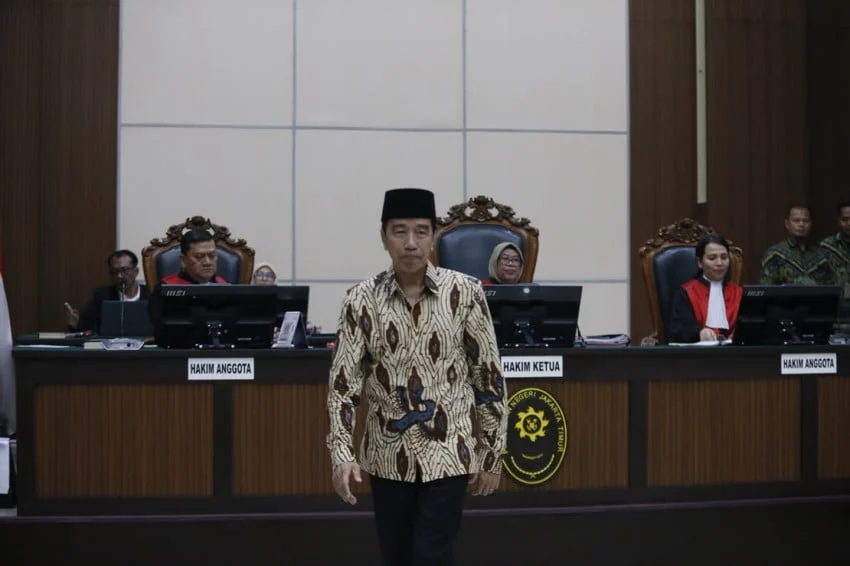
The proceedings at the East Jakarta District Court on Thursday, November 5, 2026, took a deeply personal and emotional turn when former Indonesian President Joko Widodo took the stand. Addressing the court during a high-stakes legal proceeding concerning the persistent controversy surrounding his academic credentials, the nation’s seventh president revealed a level of personal offense and indignation rarely displayed during his decade in office. At the heart of his profound anger was not merely the ongoing legal challenge regarding his university diploma, but the escalation of the dispute by the defendant, Tifauzia Tyassuma—widely known as Dr. Tifa—who had brought the controversy directly to the final resting place of his deceased parents.
The inclusion of his parents in a politically and legally charged public feud crossed a red line for the former head of state. Speaking to reporters and judicial officers outside the courtroom, Jokowi articulated the raw emotional toll the campaign has taken on his family. The proceedings highlight a broader, increasingly toxic intersection of digital-era misinformation, political polarization, and the erosion of conventional boundaries regarding the families of public figures in modern Indonesian democracy.
The Catalyst for Outrage: Crossing the Line to the Gravesite
The immediate trigger for Jokowi’s sharp condemnation stems from actions taken by Dr. Tifa during the height of the public discourse surrounding the authenticity of his university degree from Universitas Gadjah Mada (UGM). As part of an ongoing crusade that has played out across various social media platforms and public forums, the defendant reportedly visited the gravesite of Jokowi’s parents. This action, perceived by the former president and his supporters as an egregious stunt, was intended to question his lineage and family background in connection with the disputed credentials.
When asked by the press about his reaction to these events, Jokowi did not conceal his emotional response. "Yes, clearly, I am deeply offended. I am extremely angry, because my parents, my biological mother, my biological father, were spoken of in such a manner," Jokowi stated at the East Jakarta District Court.
He emphasized the deeply formative role his parents played in his life, noting that they were humble, hardworking individuals who raised him through difficult economic conditions and made immense personal sacrifices to ensure he received a proper education. To see their memory invoked in what he and his legal team characterize as a defamatory and malicious campaign has transformed a standard defamation and identity dispute into a deeply visceral conflict.
Background and Chronology of the Diploma Dispute
To understand the gravity of the courtroom confrontation on November 5, 2026, it is necessary to examine the chronology of the controversy that has shadowed the latter years of Jokowi’s political career and his retirement.
The allegations regarding Jokowi’s educational background first gained traction years prior to his departure from the presidency in October 2024. Despite numerous official confirmations from Universitas Gadjah Mada, including the public display of university records, graduation lists, and testimonies from his classmates and professors, a vocal faction of critics persisted in claiming that his forestry degree was fabricated.
- Pre-2024: Initial waves of disinformation circulate across social media platforms such as X (formerly Twitter) and YouTube, questioning the validity of the president’s graduation from UGM’s Faculty of Forestry.
- October 2024: Jokowi concludes his second and final presidential term, transitioning power to his successor, Prabowo Subianto. Concurrently, legal actions are prepared against individuals who repeatedly propagated unverified claims regarding his identity and documentation.
- 2025: Legal complaints are formally filed by representatives of the former president against several prominent social media commentators and public figures, including Dr. Tifa, alleging defamation, dissemination of false information, and electronic harassment under Indonesia’s Electronic Information and Transactions (UU ITE) law.
- November 5, 2026: The trial reaches a critical juncture at the East Jakarta District Court, featuring dramatic courtroom arguments, procedural clashes between legal teams and prosecutors, and personal testimony from Jokowi addressing the emotional and psychological damages inflicted upon his family.
Courtroom Drama and Legal Maneuvers
The hearing on November 5 was marked by high tension both inside and outside the courtroom. The adversarial nature of the trial was underscored by unusual legal tactics and sharp verbal exchanges. Notably, during the session, defense counsel representing Dr. Tifa engaged in theatrical challenges directed at the former president, prompting immediate objections from the Public Prosecutors (JPU) and highlighting the polarized atmosphere surrounding the judiciary process.
Legal analysts observing the trial note that cases involving high-profile public figures and digital-era defamation present unique challenges for the Indonesian court system. The defense has consistently attempted to frame the proceedings as a matter of public interest and free speech, arguing that scrutiny of public officials’ backgrounds—even post-presidency—should remain unrestricted. Conversely, the prosecution maintains that the dissemination of thoroughly debunked claims, coupled with targeted harassment involving deceased family members, transcends protected speech and constitutes malicious defamation designed to inflict reputational and emotional harm.
Broader Implications for Indonesian Public Discourse
The fierce reaction of the former president to the targeting of his parents serves as a case study in the shifting boundaries of political discourse in Indonesia. As digital literacy struggles to keep pace with the rapid proliferation of algorithmic content and politically motivated disinformation, public figures and their families find themselves vulnerable to increasingly personalized attacks.
Sociologists and political communications experts point out several broader implications stemming from the trial:
- Dehumanization of Political Figures: The incident highlights a growing trend where political opposition ceases to be policy-driven or ideological, instead devolving into personal animus that targets the ancestry, family, and private lives of public servants.
- The Weaponization of Memorials: Dragging deceased family members and gravesites into political disputes represents a significant escalation in the tactics used by digital commentators seeking viral engagement and notoriety.
- The Limits of Free Speech vs. Defamation: The verdict in the ongoing trial against Dr. Tifa is expected to establish a crucial legal precedent regarding how the Indonesian judiciary interprets the boundaries between legitimate public inquiry and unlawful harassment facilitated by digital media platforms.
As the trial at the East Jakarta District Court continues, the proceedings have evolved beyond a simple legal contest over a university parchment. They now stand as a symbolic battleground over the limits of civic decency in Indonesia’s digital age, testing the resilience of public figures against coordinated online campaigns and the willingness of the judicial system to protect basic standards of respect for families, both living and deceased.
