
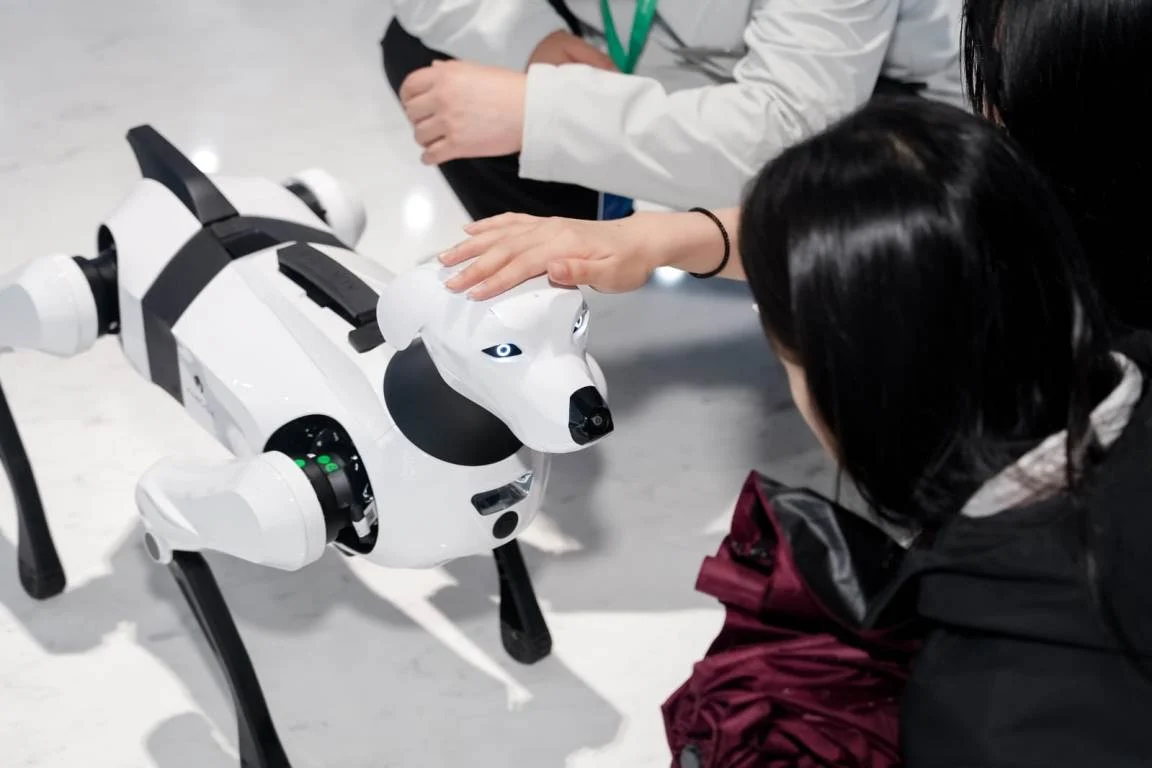
The landscape of personal robotics has undergone a significant transformation, with quadrupedal machines moving from specialized industrial or military applications into the consumer and companion sector. A primary driver of this shift is the recent unveiling of Argos, an advanced quadruped robot developed by Aimoga in a strategic partnership with the automotive giant Chery. By integrating 13 compact joint motors and a sophisticated autonomous balance system, Argos represents a new frontier in how machines interact with humans in everyday environments.
Technical Specifications and Kinematics
At the heart of the Argos robot lies a complex mechanical architecture designed to mimic the fluid, organic movements of biological quadrupeds. The integration of 13 compact joint motors is the cornerstone of its mobility. Unlike traditional robotic actuators that often suffer from stiffness or limited ranges of motion, these compact joints allow for a high degree of freedom across the limbs and the torso.
The robot’s motion repertoire is governed by an onboard "action library," which serves as the software backbone for its behavioral output. The kinematics are categorized into static postures and dynamic interactions. In the former, the robot can transition seamlessly between standing, sitting, and lying down—a sequence that requires precise weight distribution to maintain equilibrium. In the latter, the robot performs expressive movements such as head-turning, hip-swaying, and stretching.
Perhaps most impressive is the robot’s ability to perform complex physical maneuvers such as push-ups, jumping, and the imitation of a handshake. These actions are not merely pre-programmed loops; they are managed by an autonomous balance system that utilizes internal gyroscopes and accelerometers to adjust the torque in each of the 13 motors in real-time, ensuring the robot does not topple during shifts in its center of gravity.
Strategic Synergy: The Aimoga-Chery Partnership
The collaboration between Aimoga and Chery is indicative of a broader trend in the automotive industry: the diversification of mobility. While Chery is traditionally known for its internal combustion and electric vehicles, its investment in robotics suggests a long-term strategy to own the "mobility ecosystem," which includes both vehicular and non-vehicular robotic assistants.
Industry analysts observe that automotive manufacturers possess a unique advantage in robotics development, particularly in mass-manufacturing, battery management, and sensor integration. By leveraging Chery’s industrial expertise, Aimoga has been able to accelerate the prototyping phase of Argos. The inclusion of a high-definition wide-angle camera system is a direct beneficiary of this partnership, as it allows the robot to map environments with a level of situational awareness previously reserved for autonomous driving systems.
Chronology of Robotics Development in Mobility
To understand the significance of Argos, one must look at the timeline of quadrupedal development:
- Early 2000s: Research was primarily focused on military and disaster-relief hardware, characterized by heavy, loud, and tethered prototypes.
- 2015–2018: The emergence of high-performance electric actuators shifted the focus toward agility, with platforms like the Boston Dynamics Spot becoming the industry benchmark for industrial inspection.
- 2020–2023: The market began to pivot toward "consumer-grade" quadrupeds. The emphasis shifted from raw power to social intelligence, battery efficiency, and human-robot interaction (HRI).
- 2026: The launch of the Aimoga-Chery Argos signals the maturity of the "mobility companion" category, where the robot is designed specifically for home or public interaction rather than specialized industrial tasks.
The Role of Autonomous Balance in Human-Robot Interaction
One of the most significant challenges in robotics is the "uncanny valley" effect, where movements that are too robotic or jittery create discomfort in human observers. The Argos system attempts to mitigate this by prioritizing fluid motion. The 13-motor configuration allows for a degree of inertia management, enabling the robot to decelerate smoothly during movements.
The autonomous balance system serves as the safety net for this interaction. When a human interacts with the robot—such as reaching out to shake its paw—the robot must anticipate the external force applied to it. The system detects the pressure and adjusts its limb posture to compensate, ensuring that the handshake feels deliberate and stable rather than accidental. This level of responsiveness is critical for applications in therapy, elderly assistance, or educational settings, where the robot acts as a physical interface between digital software and the real world.
Market Implications and Future Outlook
The introduction of the Argos robot into the consumer space is expected to catalyze a competitive landscape. As Chery continues to refine the hardware, the primary battleground will be the software ecosystem. Developing an "action library" that can be expanded via firmware updates allows owners to potentially download new "skills" for their robot, effectively extending the device’s lifespan and utility.
From an economic standpoint, the cost of manufacturing high-torque, compact motors has plummeted over the last five years. This, combined with advances in AI-driven motion planning, suggests that robotic companions could become a staple of smart homes by the end of the decade. The integration of wide-angle cameras also hints at future capabilities, such as autonomous patrol, object recognition, and home security monitoring, transforming the robot from a mere toy into a multi-functional domestic appliance.
Expert Analysis: The Path Forward
Industry experts point out that while the mechanical capabilities of Argos are impressive, the future success of such platforms will rely heavily on safety protocols and ethical AI. As these robots become more common in domestic settings, their ability to navigate around children, pets, and fragile household items will be the ultimate test of their software.
"The move from industrial robotics to consumer robotics is not just a change in scale, but a change in philosophy," says an analyst specializing in robotics market trends. "It is about reliability and empathy. A robot that can stretch and shake hands is building a bridge of trust with the user. The integration of automotive-grade manufacturing standards by companies like Chery provides the necessary foundation for this level of reliability."
Conclusion
The Argos robot represents a significant milestone in the evolution of quadrupedal machines. By synthesizing high-end hardware—specifically the 13-motor articulation system—with advanced balancing software, Aimoga and Chery have created a platform that bridges the gap between sophisticated engineering and user-friendly interaction.
As the technology continues to iterate, the potential applications for Argos are vast. Whether as an educational tool for students, a therapeutic companion for those in need of assistance, or a sophisticated piece of household technology, the robot stands as a testament to the rapid pace of innovation. For now, the focus remains on the fluid movement and natural interaction that these 13 motors provide, marking a new chapter in the history of personal robotics. As further testing continues, the industry will watch closely to see how this platform adapts to the unpredictable nature of the real world, and whether it can effectively transition from a novelty to an indispensable component of modern living.
