
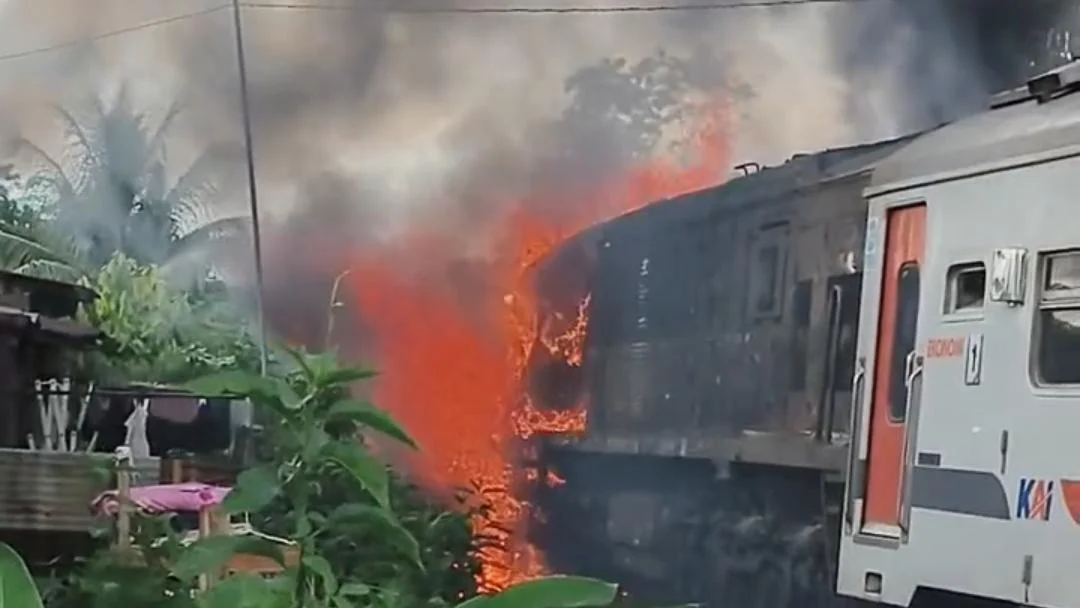
A tragic collision between the Siantar Ekspres passenger train, operating on the Pematangsiantar-Medan route, and a Sinar Tani minibus has ignited a critical debate regarding the safety protocols and legal liability surrounding non-gated railway crossings in Indonesia. The incident, which occurred on Friday, November 20, 2026, in the Sinaksak area of the Tapian Dolok district, Simalungun Regency, resulted in the death of the minibus driver and left three railway staff members suffering from severe burn injuries. The violent impact triggered a fire that engulfed both the train’s locomotive and the minibus, serving as a grim reminder of the persistent risks inherent in the country’s rail-road infrastructure.
Chronology of the Incident
The accident took place during the afternoon hours when the Siantar Ekspres was traversing the tracks near the Sinaksak neighborhood. According to preliminary reports, the minibus attempted to cross the tracks at a location known for its lack of formal safety barriers, signal alarms, or authorized crossing guards. As the minibus moved onto the tracks, the locomotive struck the vehicle with significant force. The collision was immediately followed by a fire, likely caused by the rupture of the minibus’s fuel tank and the subsequent ignition of the locomotive’s engine components.
While the 264 passengers aboard the Siantar Ekspres were safely evacuated, the incident caused significant disruption to local rail services and severe trauma to the crew on board. The three railway employees who sustained burns are currently receiving medical treatment, with PT Kereta Api Indonesia (KAI) overseeing their recovery and healthcare costs. The driver of the minibus, unfortunately, did not survive the impact.
Legal Framework and Liability
The recurring nature of such accidents has prompted legal experts and transportation analysts to clarify the distribution of responsibility in the wake of railway crossing incidents. Joni Martinus, an expert in railway safety and the Head of the Railway Division for the Indonesian Transportation Society (MTI) in South Sumatra, emphasizes that the determination of liability is rooted in the existing legal framework, specifically Law Number 22 of 2009 concerning Traffic and Road Transportation.
Article 114 of this legislation explicitly mandates that drivers must prioritize the passage of trains. It dictates that whenever a signal sounds, a gate begins to close, or any other warning is present, a driver must come to a complete stop and allow the train to pass. According to Martinus, if a driver fails to adhere to these rules—especially at a crossing—they are considered to have acted with negligence.
"In cases where a driver ignores traffic signals or attempts to beat a train to a crossing, the primary legal responsibility rests with the driver of the road vehicle," Martinus explained. Under Indonesian law, such actions can lead to criminal charges, including potential prison time or fines for the driver, provided they survive the accident. Conversely, the railway operator, PT KAI, is generally held harmless unless an independent, comprehensive investigation reveals a failure in the train’s operational protocol or mechanical negligence on the part of the railway company.
Institutional Responsibilities and Support
The incident has highlighted the distinct roles of the stakeholders involved. For the three KAI staff members injured in the line of duty, the company assumes full responsibility for their welfare. This includes not only covering the entirety of their medical expenses but also ensuring their long-term rehabilitation. As employees engaged in operational tasks, they are covered under occupational safety protocols and mandatory social security schemes for workers, which are designed to provide financial and medical support following workplace accidents.
Regarding the passengers, PT KAI operates under the mandate of Law Number 23 of 2007 concerning Railways. This law dictates that the railway operator is strictly liable for the safety of its passengers during transit. This obligation includes providing compensation for medical treatment for those injured, death benefits for the families of those who pass away, and reimbursement for lost or damaged property. In this specific incident, the successful evacuation of the 264 passengers has prevented a much larger humanitarian catastrophe, but the loss of the minibus driver remains a focal point of public concern.
The Problem of Unregulated Crossings
The Sinaksak crossing is emblematic of a broader, systemic issue plaguing the Indonesian transport network: the existence of "illegal" or informal level crossings. These crossings are often created by local communities to shorten travel times between neighborhoods, yet they lack the fundamental safety infrastructure required to prevent collisions, such as automated boom gates, flashing warning lights, or human sentries.
Joni Martinus describes these locations as "ticking time bombs." He argues that relying on the caution of individual drivers at these sites is insufficient given the high volume of traffic and the inherent limitations of a train’s stopping distance. "A train cannot swerve, and its braking distance is measured in hundreds of meters. Expecting drivers to always exercise perfect judgment at unregulated crossings is a failed strategy," he stated.
Statistical Context: A Persistent Crisis
The severity of the situation is reflected in the longitudinal data regarding accidents at level crossings over the past four years. The numbers suggest that despite various awareness campaigns, the frequency of such accidents remains alarmingly high:
- 2022: 245 recorded accidents with 110 fatalities.
- 2023: 274 recorded accidents with 94 fatalities.
- 2024: 213 recorded accidents with 123 fatalities.
- 2025: 171 recorded accidents with 106 fatalities.
These statistics underscore a volatile trend where even when the number of accidents fluctuates, the fatality rate remains consistently high. The data indicates that approximately 60% to 70% of these incidents occur at crossings that are either completely unguarded or lack modern, automated signaling technology.
Proposed Solutions and Policy Directions
To mitigate the risk of future tragedies, experts and authorities are calling for a multi-pronged approach involving infrastructure development, legislative enforcement, and public education.
1. Infrastructure Remediation
The most permanent solution is the physical separation of rail and road traffic. This includes the construction of flyovers or underpasses at high-traffic points. While these projects require significant capital investment and complex land acquisition processes, they are the only way to eliminate the risk of collision entirely. For lower-traffic areas, the immediate closure of illegal crossings is recommended, accompanied by the installation of formal gates at mandatory crossing points.
2. Strengthening Law Enforcement
There is a pressing need for stricter penalties for those who violate traffic laws at railway crossings. Increased use of surveillance technology, such as CCTV and electronic traffic law enforcement (ETLE), could help identify and penalize drivers who attempt to cross active rail lines. The goal is to instill a culture of deterrence where the consequences of "beating the train" are immediate and significant.
3. Cultivating a Culture of Safety
Education remains the soft-power component of this strategy. Public awareness campaigns must emphasize the "stop, look, listen" protocol. Furthermore, local governments must work with community leaders to discourage the creation of new informal crossings and to advocate for the safety of existing ones.
Conclusion: A Call to Action
The collision in Sinaksak is not merely a localized traffic accident; it is a symptom of a larger infrastructure deficit that requires urgent, coordinated attention from the Simalungun Regency government, the Directorate General of Railways (DJKA), and PT KAI. As Martinus noted, the loss of one life is a tragedy that should not be normalized.
The path forward requires moving beyond reactionary measures. It necessitates a commitment to a comprehensive audit of all level crossings in the region, followed by a prioritized list of closures and upgrades. Only by treating these crossings as critical safety hazards rather than mere logistical inconveniences can the authorities ensure that the tragic event of November 20, 2026, does not repeat itself. The safety of the traveling public and the integrity of the railway system depend on the ability of these stakeholders to translate policy into tangible, life-saving infrastructure.
