
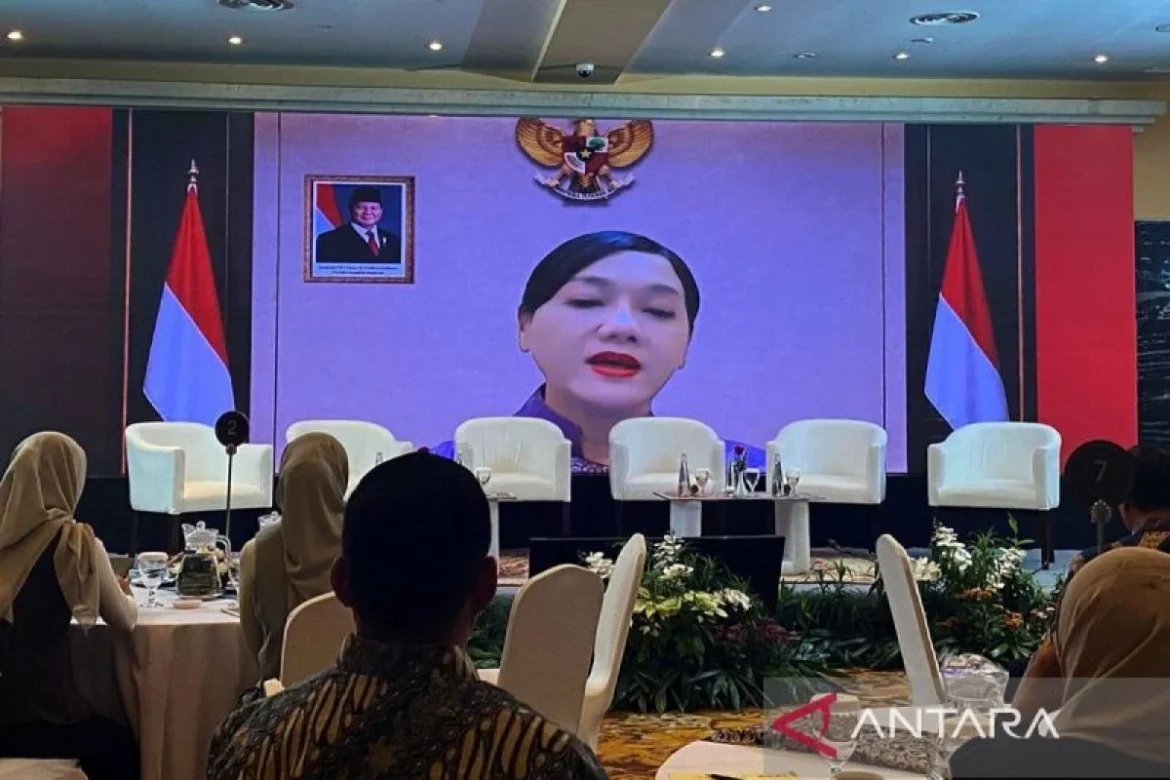
JAKARTA — The Financial Services Authority of Indonesia, known locally as Otoritas Jasa Keuangan (OJK), has firmly stated that the ongoing structural and regulatory reforms sweeping the Indonesian capital market are not merely superficial adjustments designed to appease index providers. Instead, these sweeping changes represent an unwavering, long-term strategic commitment to transforming the nation’s financial exchanges into a secure, highly transparent, and universally trusted sanctuary for both domestic and international investors.
This critical clarification was delivered by OJK Chairman of the Board of Commissioners, Friderica Widyasari Dewi, during her keynote address at the prestigious CORE Economic Outlook 2027 conference held in Jakarta. Her remarks come at a transformative juncture for Indonesia’s financial sector, as regulatory bodies aggressively clean up market anomalies, enforce stringent compliance frameworks, and roll out innovative financial instruments to fortify the economy against external headwinds.
Unprecedented Enforcement Actions and Zero-Tolerance Policy
At the heart of OJK’s current reform agenda is a fierce dedication to market integrity and aggressive law enforcement. During her address, Friderica highlighted a historic milestone in the regulatory body’s enforcement history: the imposition of a staggering Rp2.1 trillion in fines levied against several non-compliant corporate issuers. This punitive action stands as the largest cumulative financial penalty ever recorded in the history of the Indonesian capital market.
"Law enforcement will continue to be implemented decisively and without favoritism, including through criminal proceedings where warranted," Friderica declared to an audience of economists, policymakers, and financial market participants.
This hardline regulatory stance underscores a paradigm shift within Indonesia’s financial architecture. For years, critics and institutional investors had pointed to regulatory leniency and lax governance as vulnerabilities that deterred deeper foreign capital allocation. By demonstrating an unyielding willingness to penalize corporate governance failures, OJK aims to eradicate market manipulation, insider trading, and disclosure violations. Market analysts view this aggressive posture as a necessary surgical intervention to restore absolute confidence among retail and institutional stakeholders alike.
Robust Fundamental Performance Amid Structural Overhauls
Despite the rigorous regulatory clampdown, Indonesia’s capital market continues to display remarkable resilience and positive operational momentum. Fundamental indicators remain overwhelmingly strong, fueled by solid corporate earnings, a competitive dividend yield relative to regional peers, and a rapidly expanding domestic investor base.
Providing concrete figures, Friderica noted that by September 24, 2026, the Jakarta Composite Index (IHSG) had surged by 3.65 percent on a month-to-date (mtd) basis. More importantly, the daily trading behaviors and technical movements of the IHSG have become increasingly synchronized with major global benchmark indices, reflecting a higher degree of integration and maturity within the domestic bourse.
Furthermore, the democratization of the nation’s financial markets has reached a historic milestone, with the total number of registered investors crossing the 35 million mark in terms of Single Investor Identification (SID) accounts. This exponential growth in retail participation over recent years highlights a cultural shift among Indonesians toward financial literacy and long-term equity investment, reducing the market’s historical vulnerability to sudden capital flight by foreign institutional investors.
Collaborative Regulatory Overhauls and Market Integrity
To ensure that these structural gains are permanent, the OJK is working in lockstep with the Self-Regulatory Organizations (SROs) of the Indonesian financial ecosystem. This collaborative front comprises the Indonesia Stock Exchange (IDX / BEI), the Indonesian Clearing and Guarantee Corporation (KPEI), and the Indonesian Central Securities Depository (KSEI). Together, these institutions are systematically accelerating the capital market integrity reform roadmap.
Key operational milestones in this ongoing reform include:
- Enhanced Disclosure Thresholds: Mandatory public reporting and transparent tracking of share ownership stakes exceeding the 1 percent threshold.
- Granular Investor Categorization: The implementation of advanced data granularity to accurately segment and monitor different classes of market participants.
- Independent Oversight Committees: The establishment of specialized independent bodies, such as the High Shareholding Concentration (HSC) committee, paired with continuous refinement of analytical methodologies to detect systemic risks early.
These technical adjustments are meticulously designed to meet global index provider standards—such as those discussed in high-level dialogues between national leadership and international financial giants like MSCI—while simultaneously safeguarding the domestic market from speculative manipulation and concentrated ownership risks.
Diversifying the Financial Ecosystem: Three Strategic Growth Pillars
Beyond traditional equity and debt markets, the OJK is spearheading a broader national mandate to deepen the domestic financial sector and cultivate entirely new engines of economic growth. These initiatives are formally anchored in three strategic pillars mandated under the landmark Law on the Development and Strengthening of the Financial Sector (UU P2SK) enacted heading into 2026.
1. The National Carbon Market
OJK is aggressively scaling up Indonesia’s carbon trading framework through the refinement and integration of the Carbon Unit Registry System (SRUK). This digital infrastructure is engineered to facilitate transparent, highly credible, and internationally compatible carbon credit transactions. As global supply chains decarbonize, Indonesia is positioning itself as a primary hub for green finance, leveraging its vast forestry and renewable energy potential to attract international climate capital.
2. Strategic Minerals and Commodities Exchange (BMKS)
In alignment with the nation’s aggressive downstream industrial policy—often termed hilirisasi—the OJK is tasked with regulating and supervising the newly developed Bursa Mineral dan Komoditas Strategis (BMKS). This specialized exchange aims to establish reliable domestic reference pricing, eliminate informational asymmetries in commodity trading, and maximize the domestic value-added retention of Indonesia’s abundant natural resources, such as nickel, bauxite, and copper.
3. The National Bullion Ecosystem
To support the ongoing national strategy of gold downstream processing and provide citizens with diversified wealth-preservation instruments, the OJK has nurtured the rapid expansion of the domestic bullion ecosystem. Current operational data reveals that cumulative transaction values within this emerging sector have already scaled to an impressive Rp35 trillion, supported by over 1.6 million dedicated bullion accounts.
"These three initiatives are expected to increasingly strengthen the role of the financial services sector as a primary catalyst for macroeconomic growth and the enhancement of domestic value addition," Friderica emphasized.
Core Strategic Challenges and the Road Ahead for 2027
As Indonesia looks toward the macroeconomic horizon of 2027, the OJK has outlined three overriding operational challenges that will dictate regulatory priorities and supervisory focus in the near term:
- Macroeconomic Resilience and Financial Stability: Navigating persistent global economic fragmentation, geopolitical uncertainties, and shifting international monetary policies while insulating the domestic financial system from imported shocks.
- Productive Intermediation and Financial Inclusion: Directing banking and capital market liquidity toward high-productivity sectors, infrastructure projects, and Micro, Small, and Medium Enterprises (MSMEs), while strictly maintaining institutional prudential standards and risk management protocols.
- Accelerating Market Deepening: Deepening the capital markets through relentless technological innovation, advanced digitalization, enhanced consumer protection frameworks, and uncompromising market integrity enforcement.
Achieving these ambitious targets, according to regulatory leaders, will require an unprecedented level of synergy, open communication, and coordinated execution among government ministries, regulatory agencies, financial institutions, and market participants.
Broader Economic Implications and Analyst Perspectives
Independent economic analysts observing the OJK’s aggressive policy trajectory suggest that Indonesia is currently undergoing a pivotal maturation phase. For decades, the primary criticism leveled against emerging market regulators has been a perceived tolerance of lax corporate governance in exchange for short-term liquidity boosts.
By prioritizing structural transparency, executing record-breaking punitive fines against corporate violators, and simultaneously opening new asset classes like carbon credits, commodities, and bullion, the OJK is signaling a mature transition toward a rules-based, institutionalized market economy.
If successfully implemented, these reforms are expected to lower the cost of capital for compliant corporations, attract sticky, long-term foreign institutional investment that tracks strict ESG and governance mandates, and shield retail investors from predatory market practices. Ultimately, OJK’s vision for 2027 seeks to prove that Indonesia’s financial markets are no longer merely growing in size, but are fundamentally strengthening in quality, safety, and global prestige.
