
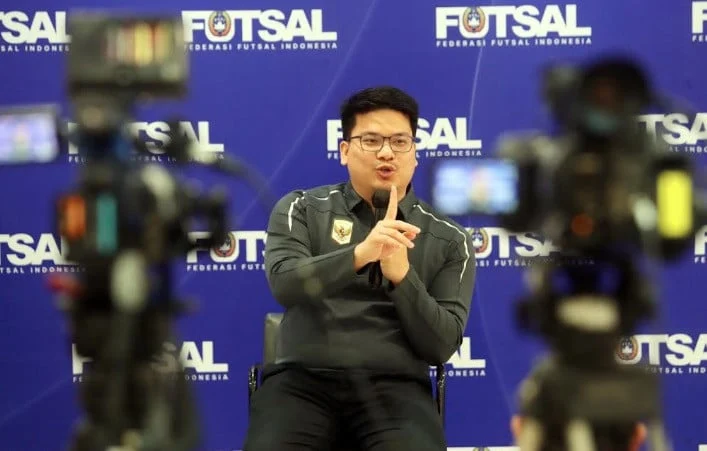
JAKARTA – The landscape of Indonesian futsal governance has entered a period of profound uncertainty following a firm declaration by Michael Sianipar, who continues to assert his position as the legitimate leader of the Federasi Futsal Indonesia (FFI). During a press conference held at the iNews Tower in Jakarta on Thursday, November 26, 2026, Sianipar formally announced his decision to boycott the upcoming Extraordinary Congress (KLB) scheduled for December 11, 2026. Sianipar’s refusal to participate in the selection process is rooted in his firm belief that the entire proceeding is legally flawed, citing violations of both the FFI’s internal statutes and the overarching regulations established by the Football Association of Indonesia (PSSI).
The Core Dispute: Legitimacy and Governance
The conflict centers on the validity of the current leadership transition within the national futsal body. Sianipar, who was elected to lead the FFI for the 2024-2028 tenure, remains steadfast in his conviction that his administration was formed through legitimate democratic processes. The tension escalated when PSSI issued a decree (SK) effectively removing Sianipar from his position and appointing Vivin Cahyani as the Acting Chairman (Plt) of the FFI.
Sianipar maintains that this administrative maneuver is not only procedurally incorrect but also contradicts the fundamental statutes that govern PSSI’s relationship with its affiliated federations. "If the foundation of the congress is illegal, any outcome produced by that congress will inherently be illegitimate," Sianipar stated during the briefing. He further emphasized the paradox of participating in an event he deems unlawful, noting that even if he were to run and win, it would only serve to validate an process that he contends is fundamentally broken.
Chronology of the Futsal Governance Crisis
The friction within the FFI did not emerge in a vacuum. To understand the current impasse, one must examine the timeline of events leading up to this point:
- Early 2024: Michael Sianipar is inaugurated as the Chairman of FFI for the 2024-2028 period following an election that was widely recognized by the FFI member associations.
- Mid-2026: Growing administrative friction between the FFI leadership and PSSI leadership begins to surface, centered on operational autonomy and interpretation of the FFI statutes.
- Late 2026: PSSI issues an official decree (SK) mandating the replacement of the FFI leadership, citing internal organizational reasons. This decree marks the formal start of the impeachment process against Sianipar.
- November 26, 2026: Michael Sianipar holds a press conference at iNews Tower, explicitly labeling the upcoming December 11 KLB as an "illegal" event and confirming his refusal to participate in the race for the chairmanship.
- December 11, 2026: The date set by PSSI for the Extraordinary Congress, which remains a point of contention for stakeholders within the Indonesian futsal community.
Legal and Procedural Analysis
The core of the legal argument revolves around the principle of organizational sovereignty. According to the statutes of the FFI and its relationship with PSSI, the removal of a democratically elected chairman requires a specific set of circumstances, usually involving clear breaches of ethics or constitutional failures that must be adjudicated through an independent committee.
Legal experts observing the situation suggest that if the PSSI’s intervention lacks a clear evidentiary basis of constitutional violation, the move could be viewed as an overreach of authority. Conversely, PSSI maintains that it holds the overarching supervisory power to intervene in the management of its affiliated bodies when it deems the stability of the organization is at risk. This clash of interpretations has created a "dual-authority" environment, which is highly detrimental to the development of professional futsal in Indonesia.
The Broader Impact on Indonesian Futsal
The implications of this standoff extend far beyond administrative politics. Futsal in Indonesia has seen a surge in popularity, with the national team achieving higher international rankings and domestic leagues attracting significant commercial interest. A leadership vacuum or a disputed presidency threatens to disrupt several critical areas:
1. International Standing and FIFA/AFC Relations
International sporting bodies, such as FIFA and the Asian Football Confederation (AFC), place a high premium on the autonomy of national federations. If the international community perceives that the leadership of the FFI was changed through political interference rather than independent organizational processes, there is a risk that the Indonesian FFI could face sanctions. Such sanctions would prevent national teams from participating in international competitions, effectively stalling years of progress.
2. Commercial and Sponsorship Stability
Corporate sponsors and broadcasting partners rely on organizational stability to justify their investments. A "dual-leadership" scenario makes it difficult for potential sponsors to sign long-term contracts, as they cannot be certain which faction holds the legal authority to sign documents or manage funds. The uncertainty surrounding the December 11 KLB is already causing a "wait-and-see" approach among key stakeholders in the futsal industry.
3. Impact on the Athlete and Grassroots Levels
At the grassroots level, the disruption is felt by clubs, coaches, and players who depend on the federation for match scheduling, referee training, and youth development programs. If the administrative gridlock persists, the structural support systems required to foster the next generation of Indonesian futsal talent will inevitably suffer.
Official Responses and Stakeholder Positions
While PSSI has not issued a detailed rebuttal to Sianipar’s specific claims as of late November 2026, the scheduling of the KLB serves as a de facto stance that the organization is moving forward with the leadership change regardless of Sianipar’s objections.
Vivin Cahyani, the designated Acting Chairman, has generally characterized the transition as a necessary measure to restore internal cohesion within the FFI. However, the lack of transparency regarding the "illegal" allegations made by Sianipar has left a segment of the futsal community uneasy. Many regional futsal associations (Asosiasi Futsal Provinsi) remain caught in the middle, waiting for a definitive resolution that will clarify who they are obligated to report to.
Conclusion: A Precedent-Setting Moment
The decision by Michael Sianipar to abstain from the KLB is a strategic move intended to maintain the moral and legal high ground. By refusing to participate, he is effectively challenging the legitimacy of the process on record, which could prove vital if the matter is taken to the Court of Arbitration for Sport (CAS) or other independent legal arbitration bodies.
The coming weeks will be critical. The December 11, 2026, KLB will likely proceed, but its success—and its long-term viability—will depend on whether the results are accepted by the broader futsal community. If the majority of the provincial associations boycott the event, or if the resulting leadership is met with sustained legal challenges, the crisis may deepen.
For Indonesian futsal, the path forward requires a reconciliation of the legal framework governing the sport. Whether this is achieved through mediation, a formal judicial review, or a compromise that respects the statutes, the ultimate goal remains the preservation of the sport’s integrity. As the December 11 deadline approaches, the eyes of the Indonesian sports world remain fixed on whether this dispute will be resolved through dialogue or if it will lead to a protracted period of institutional instability that could threaten the future of one of the country’s most promising sporting sectors.
