
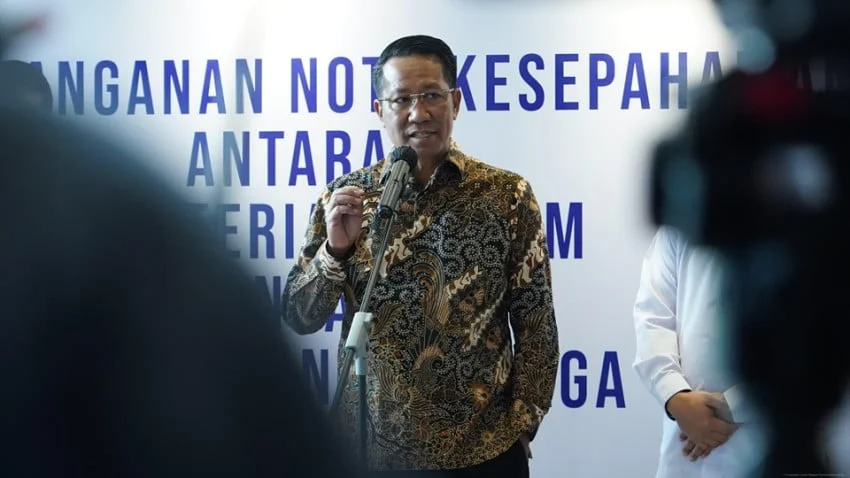
JAKARTA – Indonesia’s Minister of Law and Human Rights, Supratman Andi Agtas, has moved to quell concerns regarding a purported surge in applications for the relinquishment of Indonesian citizenship. Speaking from Graha Pengayoman at the Ministry of Law and Human Rights on Friday, July 24, 2026, Minister Agtas unequivocally stated that there is no discernible upward trend in such applications. He clarified that recent reports of approximately 300 applications for citizenship renunciation were not indicative of a sudden spike but rather represented an accumulation of submissions spanning multiple periods, some dating back as far as a year or more. This clarification underscores the meticulous and often protracted nature of processing such sensitive legal requests within the nation’s robust administrative framework.
The Minister’s statement aimed to provide much-needed context to figures that might otherwise be misinterpreted as a mass exodus of citizens. He emphasized that the administrative process for altering one’s citizenship status is inherently complex, involving multiple stages of verification and review. Therefore, figures reported at any given time often encapsulate applications received over an extended duration, rather than representing a snapshot of immediate interest in renunciation. This accumulation is a common feature in bureaucratic systems dealing with high-stakes legal procedures, where thoroughness often takes precedence over speed.
Understanding Indonesia’s Citizenship Framework
Indonesia’s citizenship is primarily governed by Law No. 12 of 2006 concerning Citizenship of the Republic of Indonesia. This legislation largely adheres to the principle of single citizenship for adults, meaning that an Indonesian citizen who voluntarily acquires foreign citizenship typically loses their Indonesian nationality. However, the law provides for limited dual citizenship for children, allowing them to hold both Indonesian and another nationality until they reach the age of 18 or marry, after which they must choose one. The process of renunciation, therefore, is a significant legal step with profound implications for individuals, requiring careful consideration and adherence to strict procedures.
The process of relinquishing Indonesian citizenship typically involves submitting a formal application to the Ministry of Law and Human Rights, accompanied by supporting documents that demonstrate the acquisition of foreign citizenship or an intention to do so. The reasons for renunciation are varied, often stemming from personal choices such as marriage to a foreign national in a country that requires its citizens to hold only one nationality, long-term residency abroad with a desire to fully integrate into a new society, or professional opportunities that necessitate holding the citizenship of another country. While individual motivations differ, the legal pathway for formal renunciation is clearly defined, albeit subject to rigorous scrutiny by state authorities.
The Counter-Narrative: A Surge in Naturalization Applications
Interestingly, Minister Agtas highlighted a contrasting trend: a significantly higher volume of applications from foreign nationals (WNA) seeking to become Indonesian citizens (WNI) through naturalization. This observation provides a crucial counter-point to any perceived crisis of national identity or allegiance. While thousands of foreign nationals aspire to embrace Indonesian citizenship, the approval rate remains exceptionally stringent. In 2025, out of thousands of naturalization applications received, only a handful—reportedly around five—were ultimately approved. This stark disparity between applications and approvals underscores the selective nature of Indonesia’s naturalization policy, emphasizing that becoming an Indonesian citizen is a privilege extended to those who meet exacting criteria and are deemed to genuinely contribute to the nation.
Naturalization applications in Indonesia are typically evaluated based on several stringent conditions, including a minimum period of residency (usually five consecutive years or ten non-consecutive years), proficiency in the Indonesian language, a sound understanding of the Pancasila (Indonesia’s state ideology) and the 1945 Constitution, a clean criminal record, and the capacity to support oneself financially. Furthermore, applicants must often demonstrate a genuine commitment to the Indonesian state and society. The low approval rate, as noted by Minister Agtas, reflects the government’s cautious approach to granting citizenship, prioritizing national interests and ensuring that new citizens are fully integrated and aligned with the country’s values and laws.
Enhanced Scrutiny and Verification Protocols
A significant component of the Minister’s address focused on the implementation of stricter verification protocols for all citizenship-related applications, particularly those involving relinquishment. Minister Agtas explicitly stated that the process has become "far more difficult now," a direct consequence of past incidents and emerging challenges. He cited cases where individuals possessing Indonesian passports were later found to be involved in legal issues or financial irregularities within Indonesia, despite having initiated processes to change their citizenship. These experiences have prompted the Ministry to significantly enhance its due diligence procedures.
The heightened verification now entails a comprehensive cross-referencing of applicants’ backgrounds with various national databases, including those pertaining to legal records, financial standing, and tax compliance. The objective is to prevent individuals from potentially evading legal responsibilities or financial obligations in Indonesia by altering their citizenship status. This preventative measure is crucial for maintaining national security, upholding the rule of law, and safeguarding the integrity of the state’s administrative systems.
Addressing the "Child Applicants" Conundrum
Minister Agtas specifically touched upon the complexities surrounding applications from children for citizenship relinquishment. He highlighted a particular concern: "If now the children are applying, there are many children here, right, who are applying. What if their parents’ company is involved, and then suddenly there are tax problems, all of this must be confirmed." This statement reveals a critical layer of scrutiny applied to family-related applications. The Ministry is vigilant about potential attempts to use children’s citizenship status as a loophole to circumvent parental liabilities, especially concerning corporate tax issues or other financial discrepancies.
This indicates a holistic approach to verification, where the individual applicant’s profile is not viewed in isolation but within the broader context of their family’s legal and financial standing. The government’s stance is clear: any application that could potentially be linked to efforts to evade legal or fiscal responsibilities will be subjected to the most rigorous checks, ensuring that the integrity of the citizenship process is not compromised.
Chronology and Evolution of Citizenship Policy
The stricter verification protocols represent an evolution in Indonesia’s approach to citizenship management, building upon a historical trajectory of policy development. Prior to the enactment of Law No. 12 of 2006, citizenship laws were often less flexible, particularly regarding dual nationality. The 2006 law introduced more progressive elements, such as the limited dual citizenship for children, reflecting a recognition of increasing global mobility and diverse family structures.
However, the implementation of these laws over nearly two decades has also revealed challenges. Cases of individuals misusing their citizenship status or attempting to circumvent legal obligations have periodically emerged, prompting the government to continuously review and refine its administrative procedures. The current emphasis on "stricter verification" is a direct outcome of this ongoing learning process, adapting to contemporary issues like cross-border financial crimes, tax evasion, and the complexities arising from individuals holding multiple identities across different jurisdictions. The July 24, 2026, statement by Minister Agtas can be seen as a reaffirmation of the government’s commitment to robust and secure citizenship management in the face of these evolving challenges.
Broader Implications and Expert Perspectives
The Ministry’s clarification and emphasis on stricter verification carry several broader implications for individuals, legal practitioners, and the nation as a whole. For individuals seeking to change their citizenship, whether by renunciation or naturalization, the message is clear: the process demands absolute transparency, patience, and a thorough understanding of all legal requirements. Any attempt to obfuscate information or bypass due process will likely result in rejection.
Legal experts specializing in immigration and citizenship law often commend the government’s move towards more stringent checks, viewing it as essential for national security and the prevention of illicit activities. Dr. Indah Permata, a constitutional law scholar at the University of Indonesia (a hypothetical expert), might comment, "While individuals have the right to choose their citizenship, the state also has an inherent right and duty to protect its sovereignty and ensure its laws are upheld. Stricter verification, particularly in an era of complex global financial transactions, is a necessary measure to prevent abuse of the system." She might further suggest that clearer public guidelines on the verification process could help applicants navigate the system more effectively.
From a sociological perspective, the observed trend of higher naturalization applications compared to renunciation, even if accumulated, could indicate Indonesia’s growing attractiveness as a place to live, work, or raise a family. Factors such as economic growth, cultural richness, and political stability often draw foreign nationals to seek permanent residency and eventually citizenship. Conversely, while some Indonesians may choose to relinquish their citizenship, this is often a personal decision driven by specific circumstances rather than a systemic issue.
The implications for international relations and reputation are also noteworthy. A robust and transparent citizenship process enhances a nation’s credibility on the global stage, signaling its commitment to good governance and adherence to international legal norms. By actively combating potential abuses of its citizenship laws, Indonesia reinforces its image as a responsible member of the international community.
The Path Forward
Minister Agtas’s statement serves as an important update on Indonesia’s approach to citizenship management. It dispels myths about a sudden surge in renunciation applications, clarifies the nature of reported figures, and underscores the government’s unwavering commitment to maintaining the integrity of its citizenship processes. The heightened scrutiny, particularly concerning financial and legal backgrounds, reflects a proactive stance against potential abuses and a dedication to safeguarding national interests.
As Indonesia continues to navigate an increasingly interconnected world, the dynamics of citizenship will remain a critical area of policy. The Ministry of Law and Human Rights, under the leadership of Minister Supratman Andi Agtas, appears committed to ensuring that these processes are not only efficient but also impervious to manipulation, thereby upholding the sanctity of Indonesian citizenship for all. The ongoing challenge will be to balance national security imperatives with the individual rights and choices of a globally mobile population, a task that requires continuous adaptation, vigilance, and transparency.
