
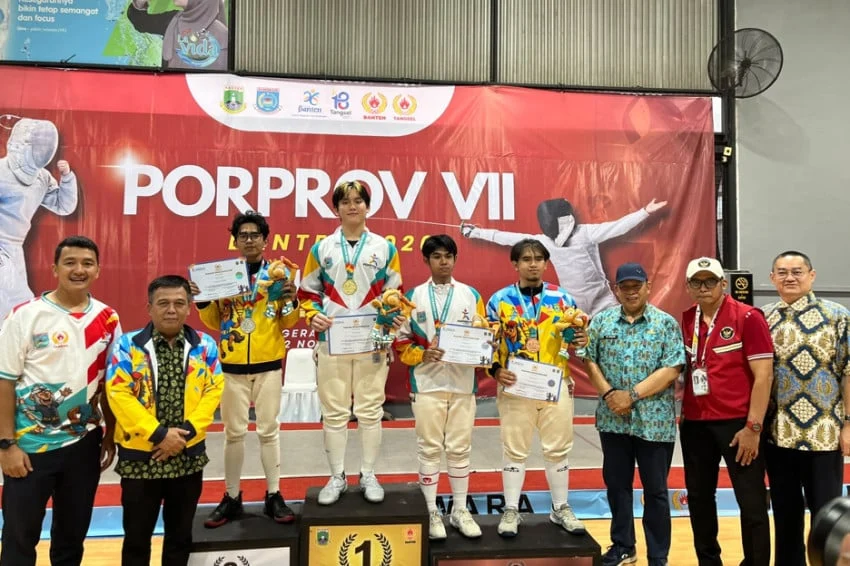
The seventh iteration of the Pekan Olahraga Provinsi (Porprov) Banten 2026 has reached a critical juncture, with organizers confirming that the multi-sport event is progressing according to the established strategic roadmap despite logistical challenges inherent in managing 60 distinct sporting disciplines. As of Friday, November 20, 2026, the host city of South Tangerang (Tangsel) has demonstrated formidable strength in the fencing category, securing a total of nine medals—four gold, two silver, and three bronze—in individual events, with team competitions still slated to commence.
Evaluating the Organizational Landscape
Agus Rasyid, Chairman of the Banten National Sports Committee (KONI), conducted a formal site visit to the MS Sport Arena in South Tangerang on Saturday, November 21, 2026, to assess the technical execution of the fencing tournament. During his visit, Rasyid addressed the broader operational status of the Porprov VII, acknowledging that while the complexity of coordinating 60 sports across various venues has presented intermittent technical and logistical hurdles, the overall trajectory of the games remains stable.
"If we analyze the progression of the 7th Porprov of 2026, the event is firmly on track," Rasyid stated. "While there have been localized points of friction, these are expected dynamics in an event of this magnitude. Our priority is to identify these bottlenecks immediately and implement rapid solutions. Every aspect, from the initial preparatory phase to the real-time execution, is undergoing continuous evaluation to ensure the integrity of the remaining competition schedule."
The logistical complexity of Porprov VII is significant, involving thousands of athletes, coaches, and support staff across the province. By maintaining a rigid evaluation cycle, KONI Banten aims to prevent minor technical delays from snowballing into systemic failures, ensuring that the athletes’ performances remain the focal point of the event.
Fencing as a Case Study in Regional Dominance
The fencing competition at MS Sport Arena serves as a microcosm for the broader competitive spirit of the games. South Tangerang’s early medal haul reflects a robust investment in the sport, distinguishing the city as a burgeoning hub for fencing talent in the Banten region. The transition from individual categories to the upcoming team matches is expected to heighten the stakes, as tactical coordination and squad depth become the deciding factors.
Fencing, a sport that requires precise timing and high-level physical conditioning, has seen significant technological integration globally, such as the advanced wiring systems popularized during the 2024 Paris Olympics. The application of such standards at the provincial level in Banten indicates a commitment to modernizing local sports infrastructure, ensuring that athletes are competing under conditions that mirror national and international benchmarks.
Chronology and Strategic Development
The Porprov VII Banten 2026 is not merely a regional competition; it is a vital checkpoint in the province’s long-term athletic development strategy. The following timeline outlines the importance of the current games within the national context:
- November 2026 (The Current Phase): Execution of the 7th Porprov Banten. The event serves as the primary testing ground for provincial talent across 60 sports.
- Post-November 2026: Consolidation of performance data. KONI Banten will begin the process of talent scouting and performance reviews based on medal counts and individual athletic metrics.
- 2027: The crucial year for the Pekan Olahraga Nasional (PON) qualification process. Athletes who performed well in the 2026 Porprov will be shortlisted for intensified training camps and regional selection committees.
- 2028: The PON games hosted by Nusa Tenggara Timur (NTT) and Nusa Tenggara Barat (NTB). This serves as the ultimate objective for the talent identified during the 2026 cycle.
Talent Identification and Future Implications
A central theme of Rasyid’s comments was the function of Porprov as a developmental pipeline. According to the KONI leadership, the success of the games should not be measured solely by the final medal tally, but by the volume of emerging talent capable of making the transition to the national stage.
"The performances we are witnessing in the arena must be interpreted as the direct result of our ongoing regional development programs," Rasyid noted. "These results serve as the primary dataset for our talent scouts. We are looking for athletes who have not only achieved victory but who demonstrate the physical and psychological capacity for sustained growth in the lead-up to the national qualifiers for the 2027 season and the 2028 PON."
This approach underscores a shift toward a data-driven model in provincial sports management. By mapping the progression of young athletes, the Banten authorities hope to create a sustainable pipeline that mitigates the "talent gap" often observed between regional and national levels of competition.
Socio-Economic Impact and Infrastructure
Beyond the competitive results, the hosting of Porprov VII acts as an economic and social catalyst for the host city. The concentration of athletes and spectators in South Tangerang has necessitated a temporary, yet significant, increase in service demand, including hospitality, transport, and facility management.
The use of MS Sport Arena for fencing highlights the necessity of multi-purpose, high-quality infrastructure. The maintenance of these facilities during the event provides a blueprint for future regional sports hosting. Furthermore, the emphasis on evaluation and troubleshooting—as highlighted by the KONI chairman—serves to build institutional capacity within the local sports departments. Future organizers will likely inherit a more refined playbook, having learned from the "dynamics" or challenges faced during this year’s implementation.
Analytical Outlook: Challenges and Opportunities
While the event is officially deemed "on track," independent observers note that the pressure to perform on provincial athletes is immense. For many, the Porprov is their first experience in a high-stakes, multi-sport tournament environment. The psychological toll of these games is significant, and the ability of regional federations to provide adequate support staff—ranging from coaches to sports psychologists—will determine the long-term retention of these athletes.
Furthermore, the integration of 60 different sports presents a unique challenge for standardized officiating and reporting. The inconsistency in how different sports are managed—given their vastly different requirements—remains a point of focus for the oversight committee. If KONI Banten can successfully manage the disparate needs of these 60 disciplines, it will set a new benchmark for provincial sports administration in Indonesia.
Conclusion: Sustaining Momentum
As the Porprov VII Banten 2026 continues, the focus will shift from initial logistics to the culmination of individual and team championships. The performance of athletes like those in the South Tangerang fencing contingent will be closely scrutinized, not just for their current medal tallies, but for their potential to represent Banten at the national level in the coming years.
The official stance from KONI remains one of cautious optimism. By prioritizing transparency in the evaluation process and maintaining a focus on the long-term goal of the 2028 PON, the organizers are positioning the 2026 Porprov as a cornerstone of provincial sports development. As the games progress, the ability to maintain this level of coordination will remain the defining metric of success for all stakeholders involved in the Banten sporting ecosystem.
The dedication shown by the athletes, combined with the rigorous oversight of the committee, ensures that despite the inherent complexities of such a massive undertaking, the spirit of fair competition remains the prevailing characteristic of the 2026 games. The coming days of the competition will likely reveal even more talent, providing the necessary data for Banten to build a formidable team for future national engagements.
