
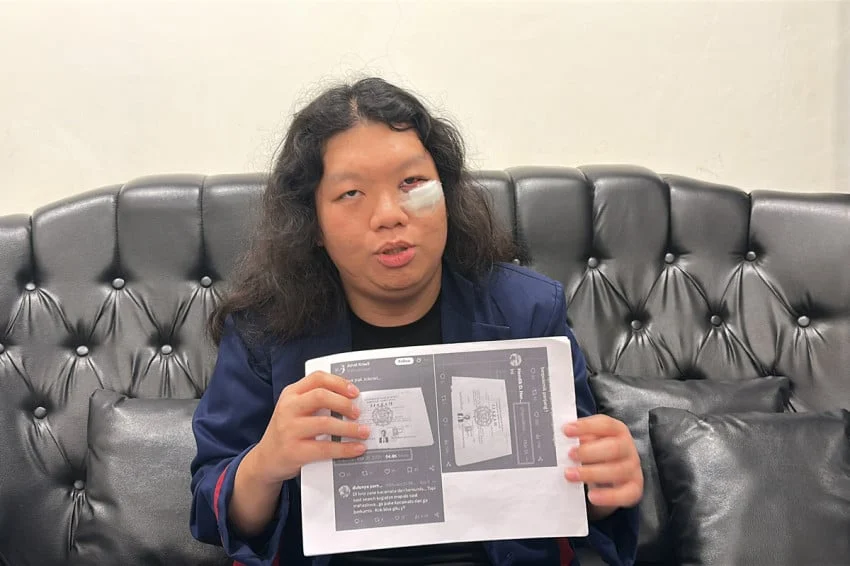
The safety of civil society actors and political activists in Indonesia has once again been cast into the spotlight following a violent assault on Luke Susilo, a prominent activist affiliated with the Gerakan Terus Jadi Anti Pembual (Terjal) network. Luke was subjected to a sudden and brutal physical attack by two unidentified perpetrators near the East Jakarta District Court in the Penggilingan area. The incident, which unfolded late at night on Thursday, November 5, 2026, has left the victim with severe facial injuries requiring specialized plastic surgery, while sparking renewed concern over the growing climate of intimidation directed toward individuals engaged in public interest litigation and political monitoring.
According to initial reports and accounts gathered from the scene, the attack occurred at approximately 11:00 PM local time. Luke had just finished monitoring a high-profile court proceeding related to the controversial former President Joko Widodo (Jokowi) diploma case, which involves notable public figures Roy Suryo and Dr. Tifa as defendants. As he walked toward the Penggilingan Transjakarta bus shelter to commute home, the sequence of events that ultimately led to the assault began to take shape, highlighting the volatile and politically charged atmosphere surrounding the ongoing judicial proceedings.
Chronology of the Incident
The confrontation did not begin as an immediate physical altercation, but rather evolved from a spontaneous public exchange into targeted violence. As Luke traversed the sidewalk near the courthouse precinct, he reportedly overheard a heated conversation between a man and a woman walking nearby. The couple was actively discussing the severe legal ramifications tied to ongoing trials, specifically referencing a potential 12-year prison sentence under Article 35 of the Electronic Information and Transactions (ITE) Law—a statute frequently scrutinized by civil rights advocates for its potential to stifle free speech and political dissent.
Prompted by the overheard conversation, Luke made a spontaneous remark regarding broader national political controversies. His commentary touched upon sensitive topics, including alleged treason plots and purported wiretapping activities targeting President Prabowo Subianto, a discourse that also dragged in the name of former National Police Chief General Listyo Sigit Prabowo. Investigators and associates believe this public remark may have drawn unwanted attention from individuals monitoring the area, serving as the catalyst for the subsequent ambush. Shortly after making the comment, Luke was intercepted by two unidentified individuals who launched a sudden physical attack before fleeing into the night.
Severity of Injuries and Medical Intervention
The violence of the assault left the Terjal activist with critical physical trauma. Luke sustained a deep, serious laceration directly beneath his eye, a wound severe enough to necessitate immediate medical transfer to a specialized plastic surgery unit. Medical professionals noted that injuries to the periorbital region carry high risks of permanent aesthetic and functional damage, underscoring the malicious intent behind the physical blows. Friends, fellow activists, and legal aid networks promptly mobilized to ensure he received adequate medical care and protection following the attack.
The assault on Luke Susilo does not occur in a vacuum; rather, it mirrors an alarming pattern of intimidation, harassment, and outright violence directed against political activists, human rights defenders, and watchdogs in Indonesia. In recent years, civil society organizations—ranging from legal aid institutes to anti-corruption watchdogs and human rights monitoring groups like KontraS—have repeatedly sounded the alarm over shrinking civic space. The use of physical violence, acid attacks, digital surveillance, and intimidation against critics of state policies or judicial outcomes severely undermines the foundational principles of a democratic constitutional state.

Context of the Court Proceedings
To fully understand the environment in which the attack took place, it is essential to examine the nature of the legal proceedings Luke was monitoring. The East Jakarta District Court has become a focal point for politically sensitive trials, most notably those surrounding the authenticity of former President Joko Widodo’s university diploma and related public criticisms. These trials have drawn massive crowds of supporters, detractors, journalists, and independent observers, turning the courthouse environs into a localized flashpoint for political tensions.
Defendants such as Roy Suryo and Dr. Tifa have polarized public opinion, transforming courtroom corridors into arenas of ideological conflict. Activists from groups like Terjal frequently attend these hearings to document proceedings, express solidarity, or push for transparency. However, the presence of impassioned observers often escalates local friction, creating a high-risk environment where political disagreements can swiftly translate into street-level hostility.
Broader Implications for the Rule of Law
Legal experts and human rights advocates have consistently argued that violence against activists engaged in lawful public monitoring poses a direct threat to Indonesia’s democratic integrity. When individuals cannot observe court proceedings or express political commentary without fear of physical reprisal, the principle of public accountability is compromised. The rule of law relies fundamentally on the premise that disputes are settled within the courtroom through transparent legal processes, rather than through intimidation, coercion, or nocturnal street assaults.
Furthermore, incidents of targeted violence against civil society actors generate a profound chilling effect. Activists may hesitate to attend public trials, report on corruption, or critique government policies if they believe their personal safety is compromised. This erosion of civic participation ultimately weakens democratic oversight and diminishes public trust in law enforcement and judicial protection mechanisms.
Calls for a Thorough Investigation
In the wake of the attack, pressure is mounting on local law enforcement authorities to swiftly identify, apprehend, and prosecute the perpetrators. Civil society coalitions have demanded that the Jakarta Metropolitan Police and the East Jakarta Sub-Regional Police launch a transparent and comprehensive investigation into the assault. Authorities face the critical task of determining whether the attack was a random act of street violence fueled by a political argument or a premeditated assault orchestrated to silence an outspoken critic.
Security analysts emphasize that solving this case is crucial not only for delivering justice to Luke Susilo, but also for sending a clear message that political violence and vigilantism will not be tolerated. As the legal proceedings at the East Jakarta District Court continue, the safety measures surrounding the courthouse and the protection afforded to public observers and activists will undoubtedly remain under intense scrutiny by both national and international watchdogs.
