
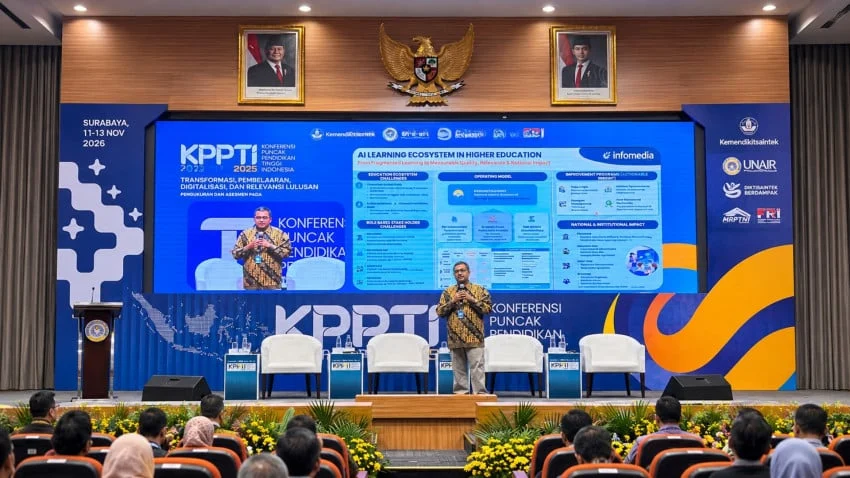
The landscape of Indonesian higher education underwent a significant transformation on Wednesday, November 11, 2026, as PT Infomedia Nusantara, a subsidiary of the Telkom Indonesia Group, unveiled its comprehensive AI Learning Ecosystem at the Indonesia Higher Education Summit (KPPTI) held at Airlangga University, Surabaya. This technological initiative marks a pivotal shift in how academic performance, institutional quality, and national educational standards are assessed, moving from traditional manual reporting to real-time, data-driven insights powered by artificial intelligence. By leveraging its extensive experience in managing massive talent recruitment pipelines, Infomedia aims to bridge the persistent gap between university outputs and industrial requirements.
The Evolution from Recruitment to Education
The development of the AI Learning Ecosystem is not an isolated project but rather an expansion of Infomedia’s data processing capabilities established over several years. Between 2022 and 2024, Infomedia successfully managed recruitment ecosystems that processed over 6.6 million applicants across all 38 provinces in Indonesia. This endeavor, which engaged more than 1,000 educational institutions, provided the company with a massive longitudinal dataset regarding the skill sets and preparedness of fresh graduates entering the workforce.
The realization that academic institutions were struggling to align curricula with the rapidly evolving demands of the digital economy prompted Infomedia to pivot its expertise. By applying the same predictive analytics and algorithmic filtering used to identify high-potential job candidates, the company has developed a system that evaluates the quality of the learning process itself. The core philosophy of the ecosystem is to provide a multi-layered analytical framework that operates from the individual classroom level up to the national policy level, ensuring that data privacy remains a priority by keeping student-specific personal information confined to institutional servers.
The Three-Tiered Architecture of AI Learning
The AI Learning Ecosystem is structured into a sophisticated, three-tiered framework designed to address the specific needs of various stakeholders in the academic ecosystem. At the micro level, the system introduces the AI Smart Classroom, an environment that integrates both physical and virtual learning components.
For faculty members, the AI acts as an administrative and pedagogical assistant. It monitors student engagement levels during lectures, provides automated summaries of complex curriculum modules, and assists in the generation of formative assessments, such as quizzes and research assignments. By automating these time-intensive tasks, lecturers are theoretically freed to focus on high-level instruction and mentorship. Simultaneously, students benefit from personalized learning analytics, receiving summaries of key lecture points and tracking their own cognitive progress through a dashboard that highlights areas of strength and potential improvement.
Moving beyond the individual classroom, the second tier of the ecosystem focuses on the university administration level. Here, the AI provides institutional leaders with comparative analytics. Universities can benchmark their departmental performance against national standards or peer institutions, identifying bottlenecks in student progression or areas where pedagogical strategies are yielding exceptional results.
The third tier operates at the national level, offering the Ministry of Education and relevant regulatory bodies a birds-eye view of the country’s educational quality. This level of oversight is designed to standardize quality assurance across the archipelago, allowing policymakers to identify systemic trends, resource disparities, and curriculum gaps that may be hindering the national workforce’s competitive edge.
Strategic Rationale and Industry Alignment
Widi Sagita Abadi, Vice President of Business Development at Infomedia, emphasized that the deployment of this ecosystem is a strategic response to the changing nature of the global labor market. "Our experience in managing recruitment at a national scale revealed a recurring mismatch between graduate profiles and industry expectations," Abadi stated during the summit. "The AI Learning Ecosystem is our solution to this. By utilizing AI, we are creating a feedback loop where the learning process is not just a static delivery of information, but a dynamic, measurable, and inclusive experience."
The integration of this technology into the university setting is particularly timely. Indonesia has been grappling with the "middle-income trap," which economists often attribute to a lack of skilled human capital. By ensuring that university education is more transparent and data-driven, Infomedia believes that higher education institutions can become more responsive to the "Link and Match" policy advocated by the Indonesian government, which seeks to align vocational and tertiary education with the needs of the private sector.
Implications for Data Privacy and Academic Fairness
A significant point of discussion during the KPPTI 2026 summit was the issue of data sovereignty and privacy. Critics and stakeholders alike raised concerns regarding how an AI system would compare institutional quality without compromising the privacy of individual students. Infomedia addressed these concerns by confirming that the system employs a decentralized data architecture.
"The granular, personal data of students never leaves the university’s internal servers," clarified a technical representative during the summit’s breakout session. "The AI Learning Ecosystem operates on anonymized metadata. We analyze performance patterns and educational throughput, not individual identities. This ensures that the benchmarking remains fair and focused on institutional efficacy rather than individual surveillance."
However, the implementation of such a system raises broader questions about "algorithmic fairness." As the education system begins to rely on AI-driven benchmarks to assess institutional quality, there is a risk that metrics could be over-simplified. Educators have cautioned that while AI is excellent at tracking engagement and test scores, it may struggle to quantify qualitative aspects of higher education, such as critical thinking, ethics, and character development—elements that are notoriously difficult to measure through standard data collection.
Future Trajectory and Economic Impact
The introduction of this AI ecosystem coincides with a broader digital transformation agenda within the Telkom Indonesia Group. As a major player in the country’s digital infrastructure, Telkom’s push into the education sector suggests a long-term goal of building a comprehensive "EdTech" backbone for the nation.
Looking ahead, the success of the Infomedia model will likely be measured by its adoption rate among public and private universities. If a significant percentage of Indonesia’s 3,000+ higher education institutions adopt the platform, the resulting dataset could become the most comprehensive repository of educational performance in the country. This would allow for unprecedented precision in resource allocation, scholarship distribution, and curriculum development.
Furthermore, the integration of AI into classrooms is expected to catalyze a shift toward personalized education. As the system becomes more adept at identifying how students learn best, universities may move away from the "one-size-fits-all" lecture model toward adaptive learning paths. This is a critical development for a nation as geographically and culturally diverse as Indonesia, where the challenges faced by an urban university in Jakarta differ significantly from those of a regional campus in a remote province.
Conclusion: A New Era for Indonesian Academics
The unveiling of the AI Learning Ecosystem at the 2026 Indonesia Higher Education Summit signifies a maturation of Indonesia’s digital education strategy. By moving beyond simple digitalization—which primarily focuses on moving content online—toward AI-enhanced quality management, Infomedia is setting a new benchmark for academic transparency.
While the efficacy of this system will only be proven over time, the initiative represents a concerted effort to leverage Big Data and Artificial Intelligence to solve one of the most pressing national challenges: the quality and relevance of higher education. As stakeholders continue to evaluate the implications of this technology, the focus remains on whether the tools will ultimately empower educators and students or inadvertently constrain academic autonomy under the guise of efficiency. For now, the integration of the AI Learning Ecosystem stands as a bold experiment in modernizing the foundation of Indonesia’s intellectual future, providing a technical bridge between the halls of academia and the requirements of a globalized economy. The months following the November 2026 summit will be crucial, as pilot programs begin to yield the first wave of comparative performance data, offering the first real evidence of whether AI can truly elevate the standard of higher education on a national scale.
