
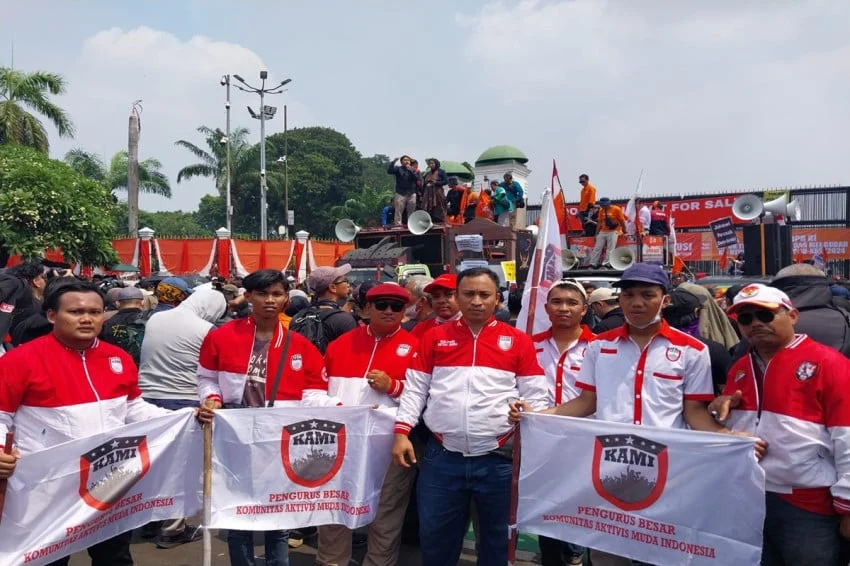
JAKARTA — The Executive Board of the Indonesian Young Activists Community (Pengurus Besar Komunitas Aktivis Muda Indonesia, or PB KAMI) has officially voiced its strong backing for National Police Chief (Kapolri) General Suyudi Ario Seto. The endorsement comes as the Indonesian National Police (Polri) aggressively pursues a high-profile criminal investigation into alleged illegal wiretapping, unauthorized data access, and the malicious deletion of electronic records. The sweeping probe has notably ensnared several high-ranking law enforcement officials, including former National Police Chief General Listyo Sigit Prabowo, who was recently detained just one month after stepping down from his premier post.
The unfolding scandal has sent shockwaves through the country’s political and legal landscape, testing the structural resilience of Southeast Asia’s third-largest democracy and raising critical questions about institutional oversight, intelligence gathering boundaries, and the absolute supremacy of the rule of law within state apparatuses.
Institutional Overhaul and a Defining Moment for Polri
Speaking from Jakarta, PB KAMI General Chairman Sultoni emphasized that the ongoing investigation must serve as a watershed moment for General Suyudi. He urged the current police leadership to leverage this crisis to execute a comprehensive, uncompromising internal cleansing. According to PB KAMI, this is a vital prerequisite to ensure that all active personnel strictly adhere to standard operating procedures, remain anchored to legal boundaries, and operate under a unified, transparent chain of command.
"This is not merely about prosecuting individuals; it is about safeguarding the soul and structural integrity of the Indonesian National Police," Sultoni stated. "We fully appreciate and support the decisive steps taken by the investigative team to name suspects in this complex case involving illegal wiretapping, unauthorized system intrusion, and electronic evidence tampering. The strict enforcement of the law must apply universally to everyone, regardless of their rank, historical stature, or perceived proximity to power. Absolutely no one should be considered above the law."
Civil society groups and legal observers have echoed these sentiments, noting that public trust in law enforcement hinges on how transparently and impartially Polri handles misconduct within its own ranks. For years, critics have argued that internal accountability mechanisms require external pressure and stringent oversight to prevent conflicts of interest. The involvement of a former National Police Chief in criminal proceedings marks an unprecedented chapter in modern Indonesian policing history, underscoring the gravity of the allegations.
Chronology and Escalation of the Investigation
The sequence of events leading to the current crisis began unfolding late last year, culminating in a series of dramatic developments throughout the final quarter of 2026. The initial suspicions arose following internal audits and whistleblowing reports regarding unauthorized surveillance operations targeting key political figures, civil society leaders, and rival internal factions.
By October 2026, specialized investigators within Polri’s internal affairs and criminal investigation divisions began uncovering digital footprints linked to illicit interception equipment and compromised secure communications channels. The investigation quickly mapped out a sophisticated network capable of bypassing standard authorization protocols to execute unlawful wiretaps and subsequently purge digital logs to cover their tracks.
The investigation reached a dramatic turning point in November 2026, roughly a month after General Listyo Sigit Prabowo concluded his tenure as Kapolri. Following a series of exhaustive evidentiary reviews and preliminary interrogations, the investigative team formally designated multiple high-ranking officers as suspects. The swift escalation culminated in the detention of the former top cop, shocking observers who had anticipated a more protracted legal process given the traditional shields protecting high-ranking state officials.

Legal Implications and Statutory Framework
The charges leveled against the suspects involve multiple violations of Indonesian law, primarily under the Electronic Information and Transactions (ITE) Law, alongside provisions of the Criminal Code (KUHP) concerning abuse of authority, unauthorized access to electronic systems, and the intentional destruction of evidence.
Legal experts point out that illegal wiretapping by state actors without proper judicial warrants or statutory mandates constitutes a severe breach of constitutional rights, specifically infringing upon privacy protections guaranteed under the Indonesian Constitution (UUD 1945). Under prevailing regulations, intelligence gathering and surveillance operations are strictly regulated, requiring explicit authorization from designated judicial or institutional bodies to prevent overreach.
The inclusion of electronic data deletion as a primary charge highlights the technical nature of the investigation. Investigators are currently collaborating with cyber forensics experts to recover scrubbed digital trails, metadata, and communication logs that could shed light on the full scope of the conspiracy. The ability of the investigative team to reconstruct these erased files will likely form the cornerstone of the prosecution’s case when the matter reaches the judiciary.
Broader Societal and Political Repercussions
The detention of a former National Police Chief and the active pursuit of high-ranking conspirators carry profound implications for Indonesia’s governance landscape. On one hand, the willingness of current leadership under General Suyudi Ario Seto to prosecute senior figures is being hailed by reformists as a testament to institutional courage and a genuine commitment to accountability. It signals a departure from historical norms where high-level institutional protection often superseded judicial transparency.
Conversely, the scandal exposes deep-seated vulnerabilities within state security agencies regarding the misuse of advanced surveillance technology. In an era where digital infrastructure underpins both governance and personal privacy, the potential weaponization of intelligence tools for factional, political, or personal gains poses a direct threat to democratic stability. International observers and domestic watchdogs are closely monitoring the proceedings to assess whether the investigation will lead to structural reforms in how surveillance technology is procured, monitored, and audited within the police force.
Furthermore, the public reaction has been intensely polarized. While civil society organizations and youth groups like PB KAMI are rallying behind the current leadership to demand total transparency, internal morale within certain segments of the police force faces significant pressure. Managing institutional stability while conducting an unsparing purge of corrupt or rogue elements represents a delicate balancing act for General Suyudi.
Path Forward: Restoring Public Confidence
As the legal process moves toward the preparation of dossiers for court submission, the ultimate success of these measures will be measured by the fairness, openness, and thoroughness of the judicial proceedings. PB KAMI has reiterated its commitment to monitoring the trial phases closely, ensuring that public pressure remains a constructive force for institutional reform rather than a catalyst for political instability.
General Suyudi Ario Seto’s administration has pledged total cooperation with independent oversight bodies, including the National Police Commission (Kompolnas) and the Indonesian Ombudsman, to guarantee that the investigation remains free from external interference. By confronting institutional malpractice head-on, the leadership aims to rebuild public confidence, reinforce the principle of equality before the law, and secure the long-term credibility of the Indonesian National Police as a trusted guardian of public order and constitutional rights.
