
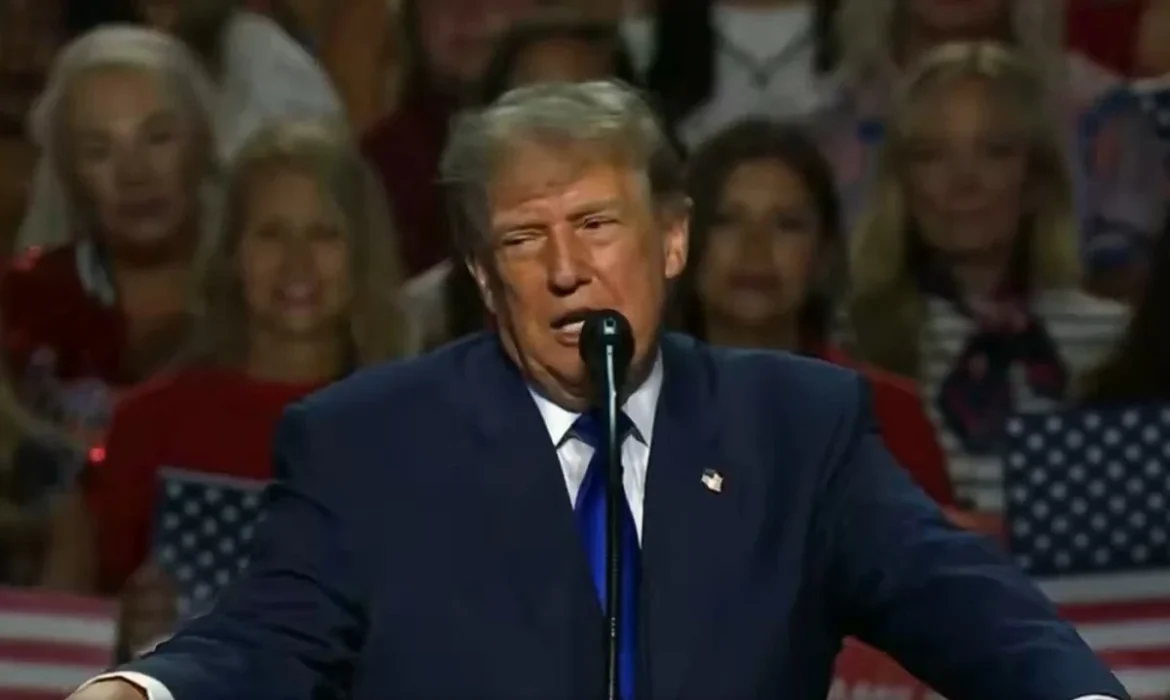
DALLAS — In a high-stakes campaign maneuver that has sent shockwaves through the American political landscape, President Donald Trump has pledged a direct payment of USD5,000 to every adult citizen in the United States. This proposed "Trump Dividend" is contingent upon the Republican Party securing a decisive victory in the upcoming midterm elections, specifically by maintaining control over both the House of Representatives and the Senate.
The announcement came during a keynote address at the Republican Party’s inaugural midterm election convention in Dallas on Wednesday, September 9, 2026. Speaking before a capacity crowd, President Trump framed the policy as a direct redistribution of the economic prosperity he claims his administration has fostered through aggressive trade protectionism, tariff implementation, and foreign investment initiatives.
The Anatomy of the Trump Dividend
The proposal, which would require an unprecedented fiscal outlay exceeding USD1 trillion, was presented by the President as a reward for the electorate’s support. According to the President’s remarks, the funds for this initiative would be drawn from the revenue generated by the administration’s tariff policies and the influx of foreign capital into the U.S. economy.
"If the Republicans win, you win along with us, and you will receive USD5,000," President Trump stated. "It will be known as the Trump Dividend."
A critical component of the proposal is its economic "lock-in" clause: the President explicitly stated that the funds must be spent within the United States. This requirement appears designed to stimulate domestic consumption, effectively recirculating government-provided capital directly back into American retail, services, and manufacturing sectors.
Economic Context and Funding Skepticism
While the President’s base has reacted with enthusiasm, economists and fiscal policy analysts have expressed significant skepticism regarding the feasibility and potential inflationary consequences of the plan.
The administration’s internal projections suggest that annual revenue from tariffs could reach hundreds of billions of dollars. Furthermore, the White House has touted new foreign investment commitments exceeding USD20 trillion as evidence of a burgeoning "Golden Age" for the American economy. However, independent financial analysts note that these figures are often speculative and do not necessarily translate into liquid cash available for federal distribution.
To distribute USD5,000 to every adult in the U.S.—a population numbering roughly 260 million—the total cost would reach approximately USD1.3 trillion. Funding such a program would likely require either significant deficit spending or a radical restructuring of the federal budget, both of which face potential gridlock in a divided Congress.
Strategic Geopolitics: The Venezuela Oil Deal
The announcement in Dallas was underscored by a recent, high-profile diplomatic success: the finalization of an energy agreement with Venezuela. Under the terms of this deal, the United States has secured majority control over more than 65 billion barrels of proven oil reserves.
President Trump utilized this development to illustrate his broader economic strategy. By securing domestic energy independence and leveraging international assets, the administration aims to solidify a revenue stream that supports programs like the proposed dividend. During his speech, the President joked about the ease with which his team navigated the Venezuelan oil negotiations, contrasting his administration’s "transactional" diplomacy with what he characterized as the inefficiencies of previous regimes.
Chronology of the 2026 Midterm Campaign
The road to this announcement has been marked by a concerted effort by the Republican National Committee (RNC) to frame the 2026 midterms as a referendum on the administration’s "America First" economic agenda.
- Early 2026: The administration begins signaling a shift toward more protectionist trade policies, citing a need to bolster domestic supply chains.
- May 2026: Initial reports emerge regarding record-breaking foreign direct investment (FDI) inflows, providing the political capital for the President to contemplate broad-based wealth distribution.
- August 2026: The U.S.-Venezuela energy agreement is formalized, providing the administration with a massive, tangible asset to point toward during the campaign season.
- September 9, 2026: President Trump delivers the keynote in Dallas, officially proposing the "Trump Dividend" to mobilize voters.
Political Implications and Reactions
The proposal has effectively set the terms of the debate for the remaining months of the campaign cycle. For the Republican Party, the dividend serves as a powerful get-out-the-vote tool, appealing to middle- and lower-income voters who have been sensitive to the fluctuations of the post-pandemic economy.
Conversely, the Democratic opposition has been quick to criticize the proposal. Critics label the initiative as a "bribe" and a desperate attempt to ignore the long-term structural risks of increased deficit spending. Opposition lawmakers argue that the plan would exacerbate inflation, potentially nullifying the purchasing power of the USD5,000 payout.
"This is not economic policy; it is a campaign tactic designed to manipulate the electorate," said a senior member of the Senate Budget Committee, who requested anonymity. "The government does not have a trillion dollars in surplus waiting to be handed out. This would be funded by printing more money or borrowing from future generations."
Analytical Outlook: Can the Dividend Work?
From an economic standpoint, the "Trump Dividend" represents a radical departure from traditional fiscal conservatism, which usually emphasizes tax cuts or infrastructure spending over direct cash transfers. However, it aligns with a growing global trend toward populist economic policies.
If implemented, the stimulus could theoretically provide a short-term boost to Gross Domestic Product (GDP). By mandating that the funds be spent within the U.S., the policy intends to create a multiplier effect, boosting retail sales and supporting small businesses. However, the risk remains that such a sudden injection of cash into the consumer market could lead to a spike in the Consumer Price Index (CPI), potentially forcing the Federal Reserve to maintain high interest rates.
Furthermore, the legality of such a disbursement remains an open question. Under current law, the executive branch has limited authority to distribute federal funds directly to individuals without congressional appropriation. Should the Republicans win, they would still need to pass legislation through both the House and the Senate to authorize the expenditure.
The Road Ahead
As the nation moves toward the November election, the "Trump Dividend" will likely remain the central point of contention. The President’s ability to frame the economy as a successful enterprise—bolstered by energy deals and trade revenues—contrasts sharply with the concerns of fiscal hawks who worry about the sustainability of such expansive promises.
For the American voter, the choice in November is becoming increasingly clear. One side offers a direct financial incentive tied to the current administration’s economic vision, while the other side warns of the long-term fiscal stability of the nation. As the Dallas convention concluded, the message from the podium was unequivocal: the midterm election is not merely a vote for legislative control, but a vote for the potential receipt of a significant federal payout.
Whether this move will pay off at the ballot box remains to be seen. What is certain is that the 2026 election cycle has been permanently altered, with the stakes elevated to a level that transcends traditional partisan policy debates, turning the ballot box into a mechanism for direct economic redistribution. All eyes are now on the upcoming debates and the subsequent release of the Republican party’s detailed fiscal roadmap, which will need to address how a USD1 trillion-plus program can be realized without destabilizing the broader financial system.
