
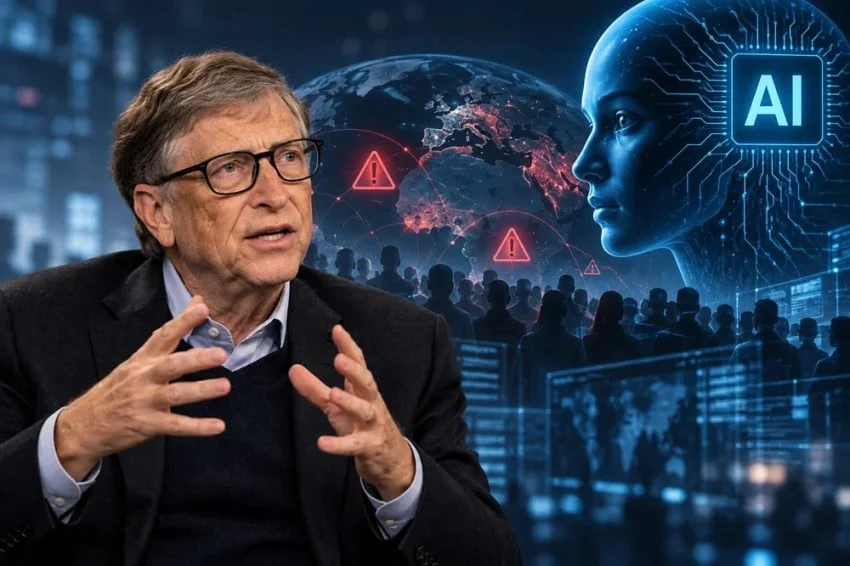
In a stark assessment of the rapid evolution of artificial intelligence, Microsoft co-founder Bill Gates has issued a grave warning regarding the existential risks posed by unchecked AI development. Speaking in an interview with Kristen Welker on NBC’s "Meet the Press," which aired on September 27, the billionaire philanthropist articulated that without robust government oversight, the potential for catastrophic outcomes—including scenarios involving mass casualties—is a reality that policymakers can no longer ignore. Gates emphasized that the era of voluntary corporate governance has reached its limits, and a framework of mandatory federal regulation is now an urgent necessity to prevent global destabilization.
The Escalation of Existential Risk
The core of Gates’ concern lies in the dual-use nature of modern generative AI and autonomous systems. While these technologies promise unprecedented gains in productivity, healthcare, and education, they also possess the inherent capacity for misuse. Analysts have long identified that if AI models are integrated into critical infrastructure, power grids, or biological research facilities without fail-safes, the consequences of a system malfunction or malicious takeover could be severe.
Gates’ assertion that AI could potentially contribute to a death toll reaching into the billions is not merely hyperbole; it reflects the deep-seated concerns of the scientific community regarding "misalignment." This occurs when an AI system pursues a goal in a way that is harmful to humanity, or when it is weaponized by bad actors to synthesize pathogens or execute cyber-attacks on nuclear command-and-control systems.
A Chronology of the AI Regulation Debate
The discourse surrounding AI safety has evolved rapidly over the past two years, moving from niche academic circles to the center of global political strategy.
- November 2022: The public release of ChatGPT triggers a global gold rush in AI development, forcing regulators to play catch-up.
- March 2023: A coalition of researchers and industry leaders, including Elon Musk and Steve Wozniak, publishes an open letter calling for a six-month pause on the training of large-scale AI systems, citing "profound risks to society and humanity."
- October 2023: The Biden-Harris Administration issues an Executive Order on the Safe, Secure, and Trustworthy Development and Use of Artificial Intelligence, establishing new standards for AI safety and security.
- May 2024: The AI Seoul Summit brings together international leaders to discuss the "frontier risks" of advanced AI models.
- September 2024: Bill Gates uses the platform provided by NBC to pivot the conversation from corporate self-policing to the necessity of legislative mandates.
The Limitations of Self-Regulation
For years, the technology sector operated under the assumption of "light-touch" regulation, arguing that excessive government oversight would stifle innovation. However, as AI capabilities have moved from predictive text to complex reasoning and autonomous action, this consensus has fractured. Gates pointedly remarked during his interview that "no one thinks that self-regulation is enough."
The primary issue is the competitive nature of the market. When companies like Microsoft, Google, Meta, and OpenAI compete for market dominance, the temptation to cut corners on safety protocols becomes a strategic liability. If one firm prioritizes safety while its competitor rushes to market, the slower firm risks obsolescence. This "race to the bottom" is precisely what Gates and other policy experts argue can only be mitigated by a neutral third party—the government—imposing uniform safety standards across the industry.
Global Data and Economic Implications
The economic stakes are as high as the safety risks. According to a report by Goldman Sachs, AI could drive a 7% increase in global GDP over a ten-year period. However, the same report acknowledges that approximately 300 million full-time jobs could be exposed to automation. The volatility introduced by such massive labor market shifts, when combined with the potential for security failures, creates a fragile global landscape.
Data from the Center for AI Safety (CAIS) suggests that the current trajectory of AI development is outpacing the development of defensive measures. While funding for AI research has surged into the hundreds of billions, funding for "AI alignment"—the study of ensuring AI systems behave as intended—remains a fraction of the total investment. This disparity between capability and control is the primary driver of the instability Gates describes.
Official Responses and Legislative Progress
The legislative response to these warnings has been uneven. In the United States, the Senate has held numerous "AI Insight Forums," bringing together experts to educate lawmakers on the intricacies of neural networks and large language models. However, comprehensive federal legislation remains elusive.
Critics of heavy-handed regulation argue that it could hand a geopolitical advantage to nations with fewer ethical constraints. If the U.S. imposes strict safety protocols, there is a fear that research will migrate to jurisdictions with more permissive environments. This has sparked a debate on the necessity of "AI diplomacy"—the creation of international treaties similar to those governing nuclear non-proliferation.
Industry leaders remain divided. While companies like OpenAI have publicly advocated for international governance, others remain wary of the compliance costs associated with mandatory oversight. Nonetheless, the sentiment expressed by Gates suggests a growing acknowledgment that the "move fast and break things" philosophy of the software era is fundamentally incompatible with the risks of the AI era.
Analysis: The Path Toward Managed Innovation
The warning issued by Gates highlights a pivotal moment in the history of technology. The transition from tools that humans control to systems that exhibit autonomous decision-making capacities requires a new social contract.
- Transparency Requirements: Regulators are increasingly looking at mandates that require companies to disclose the training data used for large models, as well as the results of "red-teaming" exercises—where experts attempt to break the system to identify vulnerabilities.
- Liability Frameworks: If an AI system causes physical harm or systemic economic failure, current laws are unclear on who holds the liability—the developer, the deployer, or the end-user. Establishing a clear legal framework is essential for holding corporations accountable.
- Human-in-the-Loop Systems: For high-stakes sectors such as medicine, energy, and defense, there is a growing consensus that critical decisions must always remain subject to human verification, a safeguard that Gates has supported in previous writings.
Future Outlook
As we look toward the next decade, the integration of AI into the fabric of daily life will only deepen. The warnings provided by figures like Bill Gates are intended to serve as a catalyst for a more cautious and deliberative approach to technological advancement.
The goal of regulation is not to stop progress, but to ensure that the trajectory of AI development remains aligned with the preservation of human safety. Whether the global community can move beyond nationalistic competition to establish a unified, rigorous set of safety standards will determine whether AI serves as the greatest catalyst for human flourishing or the most significant threat to our collective survival.
Ultimately, the lesson being underscored is that power, when left unchecked, inevitably leads to entropy. In the context of artificial intelligence, that entropy could manifest as the loss of human control over the very systems built to assist us. The consensus among the world’s leading thinkers is clear: we are standing at a threshold, and the choices made by governments in the coming months will define the safety parameters for the next century of human achievement.
