
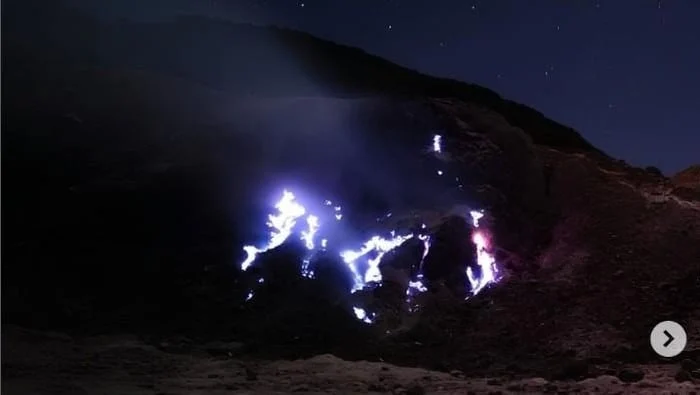
The emergence of a rare blue fire phenomenon at Kawah Manuk on Mount Papandayan in Garut, West Java, has captured public fascination while simultaneously triggering urgent safety alerts from disaster management experts. Documented between September 23 and September 24, 2026, the striking visual display instantly drew widespread comparisons to the world-famous blue flames of Mount Ijen in East Java. While the luminous cobalt hue has naturally attracted the attention of hikers, photographers, and nature enthusiasts, leading authorities and disaster mitigation experts have issued strict warnings regarding the severe hidden dangers of the volcanic environment. The occurrence of this phenomenon outside its traditional East Java habitat highlights the dynamic and unpredictable nature of Indonesia’s active volcanic systems, emphasizing that aesthetic natural wonders often mask hazardous geological realities.
Chronology of the Discovery and Public Reaction
The sequence of events leading to the public awareness of the phenomenon began in the late evening hours of September 23, 2026, when local guides and overnight campers in the Kawah Manuk area of Mount Papandayan first noticed unusual electric-blue flames flickering near the fumaroles. The glowing phenomenon persisted through the early hours of September 24, prompting observers to capture photographs and video recordings that subsequently circulated widely across social media platforms.
By September 25, the digital dissemination of the blue fire imagery had sparked considerable curiosity among domestic travelers and mountaineering communities. Many mistook the occurrence for a new tourist attraction, prompting plans for weekend excursions to capture the visual spectacle firsthand. Recognizing the potential hazard of an influx of unprepared tourists rushing to the high-altitude sulfur vents, disaster mitigation organizations and geological experts mobilized quickly. On September 27, 2026, formal statements were issued to temper the public excitement with scientific clarity, urging citizens to prioritize personal safety over capturing viral media content in a potentially toxic and volatile environment.
Scientific Explanation: Unveiling the Physics of Blue Fire
To understand the gravity of the expert warnings, it is essential to examine the scientific mechanics behind the blue fire phenomenon. Contrary to popular misconceptions, the phenomenon is not composed of flowing blue lava, nor is it a sign of an impending catastrophic eruption. Instead, the visual spectacle is the result of high-temperature sulfur combustion.
The process begins deep within the geothermal system of the volcano, where subterranean gases and sulfur-rich materials accumulate under intense heat and pressure. These gases escape through structural fractures, vents, and fumaroles situated on the crater floor. When the sulfur-rich gas encounters atmospheric oxygen at temperatures frequently exceeding 360 degrees Celsius (680 degrees Fahrenheit), it spontaneously ignites, producing a vibrant, glowing blue flame. Because these flames are often difficult to perceive during daylight hours, they typically manifest most vividly in the pitch darkness of night, creating an eerie yet mesmerizing optical effect.
Expert Analysis and Safety Warnings from IABI
Addressing the public enthusiasm, Daryono, a prominent member of the Indonesian Disaster Experts Association (IABI), stepped forward to provide a rigorous safety briefing and geological contextualization. In an official written statement released on Sunday, September 27, 2026, Daryono underscored that while the phenomenon is visually captivating, it serves as a direct indicator of a hazardous volcanic environment.
"The blue fire phenomenon recently observed at Kawah Manuk on Mount Papandayan has naturally drawn significant public attention," Daryono stated. "While a similar phenomenon is most famously associated with Kawah Ijen in East Java, beneath its aesthetic exterior lies an urgent safety message. The appearance of blue fire indicates that observers are standing within an active volcanic zone characterized by the presence of hazardous, superheated gases."
Daryono elaborated on the chemical implications of the occurrence, clarifying the distinction between routine hydrothermal degassing and actual magmatic unrest. "The emergence of blue fire does not automatically imply that the volcano is on the verge of erupting," he explained. "Rather, the phenomenon primarily demonstrates continuous degassing—the release of hot underground gases—alongside active fumarolic and hydrothermal system processes."
Despite diffusing panic regarding an immediate eruption, Daryono cautioned that volcanic systems require continuous, multi-parameter observation. He emphasized that determining an escalation in a volcano’s alert level cannot rely on visual anomalies alone. Instead, volcanologists must comprehensively evaluate seismic data, ground deformation measurements, temperature fluctuations, and shifts in gas composition and flux before drawing conclusions about volcanic stability.
Geological Background and Context of Mount Papandayan
Mount Papandayan is one of West Java’s most iconic and historically active stratovolcanoes, situated in Garut Regency. Renowned for its complex crater system—which includes Kawah Mas, Kawah Baru, Kawah Nangklak, and Kawah Manuk—the mountain has a well-documented history of geothermal and phreatic activity. The presence of numerous solfataras and fumaroles makes it a rich site for geothermal research, tourism, and historical mountaineering expeditions.
The mountain’s structural makeup is prone to hydrothermal alterations, meaning that the rocks and soils surrounding the vents are heavily weathered by acidic gases and boiling water. This delicate structural integrity, combined with the emission of toxic gases such as sulfur dioxide (SO2) and hydrogen sulfide (H2S), creates a treacherous environment for unprotected human presence. Historical records show that Mount Papandayan has experienced significant eruptive cycles, most notably its catastrophic 1772 eruption, which destroyed dozens of villages and caused massive debris avalanches, as well as minor explosive episodes in more recent decades.
The recent sighting at Kawah Manuk underscores the ongoing subterranean vitality of the Papandayan complex, proving that despite periods of relative surface dormancy, the internal plumbing system of the volcano remains exceptionally active.
Implications for Volcano Tourism and Public Safety
The viral spread of the Mount Papandayan blue fire imagery highlights a broader contemporary challenge in disaster management: the gamification and aestheticization of hazardous natural phenomena. In the era of social media, striking geological spectacles—such as lava flows, glowing fumaroles, and ash plumes—frequently translate into digital engagement, inadvertently incentivizing travelers to bypass safety perimeters in pursuit of unique content.
Volcanologists and park rangers have long battled the impulse of tourists to get closer to danger zones. In the case of sulfur-fueled blue flames, the risks are immediate and severe. Inhaling high concentrations of sulfur dioxide can cause acute respiratory distress, pulmonary edema, chemical burns to the upper respiratory tract, and, in severe cases, rapid asphyxiation and death. Furthermore, the terrain surrounding active fumaroles at Kawah Manuk is notoriously unstable. Thin crusts over boiling mud pits, hidden thermal voids, and treacherous footing present severe physical hazards that can lead to catastrophic falls or severe thermal burns.
Consequently, regional disaster management authorities and conservation agencies are reevaluating monitoring protocols around the crater. While formal climbing routes on Mount Papandayan have faced intermittent closures in the past due to events such as seasonal forest fires—including a notable closure following a major fire incident in late 2023—authorities are now emphasizing the need for enhanced patrols around active thermal zones to prevent unauthorized night hikes aimed at viewing the blue fire.
Broader Impact on Disaster Literacy in Indonesia
As an island nation situated along the volatile Pacific Ring of Fire, Indonesia hosts over 120 active volcanoes. Managing the coexistence of millions of residents and a thriving domestic tourism industry alongside these geological hazards requires high levels of community disaster literacy.
The Kawah Manuk incident serves as a critical case study for science communication in the digital age. Experts note that public fascination with phenomena like blue fire should be channeled into educational opportunities rather than restricted through uncommunicated prohibitions. By explaining the exact chemical processes behind the flames—demystifying the illusion of magical blue lava and replacing it with the sobering reality of toxic sulfur gas and extreme heat—scientists can foster a culture of informed respect for nature.
Moving forward, geological agencies and local governments are expected to bolster educational campaigns targeting outdoor recreation groups, tour guides, and social media influencers. Emphasizing that volcanic craters are dynamic industrial-scale chemical laboratories driven by immense terrestrial forces is vital to preventing preventable injuries and fatalities.
Conclusion: Balancing Wonder with Caution
The sighting of blue fire at Kawah Manuk, Gunung Papandayan, on September 23–24, 2026, is a powerful reminder of the restless power beneath Indonesia’s landscapes. While the glowing sulfur flames offer a breathtaking spectacle that enriches our appreciation of the planet’s geothermal complexity, they demand a balanced response rooted in rigorous scientific interpretation and strict adherence to safety protocols. As experts like Daryono have firmly asserted, the blue light is not an invitation to adventure, but a vivid caution from the depths of the earth—a reminder that nature’s greatest beauties often demand the greatest distance.
