
JAKARTA — In what is arguably one of the most explosive national security and law enforcement scandals in modern Indonesian history, the Indonesian National Police’s Criminal Investigation Agency (Bareskrim Polri) has officially named three high-ranking police officers as suspects in a sprawling criminal case involving illegal wiretapping, the malicious deletion of electronic data, and unauthorized access to electronic systems. The announcement sent shockwaves through political and legal circles across the archipelago, fundamentally challenging public trust in the country’s highest-tier security apparatus.
The core of the investigation centers on allegations that top-tier security officials abused their extensive systemic privileges to orchestrate a widespread surveillance operation. Among the three prominent suspects is a former Chief of the Indonesian National Police (Kapolri) who currently holds the powerful and influential position of Chief of Staff to the President, Listyo Sigit Prabowo (LSP). Alongside him, Bareskrim Polri has implicated two other active high-ranking police generals: the Head of the Legal Division of the National Police (Kadivkum Polri), Inspector General Ahrie Sonta (ASN), and Inspector General Eko Hadi Santoso (EH).
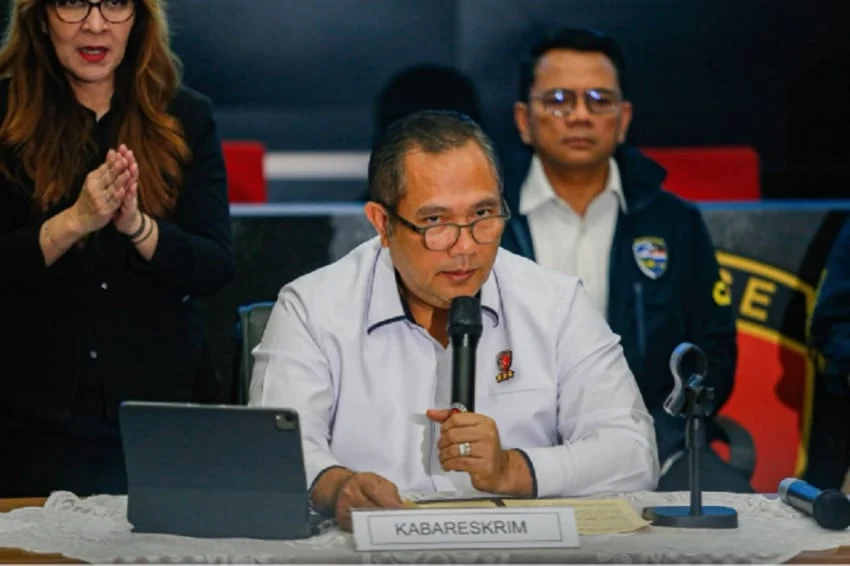
The revelations were formally made public by the Director of Bareskrim Polri, Commissioner General (Komjen) Asep Safrudin, during a high-stakes press conference held at the National Police Headquarters (Mabes Polri) in Jakarta on Tuesday, November 3, 2026. Flanked by senior investigators, Komjen Asep outlined the gravity of the accusations, detailing how a systematic abuse of power had allegedly compromised the privacy and security of Indonesia’s highest-ranking executive, government ministers, prominent political figures, journalists, mass organization leaders, non-governmental organizations (NGOs), and elite business leaders.
The Anatomy of a High-Level Surveillance Operation
According to official statements delivered by Komjen Asep Safrudin, the scope of the illegal wiretapping operation was breathtaking in its breadth and audacity. Investigators revealed that the targeted individuals whose private communications were systematically intercepted included President Prabowo Subianto himself, alongside numerous key state officials, legislative figures, influential political actors, major media outlets, civil society groups, and prominent corporate executives.
The modus operandi uncovered by Bareskrim’s cyber and criminal investigation teams indicates a deliberate, calculated subversion of institutional protocols. Throughout 2025 and 2026, the suspects allegedly issued internal commands to execute wiretapping operations completely devoid of the mandatory legal frameworks. Specifically, investigators found no formal request letters from authorized investigators and no accompanying Police Reports (Laporan Polisi) that would typically legitimize such intrusive measures under Indonesian law. Furthermore, these intercepted communications bore zero relevance to legitimate law enforcement operations, counter-terrorism efforts, or national security imperatives.
To compound the criminality of the acts, the perpetrators allegedly engaged in a systematic cover-up. In October 2026, as internal scrutiny began to tighten and independent digital forensics pointed toward systemic anomalies, the suspects reportedly executed a series of digital purges. They deliberately wiped system logs, destroyed electronic footprints, and erased server data in a desperate bid to obliterate evidence of the unauthorized interceptions before digital forensic experts could secure the network infrastructure.
Scientific Crime Investigation and Chronology of the Probe
The unraveling of this high-level conspiracy was not the result of a sudden whistleblower tip, but rather the product of meticulous, methodical police work driven by advanced scientific crime investigation (SCI) methodologies. Bareskrim Polri launched a discreet internal inquiry months prior, prompted by anomalies detected in secure telecommunication channels and reports of unverified data leaks circulating among elite political circles.
By leveraging advanced digital forensics, metadata analysis, and strict chain-of-custody protocols for electronic evidence, investigators mapped out the digital pathways utilized during the illicit surveillance operations. The inquiry established a clear timeline spanning nearly two years, identifying the precise windows during which unauthorized monitoring tools were deployed, exploited, and ultimately scrubbed of their operational logs.
During Tuesday’s briefing, Komjen Asep Safrudin emphasized that the investigation remains fluid and active. While three high-ranking officials have formally transitioned to suspect status, law enforcement agencies are continuing to cast a wider net to determine the full extent of the conspiracy. Notably, investigators disclosed that at least one other high-profile individual, identified by the initial SU, is currently undergoing intensive examination in the capacity of a witness. Authorities have not ruled out the possibility of additional suspects emerging as forensic audits of the seized hardware continue.
Legal Framework and Severe Penalties Faced by the Accused
The severity of the charges reflects the profound implications of the alleged crimes. Bareskrim Polri has applied a robust combination of statutory provisions derived from Indonesia’s updated legal codes to ensure that the accused face accountability commensurate with the gravity of their actions.
The primary charge leveled against Listyo Sigit Prabowo, Ahrie Sonta, and Eko Hadi Santoso is rooted in Article 258 of Law Number 1 of 2023 concerning the Criminal Code (KUHP). This specific provision criminalizes acts committed in an unlawful manner that involve listening to, recording, deflecting, altering, obstructing, and/or logging transmissions of electronic information that are not of a public nature. The legislature designed this statute to protect the sanctity of private communications and secure digital infrastructure from predatory state or private overreach.
In addition to the primary charge under the new Criminal Code, investigators have invoked supplementary provisions addressing digital tampering and unauthorized entry into computer systems. Specifically, the trio faces prosecution under Article 332, paragraph (1) or paragraph (2), of Law Number 1 of 2023, which explicitly penalizes individuals who intentionally and without legal right access computers or electronic systems belonging to other parties.
When detailing the potential consequences during the press briefing, Komjen Asep Safrudin underscored the severe legal jeopardy confronting the suspects. Under the statutory framework of the applied laws, conviction on the primary wiretapping and interception charges carries a maximum penal sentence of up to 10 years of imprisonment. This stiff penalty underscores the legislative intent to treat digital espionage and the compromise of state communications as severe threats to institutional stability.
National Reactions and the Broader Implications for Indonesian Democracy
The formal designation of a former National Police Chief and sitting presidential aide as a criminal suspect in an illegal wiretapping operation has ignited an unprecedented political firestorm in Jakarta. Constitutional and legal experts, civil liberties advocates, and political analysts have been quick to weigh in on the systemic repercussions of the scandal.
Prominent constitutional law expert and former Coordinating Minister for Legal, Human Rights, and Security, Yusril Ihza Mahendra, captured the gravity of the national sentiment when addressing the emerging scandal. In early reactions circulated across national media, Yusril characterized the illicit wiretapping of a sitting head of state and key government officials as an extraordinary breach of national security, describing it bluntly as "a serious problem for a country." Analysts point out that when the top echelons of the police force—the very institution tasked with upholding the law—are implicated in subverting the rule of law for unauthorized surveillance, it creates a profound crisis of institutional legitimacy.
The involvement of Listyo Sigit Prabowo, given his towering dual pedigree as a former Kapolri and a vital member of the current presidential administration under Chief of Staff duties, introduces delicate political complexities. Observers note that while the swift and public action taken by Bareskrim Polri demonstrates a commendable degree of institutional independence and a willingness to police its own ranks regardless of rank or past authority, it simultaneously exposes vulnerable fault lines within the state apparatus.
Furthermore, the targeting of a broad spectrum of society—ranging from the executive branch and political opposition to journalists, civil society organizations, and corporate leaders—suggests that the motivations behind the surveillance may extend far beyond routine law enforcement or intelligence gathering. Speculation abounds regarding whether the collected data was weaponized for political leverage, extortion, or corporate espionage, questions that will undoubtedly form the focal point of the judicial proceedings to come.
Path Forward and Judicial Accountability
As the case transitions from the investigative phase toward the preparation of prosecution dossiers, public attention remains intensely focused on the transparency and integrity of Bareskrim Polri’s ongoing procedures. The legal teams representing the accused have yet to issue comprehensive formal rebuttals, though legal analysts anticipate vigorous challenges regarding the interpretation of statutory provisions under the new Criminal Code and the admissibility of the digital evidence gathered through scientific crime investigation methods.
For President Prabowo Subianto’s administration, the scandal presents both a profound challenge and a defining test of governance. The unfolding legal battle will test the resilience of Indonesia’s democratic institutions, the independence of its judiciary, and the unwavering enforcement of the principle that no individual—regardless of historical rank, police background, or proximity to executive power—stands above the law. As the courts prepare to handle what promises to be the trial of the decade, the nation watches closely to see how the scales of justice will balance in the face of elite criminality and digital-age espionage.
