
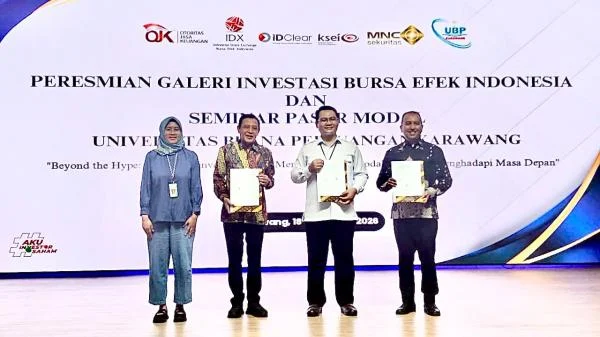
The landscape of Indonesia’s capital market reached another significant milestone on Wednesday, November 18, 2026, as MNC Sekuritas, in strategic collaboration with the Indonesia Stock Exchange (BEI) and Universitas Buana Perjuangan (UBP) Karawang, officially inaugurated the Bursa Efek Indonesia Investment Gallery (GI BEI) at the university’s campus in Karawang, West Java. This landmark launch marks a critical step forward in bridging the gap between academic theory and practical financial application for students and the wider community in the region.
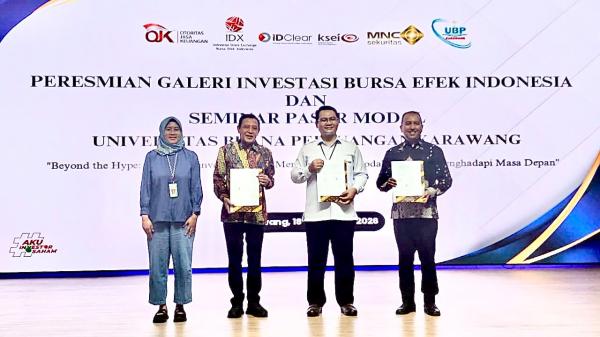
The inauguration ceremony was formally marked by a ribbon-cutting procession. Key figures leading the ribbon-cutting included Nova Almaida, Assistant Manager of Conduct Supervision for PUJK (Financial Services Business Actors), Education, and Consumer Protection at the Financial Services Authority (OJK) Regional Office for West Java; Dedy Priadi, Vice Director of Market Development at the Indonesia Stock Exchange; Budi Rismayadi, Rector of UBP Karawang; and Luqman El Hakiem, Head of Retail Distribution and Business Development at MNC Sekuritas.
The establishment of this new investment gallery underscores a concerted effort by regulatory bodies, financial institutions, and academic centers to foster a robust culture of smart investing among the younger demographic, turning campuses into incubators for future financial leaders and investors.
Fostering Smart Investment in a Dynamic Financial Era
During his keynote address at the inauguration ceremony, UBP Karawang Rector Budi Rismayadi emphasized that the modern financial and investment ecosystem is characterized by unprecedented dynamism. The rapid evolution of digital technology has dramatically simplified the process for the general public, particularly tech-savvy members of the younger generation, to access a diverse array of financial instruments available within the capital market.
However, Rector Rismayadi cautioned that accessibility should not outpace financial literacy. He noted that investing must be treated as a disciplined, analytical discipline rather than a speculative hobby.
"Investment is not merely about following trends, chasing short-term profits, or simply monitoring daily stock price movements," Budi stated. "Investment requires mature consideration, a deep understanding of risk management, and the capability to analyze financial information objectively. We expect this Investment Gallery to function not only as an academic support facility but also as a comprehensive center for education and capital market information for students, faculty members, and the broader community."
His sentiments reflect a growing concern among educational and financial institutions regarding the rise of speculative retail trading among youths driven by social media trends. By anchoring financial education within an academic institution like UBP Karawang, stakeholders aim to cultivate prudent, long-term investors who understand fundamental and technical analysis.
Strengthening Capital Market Inclusion and Literacy
Speaking on behalf of MNC Sekuritas, Head of Retail Distribution and Business Development Luqman El Hakiem highlighted that the opening of GI BEI at UBP Karawang is a direct manifestation of the company’s ongoing commitment to expanding financial literacy and inclusion across Indonesia. Furthermore, this initiative serves to reinforce the active participation of the younger generation in the national capital market.
MNC Sekuritas has consistently prioritized educational initiatives. Just a day prior to this inauguration, the securities firm was recognized for its relentless educational campaigns, securing second place as the "Investor Growth and Education Champions" at the Investor Protection and Market (IPM) Awards 2026. This accolade underscores the firm’s operational focus on sustainable investor growth through structured education rather than purely transactional acquisition.
By partnering with universities, MNC Sekuritas aims to demystify capital market products—such as equities, mutual funds, and fixed-income securities—while introducing advanced financial concepts early in a student’s academic journey. Previous collaborations, such as recent public lectures on private equity hosted alongside Universitas Bunda Mulia, demonstrate the brokerage’s versatile educational framework tailored to higher-education standards.
Background and Context: The Rise of Academic Investment Galleries
The establishment of Bursa Efek Indonesia Investment Galleries across universities in Indonesia is part of a long-term national strategy spearheaded by the IDX to democratize financial knowledge. Historically, the Indonesian capital market was dominated by institutional investors and high-net-worth individuals residing in major metropolitan areas like Jakarta and Surabaya.
However, over the past decade, financial authorities have recognized that geographical decentralization and demographic shifts—particularly the demographic dividend featuring a massive population of productive-age citizens—require proactive educational outreach. Regional hubs like Karawang, which serves as a major industrial and economic engine in West Java, represent prime territories for cultivating retail investor growth.
An Investment Gallery acts as a hybrid space: it provides real-time market data terminals, simulated trading platforms, and physical reference libraries where students can bridge classroom economic theories with live market dynamics. Under the guidance of trained faculty members and securities professionals, students gain hands-on experience in portfolio management, corporate governance evaluation, and economic indicator interpretation.
The Role of Regulators in Safeguarding Retail Investors
The presence of Nova Almaida, representing the OJK Regional Office for West Java, at the inauguration highlights the critical regulatory oversight required in expanding financial access. As retail participation surges—spurred by user-friendly mobile trading applications—the OJK has intensified its focus on consumer protection, anti-fraud education, and digital financial literacy.
Regulators have noted an increase in illegal investment schemes and unregulated trading platforms targeting young, inexperienced individuals seeking quick returns. By establishing official, regulated educational outposts like the GI BEI at UBP Karawang, authorities provide students with a secure, verified gateway to legal financial markets, steering them away from high-risk, unregulated alternatives.
Broader Implications and Future Outlook for the Indonesian Capital Market
The opening of the GI BEI at UBP Karawang carries several profound implications for the local and national economy:
- Democratization of Wealth Creation: By introducing students to capital markets early, the initiative equips future workforce entrants with tools for wealth preservation and long-term financial planning, ultimately reducing reliance on conventional, low-yield savings products.
- Support for Market Liquidity: Increased participation from an educated retail base contributes to the overall depth, liquidity, and resilience of the Indonesia Stock Exchange, helping cushion the market against sudden external shocks driven solely by foreign capital outflows.
- Regional Economic Empowerment: Equipping the academic community in Karawang—a region heavily defined by manufacturing and industrial sectors—with financial market knowledge helps integrate industrial workers and local entrepreneurs into the broader national financial grid.
- Elevated Industry Standards through Collaboration: The synergistic model combining the regulatory insight of the OJK, the market infrastructure of the IDX, the institutional backing of MNC Sekuritas, and the academic reach of UBP Karawang creates a blueprint for sustainable financial literacy campaigns nationwide.
As the newly inaugurated Galeri Investasi BEI officially opens its doors to the academic community and the public, it stands as a testament to the collaborative future of Indonesia’s financial sector. With ongoing support from institutions dedicated to investor education, the next generation of Indonesian investors is better positioned to navigate market complexities with confidence, prudence, and analytical rigor.
