
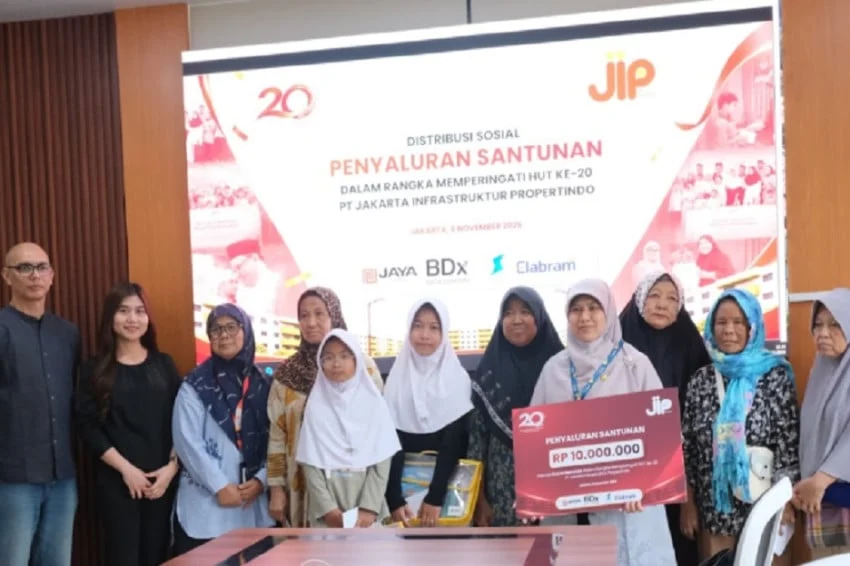
Marking a significant milestone in its corporate journey, PT Jakarta Infrastruktur Propertindo (JIP), a prominent subsidiary of the Jakarta-owned developer PT Jakarta Propertindo (JakPro), celebrated its 20th anniversary by demonstrating a deep commitment to corporate social responsibility. In an initiative designed to give back to the urban communities that form the backbone of Jakarta, the company distributed essential aid to 100 beneficiaries residing in Unit Pengelola Rumah Susun (UPRS) II at Marunda Low-Cost Apartment (Rusun Marunda) in North Jakarta. The commemorative outreach, which took place on November 6, 2026, reflects the corporation’s evolving ethos: balancing aggressive infrastructure development and telecommunication solutions with tangible social welfare contributions for underprivileged urban residents.
The choice of Rusun Marunda as the focal point for this anniversary initiative is deeply symbolic. As one of the largest public housing complexes managed by the Jakarta Provincial Government, Marunda houses thousands of families navigating the complexities of urban economic transitions. By targeting 100 specific beneficiaries—ranging from elderly residents and low-income households to single-parent families—JIP aimed to alleviate immediate daily living burdens while simultaneously fostering a sense of community solidarity. The aid distribution event was marked by warmth and mutual appreciation, serving as a reminder that corporate longevity must be measured not only by financial metrics and asset optimization, but also by the positive footprint left on society.
Two Decades of Urban Evolution and Strategic Growth
To fully comprehend the significance of JIP’s twentieth anniversary, one must examine the transformative trajectory of the company over the past twenty years. Established during a period when Jakarta was rapidly accelerating its modernization efforts, JIP was mandated to spearhead infrastructure and telecommunication support systems essential for a burgeoning global megacity. Over the last two decades, the company has navigated numerous economic shifts, regulatory evolutions, and technological revolutions.
From its early days as a localized infrastructure provider, JIP has systematically expanded its portfolio. Today, the corporation plays a pivotal role in optimizing regional assets owned by the Jakarta Provincial Government. Through strategic initiatives—such as collaborations to eliminate telecommunication blank spots, deploy robust fiber optic networks, and enhance digital connectivity across public spaces—JIP has positioned itself at the epicenter of Jakarta’s smart city transformation. The company’s twentieth anniversary is not merely a celebration of time passed, but a testament to its resilience, adaptability, and enduring relevance in a highly competitive digital and infrastructural landscape.
Leadership Perspectives on Corporate Philosophy and Social Responsibility
Addressing the milestones achieved during the past twenty years, PT Jakarta Infrastruktur Propertindo President Director Nur Iswan emphasized that the company’s longevity is inextricably linked to collaboration, adaptability, and stakeholder trust. In his official remarks surrounding the anniversary, Iswan noted that the journey of the past two decades has been shaped by diverse challenges, major corporate achievements, and strategic partnerships that have collectively defined JIP’s corporate identity.
"The commemoration of our company’s twentieth anniversary serves as a crucial momentum to strengthen our strategic steps moving forward," stated Nur Iswan. He further elaborated that JIP is firmly committed to ensuring that future business growth runs parallel with sustainable social value generation. According to Iswan, commercial success in the modern era cannot be decoupled from community empowerment. By aligning corporate expansion strategies with localized philanthropic actions, JIP aims to cultivate an ecosystem where technological modernization and grassroots welfare support reinforce one another. This philosophy underscores why the leadership chose direct community engagement at Rusun Marunda as a core component of their anniversary celebrations, rather than relying solely on internal corporate galas.
Addressing Urban Vulnerability at Rusun Marunda
The socioeconomic conditions within public housing complexes like Rusun Marunda present unique challenges that require collaborative intervention from both government bodies and corporate entities. Many residents in UPRS II face economic vulnerabilities stemming from informal employment sectors, limited access to capital, and the high cost of urban living. Consequently, targeted corporate social responsibility (CSR) programs play an instrumental role in bridging resource gaps and providing short-term relief to vulnerable families.
The assistance delivered by JIP to the 100 beneficiaries in Rusun Marunda was carefully curated to address immediate household needs. Representatives from JIP, alongside local estate management personnel, coordinated the distribution to ensure that the aid reached the most deserving candidates transparently and efficiently. Beyond the material provisions, the presence of JIP’s executive leadership at the housing complex signaled to the residents that they remain an integral part of Jakarta’s broader developmental narrative. For marginalized communities who often feel disconnected from the glossy skyscrapers and digital infrastructure characterizing modern Jakarta, such corporate outreach bridges the psychological divide between the city’s commercial core and its residential peripheries.
The Broader Implications of Infrastructure-Led Social Initiatives
JIP’s dual focus on high-tech infrastructure development and grassroots social welfare points toward a broader trend in contemporary corporate governance: the convergence of Environmental, Social, and Governance (ESG) principles within state-owned and regional government-owned enterprises (BUMD). In recent years, stakeholders—ranging from the Jakarta Provincial Government to individual investors and end-users—have increasingly demanded that regional enterprises demonstrate accountability beyond their balance sheets.
By optimizing provincial assets to eliminate connectivity blank spots while simultaneously funding community-level welfare programs in public housing, JIP exemplifies a holistic corporate model. The elimination of blank spots enhances digital equity, allowing children in underserved areas to access online education and local micro-entrepreneurs to participate in the digital economy. Meanwhile, direct philanthropic interventions like the Rusun Marunda aid distribution provide immediate safety nets for those struggling with the pressures of urban inflation.
Looking Ahead: The Next Chapter for JIP
As PT Jakarta Infrastruktur Propertindo steps into its third decade of operation, the company faces both immense opportunities and complex responsibilities. The rapid acceleration of artificial intelligence, 5G deployment, Internet of Things (IoT) integration, and smart city demands will require JIP to continuously innovate its technological offerings. Simultaneously, expectations regarding corporate citizenship will only intensify.
The success of the twentieth-anniversary outreach at Rusun Marunda sets a high benchmark for JIP’s future community engagements. Company executives have signaled that similar initiatives will be integrated into the corporate calendar on a more frequent basis, ensuring that as Jakarta evolves into a globally competitive smart metropolis, no community is left behind. Through a balanced synthesis of infrastructural innovation, strategic asset optimization, and unwavering social compassion, JIP continues to cement its status as a vital pillar of Jakarta’s ongoing development, proving that twenty years of corporate existence is merely a foundation for an even more impactful future.
