
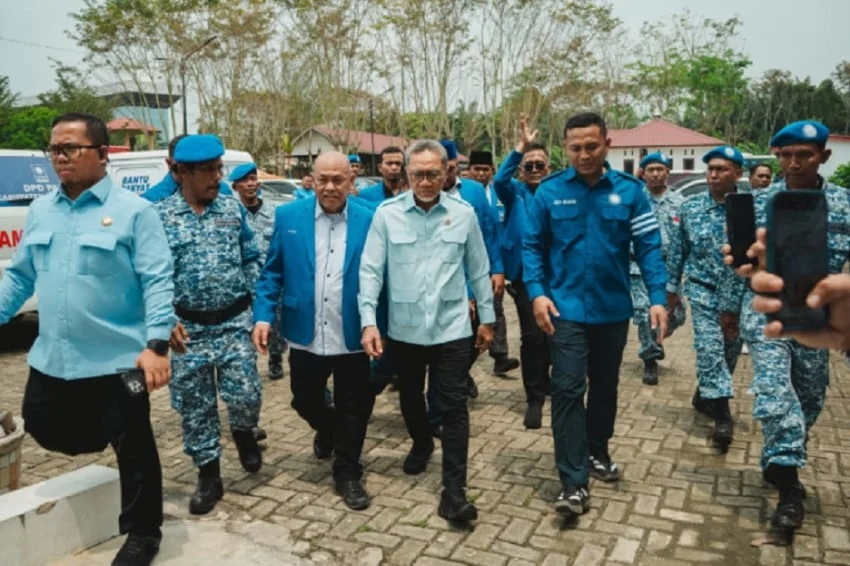
The Regional Leadership Council (DPW) of the National Mandate Party (PAN) in North Sumatra has officially and unequivocally reaffirmed its unwavering support for the party’s central leadership under General Chairman Zulkifli Hasan, commonly known as Zulhas. This definitive stance comes as a direct response to recent political rumors and speculative reports circulating within various media circles regarding an alleged impending leadership transition or succession maneuver at the pinnacle of the party.
The regional faction has made it abundantly clear that any narratives suggesting internal discontent or coordinated efforts to unseat the current chairman are baseless. Instead, the leadership in North Sumatra has emphasized complete structural harmony, organizational discipline, and an intensified focus on grassroots engagement alongside legislative duties.
Solidarity and Focus on Grassroots Consolidation
Speaking from the capital city of Jakarta, PAN North Sumatra Secretary Dedy Irawan underscored that the entire regional machinery operates under a singular command structure centered on Zulkifli Hasan. According to Irawan, the provincial branch is dedicating its utmost energy and resources toward internal consolidation, strengthening structural integrity at the municipal and village levels, and executing community-centric programs designed to assist everyday citizens.
"DPW PAN Sumut stands firmly under one command, loyal to Zulkifli Hasan," Dedy Irawan stated. "At this critical juncture, our primary institutional focus is neither internal political friction nor speculative succession debates. Rather, we are entirely concentrated on organizational consolidation, structural reinforcement, and active initiatives aimed at supporting and empowering the general populace."
This declaration of loyalty is designed to project stability from one of the party’s most critical electoral strongholds outside of Java. North Sumatra represents a significant voter base for PAN, making regional cohesion paramount to the party’s broader national strategy. By projecting an image of absolute unity, the provincial leadership aims to neutralize any destabilizing narratives that might seek to fracture the party’s internal alignment ahead of upcoming legislative milestones.
Allegations of External Interference and Strategic Alliances
Beyond merely addressing internal rumors, the leadership of PAN North Sumatra has pointed toward external factors as the driving force behind the destabilizing reports. According to Dedy Irawan, the rumors concerning a leadership shake-up are not organic products of internal party dissatisfaction, but rather deliberate attempts by external political actors seeking to sow discord within the organization.
Irawan specifically highlighted that these attempts are allegedly being orchestrated by factions who harbor reservations or outright opposition to the close, cooperative relationship currently maintained between PAN and the administration of President Prabowo Subianto. As a core member of the current governing coalition, PAN has positioned itself as a staunch and reliable political partner to the central government. This alignment has granted the party significant strategic influence within the national cabinet and legislative bodies, particularly through Zulkifli Hasan’s active role in national governance.
Analysts note that political dynamics within governing coalitions in Indonesia are frequently subjected to subtle pressures from rival factions seeking to weaken the bargaining positions of allied parties. The attempt to manufacture narratives regarding leadership disputes inside PAN is viewed by party insiders as a tactical maneuver designed to distract the party from its legislative agenda and strain its cooperative ties with the executive branch. By publicly calling out these alleged external pressures, PAN North Sumatra has sought to rally the party base around the importance of defending its strategic political alliances.
Context of National Political Tensions
The reaffirmation of support for Zulkifli Hasan occurs against a backdrop of heightened political activity and occasional friction within the national legislature. While PAN has maintained a largely unified front in support of government policies, recent developments in the House of Representatives (DPR) have occasionally tested party discipline and coalition solidarity.
Notably, recent political discussions surrounding parliamentary inquiries and accountability mechanisms—such as the debates involving high-profile oversight proposals—have occasionally created ripples across coalition parties. While the vast majority of PAN lawmakers have remained strictly aligned with party directives and coalition agreements, isolated instances of independent legislative maneuvering by individual members have occasionally drawn intense media scrutiny.
Such incidents, while often minor in scale, tend to be amplified by political commentators as symptoms of broader internal fractures. It is within this volatile media ecosystem that rumors regarding Zulkifli Hasan’s leadership security gained traction, prompting regional bodies like DPW PAN North Sumatra to step forward with forceful declarations of loyalty to preempt any erosion of confidence.
Background on Zulkifli Hasan’s Leadership and PAN’s Trajectory
Zulkifli Hasan has long been a central figure in Indonesian politics, having served in various high-profile ministerial positions, including Minister of Forestry and, more recently, Coordinating Minister for Food Affairs, in addition to his extensive tenure leading PAN. Under his stewardship, the party has successfully navigated several political transitions, maintaining its parliamentary representation and securing strategic positions within successive government coalitions.
PAN was originally founded in the wake of the 1998 reform movement, emerging as a modern, open, and reformist political entity rooted in nationalist and religious values. Over the decades, the party has evolved its organizational strategy, balancing its foundational ideals with pragmatic coalition politics to ensure continuous national relevance. Zulkifli Hasan’s leadership style has traditionally emphasized broad consensus-building, loyalty to executive partnerships, and disciplined regional coordination.
However, leading a diverse, nationwide political party invariably involves managing competing ambitions among regional cadres and national elites. Leadership transitions within Indonesian political parties are historically sensitive processes that often attract intense speculation, making regular public demonstrations of unity—such as the one issued by DPW PAN Sumut—an essential tool for maintaining institutional stability and investor or voter confidence.
Implications for Regional Stability and National Strategy
The definitive stance taken by the North Sumatra branch carries several important implications for both the internal mechanics of PAN and the broader national political landscape.
First, it serves as a powerful deterrent against similar speculative moves by other regional chapters. In Indonesian party politics, regional councils often take their cues from major provincial branches like North Sumatra, East Java, and West Java. By acting swiftly to shut down rumors of leadership change, PAN North Sumatra sets a precedent of preemptive solidarity that other DPWs are likely to emulate, thereby safeguarding national leadership from localized rebellions.
Second, the strong alignment with Zulkifli Hasan reinforces PAN’s commitment to the Prabowo Subianto administration. At a time when policy coordination and legislative backing are critical for the execution of the government’s flagship national programs—particularly in sectors like food security, economic development, and infrastructure—solidarity among coalition partners is non-negotiable. Any perceived vulnerability in PAN’s leadership could potentially disrupt coalition dynamics, making the party’s firm rebuttal a stabilizing factor for the broader governing alliance.
Finally, by pivoting the narrative away from internal gossip and back toward structural consolidation and community service, PAN aims to reassure its grassroots supporters and potential voters. Political parties frequently struggle with public fatigue over internal power struggles; by publicly prioritizing public welfare and organizational strengthening, PAN seeks to project an image of a mature, disciplined political institution focused squarely on national development rather than elite political maneuvering.
Conclusion and Future Outlook
As the political year progresses toward upcoming strategic milestones, the leadership of PAN appears determined to maintain strict organizational discipline and unified messaging. The decisive action taken by the North Sumatra regional council demonstrates that the party’s internal defenses against speculative disruption remain robust.
With Zulkifli Hasan maintaining a secure mandate from regional stakeholders and the party apparatus firmly focused on grassroots reinforcement and coalition stability, PAN is positioning itself to navigate current legislative challenges with minimal internal friction. Moving forward, the ability of regional branches to project unwavering support for the central leadership will remain a crucial benchmark for the party’s overall political resilience and organizational cohesion.
