
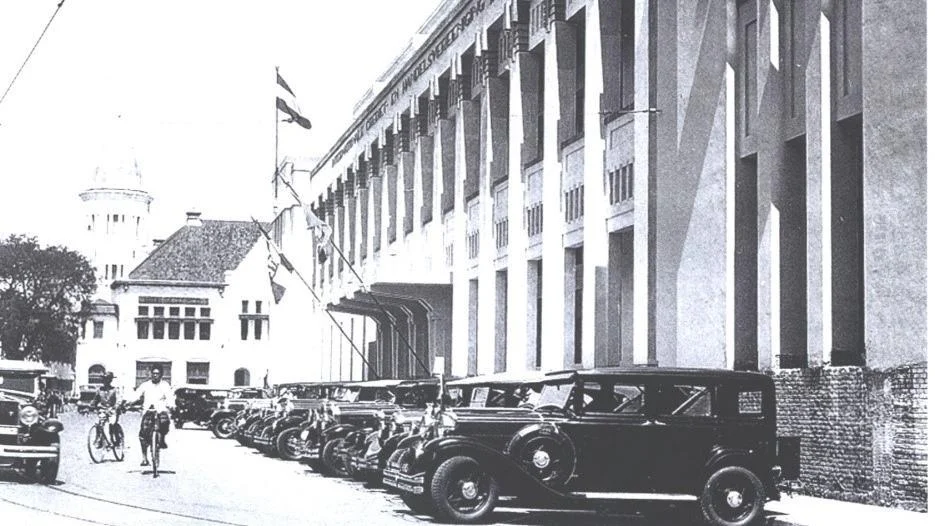
Standing stoically at the corner of Heerenstraat and Willemsplein in the heart of Surabaya’s Old Town, the Internatio Building serves as more than just a relic of colonial architecture. It is a monument to the volatile transition of power in post-independence Indonesia, a structure that bore witness to the cataclysmic events of late October 1945—a period that fundamentally altered the course of the Indonesian National Revolution. Known officially as the Internationale Crediten Handelvereeniging, this building remains a silent observer of the skirmishes, diplomatic failures, and eventual bloodshed that led to the Battle of Surabaya on November 10, 1945.
Architectural Legacy and Colonial Economic Hub
Constructed between 1927 and 1931, the Internatio Building was designed by the renowned architect Frans Johan Louwrens Ghijsels, a principal figure at the Algemeen Ingenieurs en Architecten Bureau (AIA). Ghijsels, whose portfolio includes iconic structures such as the Jakarta Kota Station and the Panti Rapih Hospital in Yogyakarta, imbued the building with the distinct architectural style of the era—a blend of European structural engineering and tropical adaptations.
During the Dutch colonial administration, the building functioned as the headquarters for international trade and investment management. Its location at the Jembatan Merah (Red Bridge) area was strategic; this district was the beating heart of commerce in East Java. The building symbolized the Dutch economic hegemony, housing offices that facilitated the flow of commodities and capital between the Dutch East Indies and the global market. Its physical presence was designed to convey stability, prosperity, and the permanence of colonial rule—a perception that would be violently challenged just fourteen years after its completion.
The October Crisis: A Powder Keg
The narrative of the Internatio Building shifted dramatically following the Japanese surrender and the subsequent arrival of Allied forces in Surabaya on October 25, 1945. The British Indian Army, tasked with disarming Japanese troops and repatriating prisoners of war, occupied the Internatio Building. Mayor V. Gopal was placed in charge of the detachment stationed there.
For the newly independent Indonesian populace, the presence of British troops, who were perceived to be facilitating the return of the Dutch colonial administration, acted as a severe provocation. Within days, the city descended into chaos. The Internatio Building became the focal point of a massive, spontaneous siege. Thousands of Indonesian revolutionaries surrounded the structure, demanding the British vacate the city.
The situation reached a boiling point on October 29 and 30, 1945. Recognizing the potential for a large-scale massacre, the national leadership—including President Sukarno, Vice President Mohammad Hatta, and Minister of Social Affairs Amir Sjarifuddin—traveled to Surabaya to mediate a ceasefire.
The Death of Brigadier General Mallaby
The most significant historical event occurring in the shadows of the Internatio Building was the death of Brigadier General Aubertin Walter Sothern Mallaby. On October 30, amidst the tense negotiations, Mallaby was killed in his car near the building.
The exact circumstances of his death remain a subject of historical debate, but it is widely accepted that the skirmish was a result of the breakdown in communication between the British forces and the local Indonesian militias. The death of a high-ranking British officer served as the primary catalyst for the British military’s decision to launch a full-scale offensive, leading to the infamous ultimatum issued by Major General E.C. Mansergh, which culminated in the Battle of Surabaya on November 10, 1945.
The Role of Local Diplomacy: The Case of Doel Arnowo
While the narrative of the period is often dominated by military history, the role of local civilian leaders was equally pivotal. Doel Arnowo, who served as the Chairman of the National Committee of Indonesia (KNI) for the Surabaya Residency, emerged as a key mediator. Appointed on August 28, 1945, Arnowo was tasked with the daunting responsibility of maintaining order amidst the collapse of the Japanese administration and the arrival of the Allies.
Arnowo played a critical role in the contact bureau, the liaison office established to communicate between the Indonesian nationalist forces and the British military. He was instrumental in negotiating the terms of the short-lived ceasefire and worked closely with Governor R.M.T.A. Soerjo to prepare public addresses aimed at calming the fervor of the local militias. His efforts underscored a crucial aspect of the Indonesian revolution: the struggle was not merely fought on the streets with weaponry, but through complex, high-stakes diplomatic maneuvering and grassroots organization. After the revolution, Arnowo’s influence continued as he served as the Mayor of Surabaya in 1950, focusing on the rehabilitation of the city’s infrastructure and the revitalization of its traditional markets.
The Evolution of the Space
The area surrounding the Internatio Building has undergone significant urban transformations since 1945. The space in front of the building, which once served as a transit hub for buses and municipal transportation, has been repurposed into a public open space known as Taman Jayengrono. This park, along with the adjacent "History Park" and the Jembatan Merah monument, serves as a site of collective memory, allowing contemporary citizens to engage with the city’s tumultuous past.
Today, the Internatio Building is managed by PT Tjipta Niaga (now under the umbrella of PT Aneka Niaga) and continues to be utilized, primarily for printing facilities. Despite these functional changes, the building remains a protected heritage site, standing as a testament to the transition from a colonial commercial hub to a site of nationalist sacrifice.
Historical Implications and Analysis
The Internatio Building represents the intersection of economic history and revolutionary struggle. It provides a window into how architectural structures can become unintended actors in historical events. The building’s occupation by the British and the subsequent siege by local forces highlight the fundamental failure of the Allied forces to recognize the intensity of the nationalist sentiment in Surabaya.
From an analytical perspective, the events at Internatio demonstrate the precariousness of post-war military transitions. The death of General Mallaby was not merely an isolated incident of violence; it was the inevitable consequence of a power vacuum in which local militias felt empowered by the declaration of independence, while the British remained constrained by their mandate to restore the pre-war status quo.
The building stands as a permanent reminder that the Battle of Surabaya was not simply a battle between two armies, but a clash between two irreconcilable visions for the future of the Indonesian archipelago. By preserving the Internatio Building, the municipal government of Surabaya ensures that the nuances of the Indonesian National Revolution—ranging from the architectural legacy of the Dutch to the diplomatic efforts of figures like Doel Arnowo—are not erased by the rapid modernization of the city.
As Surabaya continues to develop into a modern metropolitan center, the Old Town district, with the Internatio Building at its center, serves as an essential educational resource. It invites observers to reconsider the cost of sovereignty and the complexity of the events that transformed a city into the "City of Heroes." The building is no longer a site of trade or imperial administration, but a bridge connecting the modern generation to the sacrifices made in the pursuit of independence.
