
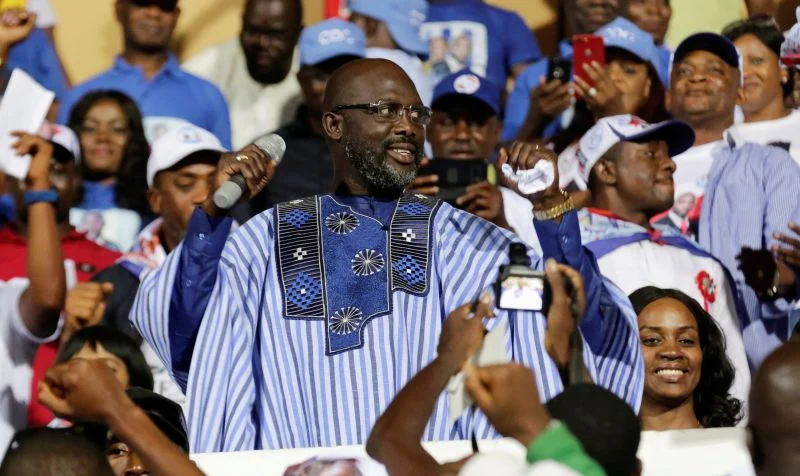
The transition of George Tawlon Manneh Oppong Ousman Weah from a global football icon to the highest political office in his homeland represents one of the most remarkable career trajectories in modern history. Following his groundbreaking achievements on the international football stage—most notably capturing the prestigious FIFA World Player of the Year and Ballon d’Or awards in 1995—Weah officially secured his victory as the President of Liberia in December 2017. Before steering the political future of a West African nation recovering from decades of civil conflict and economic instability, Weah captivated the sporting world as a lethal striker for elite European institutions, including AC Milan, Paris Saint-Germain, AS Monaco, Chelsea, and Manchester City. His pivot from athletic supremacy to statecraft underscores a lifelong dedication to public service and national upliftment, transforming a sporting hero into a symbol of democratic hope for millions of Liberians.
Early Life and Humble Beginnings in Monrovia
Born on October 1, 1966, in the Clara Town suburb of Monrovia, Liberia, George Weah’s journey to global prominence began in the most challenging of circumstances. Raised largely by his grandmother, Emma Klonh Wleh, in a working-class neighborhood of the Liberian capital, Weah developed his prodigious football talents on the dusty, unforgiving terrain of local sandlots. Long before luxury training facilities and tactical coaches entered his world, Weah honed his natural coordination, exceptional speed, and instinctive goal-scoring abilities through unyielding street play.
His raw talent soon caught the attention of local talent scouts, leading to spells with various domestic clubs that served as the foundational stepping stones of his career. Weah played for Invincible Eleven, Mighty Barolle, Bongrange Bonguine, and Young Survivors of Claretown. During his teenage years with Young Survivors—a side notable for operating entirely without a formal coach—Weah’s leadership and scoring prowess propelled the amateur team all the way to the top tier of Liberian football. This extraordinary feat signaled to regional scouts that the young striker possessed capabilities far beyond the local league, setting the stage for his eventual departure to the broader African football landscape.
The African Launchpad and European Breakthrough
In 1987, Weah’s career took a decisive continental leap when he was signed by Tonnerre Yaoundé, one of Cameroon’s most prestigious football clubs. Transitioning from Liberian football to the more physical and tactically demanding Cameroonian championship proved seamless for the young forward. In his very debut season with Tonnerre, Weah made an immediate impact, helping the club secure the Cameroonian championship title. His performances in Central Africa did not go unnoticed by visiting European scouts who frequented the continent in search of undiscovered gems.
Later that same year, at the age of 21, Weah made the monumental move to Europe, signing with AS Monaco in the French Division 1, then managed by legendary coach Arsène Wenger. Wenger’s tactical guidance played an instrumental role in refining Weah’s raw athleticism into a disciplined, highly sophisticated European style of play. During his five seasons with Monaco, spanning from 1987 to 1992, Weah firmly established himself as one of the most terrifying strikers in French football. He netted an impressive 57 goals across all competitions and played a pivotal role in capturing the French Cup (Coupe de France) in 1991.
His combination of blistering pace, physical strength, and exceptional finishing ability soon attracted the attention of French giants Paris Saint-Germain (PSG). Joining PSG ahead of the 1992–1993 season, Weah elevated his game to an even higher international echelon. In the French capital, he cemented his legacy by winning another French Cup, a Ligue 1 league title, and leading the club to a historic appearance in the semi-finals of the UEFA Champions League during the 1994–1995 campaign. Across 123 total appearances for PSG, Weah tallied 37 goals and numerous assists, earning widespread acclaim as one of the most complete forwards in the world.
Reaching the Summit: AC Milan and Historic Individual Honors
The pinnacle of Weah’s club career arrived in the summer of 1995 when Italian powerhouse AC Milan secured his transfer from PSG. Stepping onto the grand stage of the Serie A—then widely regarded as the most competitive and tactically rigorous league in global football—Weah did not merely adapt; he dominated. Under the management of Fabio Capello and later Alberto Zaccheroni, Weah became the focal point of the Rossoneri attack, forming lethal partnerships and terrorizing elite Italian defenses.
During his initial stint at San Siro from 1995 to 2000, Weah captured two Serie A titles (Scudetto) in 1996 and 1999. His statistical output during this era was formidable, registering 51 goals and multiple assists in 114 league appearances. Among his most iconic moments in an AC Milan shirt was his breathtaking individual goal against Hellas Verona in September 1996, where he collected the ball deep inside his own penalty area, dribbled past nearly the entire opposing team, and slotted home—a masterpiece widely replayed as one of the greatest solo goals in football history.
It was during this golden period with AC Milan that Weah achieved unprecedented individual accolades. In 1995, he was awarded the FIFA World Player of the Year, the prestigious Ballon d’Or, and the African Footballer of the Year awards, making history as the first—and to this day, only—African player to win the Ballon d’Or and FIFA’s top individual honor in the same year. Furthermore, his triumph broke the traditional monopoly held by European and South American players over the Ballon d’Or, a milestone made even more poignant by the fact that his homeland, Liberia, was at the time ravaged by a devastating civil war.
The Twilight of a Storied Playing Career
Following his illustrious years in Italy, Weah sought new challenges in the latter stages of his playing career. In the year 2000, he embarked on a journey to the English Premier League, signing briefly with Chelsea. Despite his advanced age by football standards, Weah made an immediate impact in London, scoring crucial goals and helping the Blues capture the FA Cup in 2000.
His brief yet impactful stint at Stamford Bridge was followed by a transfer to Manchester City during the 2000–2001 season, where his veteran presence provided invaluable leadership to a transitioning squad. Weah later concluded his European club career with Marseille in France before finishing his active playing days with Al-Jazira in the United Arab Emirates. When he finally hung up his boots, Weah left behind a legacy as a global football ambassador, a trailblazer for African athletes, and a national hero in Liberia who used his platform to advocate for peace and humanitarian causes in his war-torn country.
Transition from the Pitch to the Political Arena
Long before his election to the presidency, George Weah demonstrated a profound commitment to the socio-economic development of Liberia. Throughout the two brutal civil wars that fractured the nation between 1989 and 2003, Weah utilized his personal wealth and international influence to provide humanitarian aid, fund the national football team out of his own pocket, and serve as a UNICEF Goodwill Ambassador. His efforts to promote peace, education, and health initiatives across West Africa laid the groundwork for his eventual transition into formal politics.
Following the conclusion of the civil conflicts, Weah recognized that symbolic charity was insufficient to enact systemic change. He formally entered the political sphere, founding the Congress for Democratic Change (CDC) party and launching his first presidential bid in the 2005 elections. Though he initially faced skepticism from traditional political elites who questioned his formal educational background at the time—criticism he subsequently addressed by earning degrees from DeVry University—Weah remained steadfast in his commitment to representing the marginalized youth of Liberia.
His political ascent was characterized by grassroots mobilization and an unwavering connection to the working-class population. After serving as a Senator representing Montserrado County from 2014 to 2018, Weah consolidated his political capital and built formidable coalitions. In the landmark presidential election of December 2017, running alongside vice-presidential candidate Jewel Howard-Taylor, Weah secured a decisive democratic victory. His inauguration marked the first peaceful and democratic transfer of power in Liberia in over seven decades, signaling a monumental milestone for the nation’s democratic institutions.
Broader Implications and Legacy
The election of George Weah as the President of Liberia resonated far beyond the borders of West Africa, serving as a powerful testament to the intersection of sports diplomacy and democratic renewal. Analysts examining his presidency note that Weah’s administration inherited a complex matrix of economic challenges, infrastructure deficits, and the lingering scars of historical conflict. While his presidency tested the practical realities of governing a developing nation against the immense public expectations placed upon a national icon, his journey fundamentally redefined the boundaries of what athletes can achieve beyond sports.
By rising from the impoverished sandlots of Monrovia to the pinnacle of European football, and subsequently ascending to the highest office of his nation, Weah cemented an enduring legacy. His life story bridges the gap between athletic excellence and civic duty, demonstrating that the discipline, leadership, and resilience forged on the football pitch can be successfully channeled into the monumental task of nation-building.
