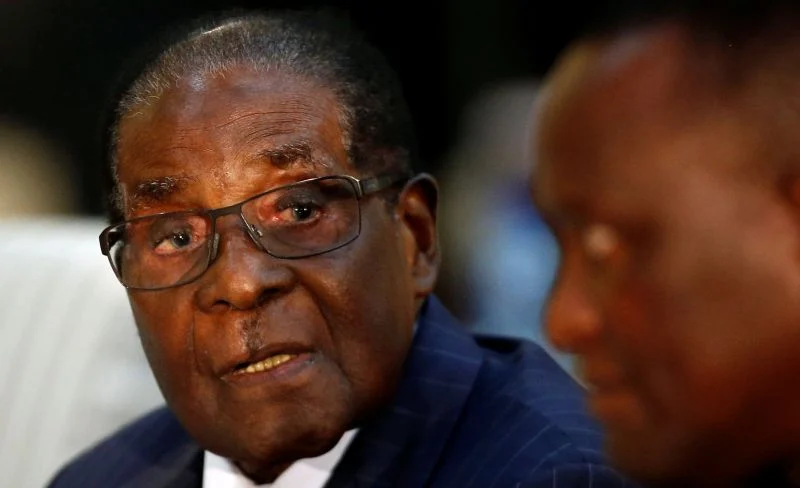
The political landscape of Southern Africa shifted dramatically on Wednesday, November 22, 2017, when Robert Gabriel Mugabe officially stepped down as the President of Zimbabwe. At the age of 93, the world’s then-oldest head of state finally relinquished power following a rapid military intervention and intense mounting pressure from his own ruling party, the Zimbabwe African National Union-Patriotic Front (ZANU-PF), alongside massive public demonstrations. His resignation brought a formal end to a near-four-decade rule that began with the birth of the nation in 1980.
Mugabe’s departure sparked jubilant scenes across the capital city of Harare and throughout the country. Citizens flooded the streets, dancing, singing, and waving national flags to celebrate the end of an era defined by economic collapse and authoritarian governance. Inside the national parliament, lawmakers openly cheered as the Speaker of Parliament read out Mugabe’s historic resignation letter, which interrupted impeachment proceedings that had already been set into motion.
For a leader who was once heralded as a liberator who freed his nation from the shackles of white minority rule, his downfall marked a tragic descent into autocracy. His exit not only reshaped Zimbabwe’s immediate political future but also left behind a complex legacy of anti-colonial heroism juxtaposed with severe economic mismanagement and human rights abuses.
From Revolutionary Hero to Polarizing Prime Minister
Born on February 21, 1924, in Kutama, located in the northeastern region of then-Salisbury—now known as Harare—Robert Mugabe grew up during the colonial era when the country was known as Rhodesia. Possessing a formidable intellect, Mugabe earned multiple university degrees while working as a schoolteacher, laying the intellectual foundation for his future political career.
In 1961, he married his first wife, Sally Hayfron, a prominent political activist from Ghana. By the early 1960s, Mugabe had become deeply disillusioned with the oppressive white minority government led by Ian Smith. In 1964, he delivered a speech deemed subversive by the colonial authorities, leading to his arrest. Mugabe spent the next decade imprisoned without trial.
Rather than subduing his spirit, imprisonment galvanized his political resolve. Following his release in 1974, Mugabe crossed the border into Mozambique, where he assumed leadership of the Zimbabwe African National Liberation Army (ZANLA), the military wing of ZANU. From exile, he orchestrated a protracted and bloody guerrilla war against the Rhodesian regime.
The armed struggle eventually forced the white minority government to the negotiating table, leading to the Lancaster House Agreement in 1979 and democratic elections the following year. In 1980, the newly minted nation of Zimbabwe emerged, and Robert Mugabe assumed office as the country’s first Prime Minister, greeted by immense domestic and international goodwill. Tragedy struck his personal life in 1992 when his wife Sally passed away due to kidney failure. Four years later, in 1996, Mugabe married his former secretary, Grace Marufu, who would later become a polarizing figure in Zimbabwean politics.
Chronology of the November 2017 Military Coup
The events leading to Mugabe’s resignation unfolded rapidly over the course of a single week in November 2017, triggered by intense factional infighting within ZANU-PF over the eventual presidential succession.
The crisis began on November 6, 2017, when Mugabe dismissed his long-time ally and Vice President, Emmerson Mnangagwa. Widely respected by the military and veterans of the liberation war, Mnangagwa’s firing was widely perceived as a maneuver by Mugabe to clear a path for his wife, Grace Mugabe, to succeed him. Mnangagwa fled the country, citing threats to his life.
Sensing an existential threat to the legacy of the liberation struggle, the Zimbabwe Defense Forces (ZDF), led by General Constantino Chiwenga, intervened. On November 14, military tanks rolled into Harare. By the early hours of November 15, soldiers had seized control of the state broadcaster, ZBC, and placed President Mugabe under house arrest.
Despite being detained, Mugabe initially resisted stepping down, insisting that he remained the only legitimate head of state. He even made a public appearance days later at a university graduation ceremony, projecting an image of defiance. However, the military and the ruling party systematically dismantled his support base. On November 19, the ZANU-PF central committee stripped Mugabe of his role as party leader, expelled his wife and her key allies, and formally demanded his resignation by noon the following day, threatening impeachment if he refused.
When the deadline passed without his resignation, parliament convened on November 21 to initiate impeachment proceedings. Mid-session, the Speaker halted the proceedings, announcing that a letter had been received from Mugabe. The letter confirmed his immediate resignation, prioritizing a graceful exit over a humiliating parliamentary ouster.
Socioeconomic Implications and Governance Legacy
Robert Mugabe’s 37-year grip on power—first as Prime Minister from 1980 to 1987, and subsequently as President from 1987 onward—left deep physical, social, and economic scars on Zimbabwe.
During the first decade of his rule, Mugabe earned international praise for investing heavily in healthcare and education, expanding access for the country’s Black majority. Literacy rates in Zimbabwe soared to become among the highest on the African continent. However, as political opposition grew in the late 1990s, particularly with the emergence of the Movement for Democratic Change (MDC) led by Morgan Tsvangirai, Mugabe’s administration adopted increasingly repressive tactics.
The turning point for the nation’s economy occurred around 2000 with the initiation of the Fast Track Land Reform Program. While ostensibly designed to correct historical injustices regarding land ownership by seizing white-owned commercial farms and redistributing them to landless Black Zimbabweans, the execution was chaotic and violent. Agricultural production collapsed, leading to severe food shortages in a country once known as the breadbasket of Africa.
The agricultural crash triggered a catastrophic economic downward spiral. By 2008, Zimbabwe experienced hyperinflation that reached astronomical proportions, rendering the local currency entirely worthless. Millions of citizens were forced into poverty, and an estimated three million Zimbabweans migrated abroad in search of economic refuge. Human rights organizations consistently documented systematic political violence, voter intimidation, and the suppression of independent media during successive election cycles, cementing Mugabe’s status in the West as an authoritarian dictator.
Domestic and International Reactions
The international community responded to Mugabe’s resignation with a mixture of cautious optimism and diplomatic pragmatism. Western governments, which had imposed targeted sanctions on Mugabe and his inner circle due to human rights abuses and election rigging, emphasized the historic nature of the moment while calling for a peaceful transition to democratic governance. Neighboring South Africa and regional bodies such as the Southern African Development Community (SADC) praised the peaceful nature of the transition, avoiding the use of the word "coup" to describe the military intervention.
Domestically, civil society organizations and opposition leaders expressed hope that the end of the Mugabe era would herald a new dawn of constitutionalism, rule of law, and economic recovery. Yet, caution remained widespread. Many citizens and analysts questioned whether the military-backed elevation of Emmerson Mnangagwa—a veteran stalwart of the ruling party who had stood beside Mugabe for decades—truly represented systemic change or merely a recycling of the old guard.
Outlook and Future Implications for Zimbabwe
As Zimbabwe closed the chapter on the Robert Mugabe era, the nation faced monumental hurdles. The immediate priority for the incoming administration under Emmerson Mnangagwa was stabilizing the crippled economy, addressing severe liquidity shortages, attracting foreign direct investment, and restoring international credibility.
Political analysts note that while Mugabe’s removal eliminated a massive obstacle to reform, the entrenched institutional structures of ZANU-PF remained intact. The true test of Zimbabwe’s post-Mugabe future would lie in whether the new government could deliver credible, transparent, and democratic elections, dismantle authoritarian apparatuses, and foster genuine national reconciliation.
Ultimately, Robert Mugabe’s demise stands as a cautionary tale of leadership. A man who started as a visionary champion of freedom and self-determination ultimately overstayed his mandate, allowing hubris and the preservation of personal power to eclipse the needs of the nation he fought so hard to create. His passing from the political stage left Zimbabweans to rebuild a broken nation, carrying the heavy burden of history while looking tentatively toward an uncertain future.