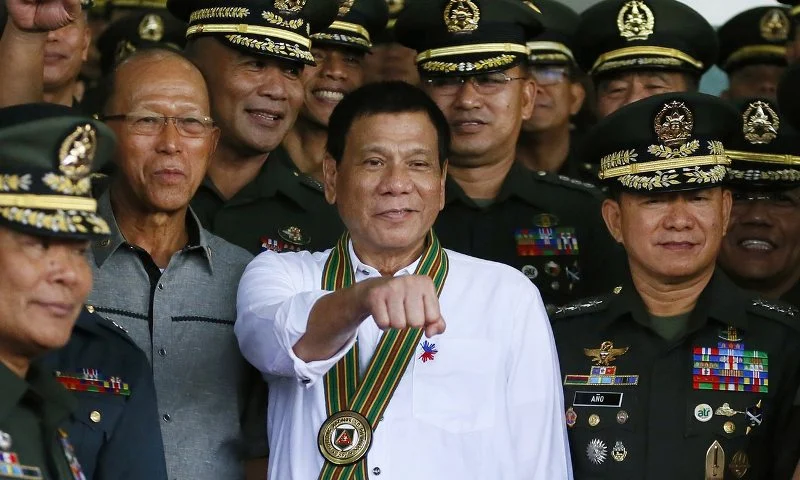
The political landscape of the Philippines has long been shaped by entrenched family dynasties, powerful clans, and figures who command absolute loyalty through unconventional means. Among the most formidable and polarizing leaders to emerge from this ecosystem is Rodrigo Roa Duterte, the sixteenth President of the Philippines. Often dubbed the "Donald Trump of Asia," "Digong," "Rody," or simply "The Punisher," Duterte captured the global imagination through his populist rhetoric, his uncompromising stance on crime, and his unorthodox path to the Malacanang Palace. Yet, beneath the abrasive persona and the fiery public declarations lies a deeply rooted political lineage that spans generations, connecting several prominent clans across the Philippine archipelago.
Born on March 28, 1945, in Maasin, Southern Leyte—which was then part of the undivided province of Leyte—Rodrigo Roa Duterte grew up in an environment where public service, governance, and political maneuvering were part of daily life. Tracing his genealogy reveals a rich tapestry of cultural heritages and a vast network of political influence that bridges the Visayas and Mindanao regions. Understanding the origins of the man who would govern Davao City for over two decades requires a comprehensive examination of his ancestry, his family’s political footprint, and the broader socio-political implications of dynastic power in Philippine history.
Ancestral Roots and Multicultural Heritage
Rodrigo Duterte’s genetic and cultural background is remarkably diverse, reflecting the historical crossroads of trade, migration, and colonization that defines the Philippines. On his paternal side, he carries Cebuano blood, inherited from his father, Vicente G. Duterte. The Duterte family name is historically prominent in the central region of the country, specifically in the province of Cebu.
On his maternal side, he belongs to the influential Roa clan through his mother, Soledad Roa, a schoolteacher and civic leader whose philanthropic and community-based activities left a lasting impression on the local population. Beyond these primary Visayan roots, genealogical research indicates that Duterte’s ancestry includes a complex mixture of international lineages. Tracing back through previous generations, his family tree incorporates Portuguese, Spanish, Chinese, Arab, and Malay heritage. This multicultural admixture is not uncommon among prominent Filipino families, but in Duterte’s case, it mirrors the diverse socio-cultural fabric of the nation, bridging indigenous island roots with centuries of external historical contact.
Despite this varied ancestry, Duterte’s cultural identity is unmistakably rooted in the southern Philippines. As the second of five siblings, he spent his formative years absorbing the complexities of local governance, public administration, and the distinct cultural ethos of Mindanao—a region that has historically felt both neglected by and disconnected from the political center of gravity in Metro Manila.
A Dynasty Etched in Public Service: The Political Lineage of the Duterte and Roa Clans
To view Rodrigo Duterte as a political anomaly who arrived on the national stage from nowhere is to misunderstand the deeply institutionalized nature of Philippine politics. The Duterte and Roa families are part of an extensive network of regional elites whose influence stretches across Cebu, Durano, Almendras, and Roa territories.
Duterte’s father, Vicente G. Duterte, served as a private lawyer before transitioning into formal government roles. Vicente made a significant mark on local administration by serving as the mayor of Danao in Cebu, and later moving south to serve as the provincial governor of Davao. This strategic migration from the Visayas to Mindanao proved pivotal, establishing the family’s footing in the resource-rich frontier island that would eventually become their political stronghold.
The wider family network boasts numerous figures who held municipal and provincial posts. Rodrigo’s cousin, Ronald Duterte, occupied the mayor’s office in Cebu City from 1983 to 1986, a turbulent period in modern Philippine history marked by the twilight of the Marcos dictatorship. Ronald’s father, Ramon Duterte, also served as the mayor of Cebu City from 1957 to 1959. These interconnected terms of office demonstrate that political leadership was not merely an individual ambition for the family, but an inherited vocational expectation.
Concurrently, the maternal side of the family contributed to the clan’s public standing. While Vicente Duterte navigated the high-stakes world of executive governance and electoral politics, Soledad Roa balanced the family’s public profile through education and grassroots community work. Her dedication to social welfare initiatives instilled in her children a strong awareness of public welfare, even if Rodrigo Duterte would later express this awareness through highly controversial and authoritarian methods.

Through marriages, alliances, and shared political ambitions, the Duterte-Roa clan cemented their status as political royalty in the Visayas-Mindanao corridor. This deeply entrenched network provided the foundational scaffolding that allowed Rodrigo Duterte to construct his own political empire.
The Davao Era: Twenty-Two Years of Uncontested Local Hegemony
The most defining chapter of Duterte’s political career prior to the presidency was his unprecedented tenure as the mayor of Davao City. Serving across multiple non-consecutive and consecutive terms, Duterte governed the sprawling southern metropolis for a total of 22 years. He holds the distinction of being the first Philippine president to have emerged directly from the local government unit of Mindanao, bypassing the traditional stepping stones of national legislative experience in the House of Representatives or the Senate.
Duterte’s longevity in Davao was built on a paradoxical reputation. On one hand, he transformed a city once notorious for communist insurgency, crime syndicates, and urban violence into one of the safest urban centers in Southeast Asia, earning praise for strict law-and-order policies, economic development, and efficient public services. On the other hand, his iron-fisted approach drew severe condemnation from human rights organizations, both domestic and international, which accused him of tolerating or actively directing extrajudicial killings through the notorious Davao Death Squad (DDS).
This dual identity—the benevolent paternalistic patriarch ("Digong") on one side and the merciless vigilante ("The Punisher") on the other—became the central pillar of his 2016 presidential campaign. By framing himself as an outsider fighting a corrupt national elite in Manila, Duterte successfully masked the reality of his own dynastic pedigree. He campaigned on a populist platform promising to eradicate the nation’s illegal drug trade within three to six months, a bold and ultimately unrealistic pledge that galvanized millions of frustrated voters weary of institutional stagnation, crime, and systemic poverty.
Broader Implications and Socio-Political Analysis
The rise of Rodrigo Duterte to the presidency and the enduring prominence of his family highlight systemic characteristics of the Philippine political landscape. Political scientists and sociologists frequently point to the Duterte phenomenon as a prime example of the tension between democratic institutions and dynastic rule.
In the Philippines, political dynasties are not anomalies; they are structural necessities for sustained political survival. The concentration of power within families like the Dutertes, Marcoses, Aquinos, and Cojuangcos demonstrates that electoral success relies heavily on name recognition, inherited resource networks, and localized patronage systems rather than purely ideological alignment. When Duterte assumed the presidency in June 2016, he did not dismantle the traditional elite structure; rather, he reconfigured it, shifting the center of political gravity away from the traditional Tagalog-speaking elite of Luzon and toward the regional power bases of Mindanao and the Visayas.
Furthermore, Duterte’s presidency marked a significant shift in political communication and governance style. His use of coarse language, his open disdain for diplomatic norms, and his direct appeals to the working class resonated deeply in a country disillusioned with traditional, polished politicians whom they perceived as out of touch. The implications of this leadership style extended far beyond domestic policy, fundamentally altering the Philippines’ foreign relations—particularly its traditional alliance with the United States and its diplomatic balancing act with China.
Conclusion
The trajectory of Rodrigo Roa Duterte’s life and career cannot be understood in isolation from his heritage. From his multicultural ancestry rooted in Cebu and the broader Visayas to his family’s deep entrenchment in regional governance, Duterte is the product of a well-orchestrated political lineage. As the descendant of governors, mayors, and civic leaders, he utilized the institutional knowledge and network access of his forebears to anchor his power in Davao City for over two decades.
Ultimately, the story of Rodrigo Duterte is emblematic of the broader Philippine political narrative—one where family dynasties, regional loyalties, and populist strongmen continually redefine the boundaries of democracy. Whether viewed as a decisive reformer who restored public order or a polarizing figure who strained democratic norms, the 16th President of the Philippines remains a powerful testament to the enduring influence of political bloodlines in Southeast Asian governance.