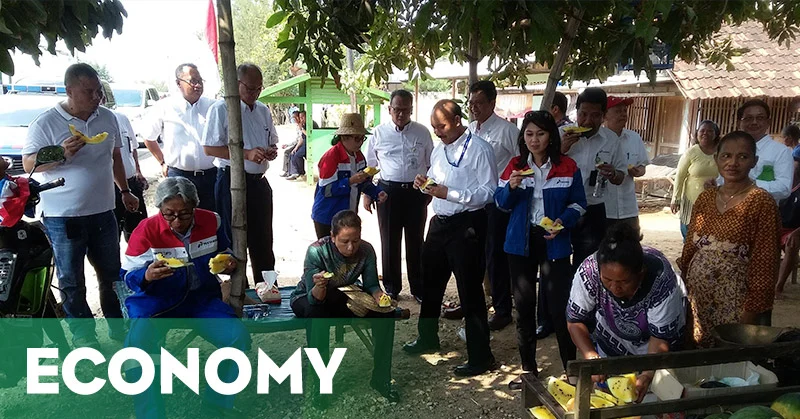
The official working visit to the Trans Pacific Petrochemical Indotama (TPPI) refinery complex in Tuban, East Java, on November 11, 2015, carried immense strategic importance for Indonesia’s energy security. However, before President Joko Widodo and his high-level ministerial delegation formally inspected the long-dormant facility, a moment of spontaneous interaction with local residents highlighted the human element of the high-stakes national project. State-Owned Enterprises (SOE) Minister Rini Soemarno, alongside then-Pertamina President Director Dwi Soetijpto and other key government and corporate officials, paused their journey to engage with the local community, sampling locally grown watermelons at a neighborhood stall near the refinery perimeter. This seemingly modest interlude preceded a critical milestone in Indonesia’s downstream oil and gas sector: the revitalization and reintegration of the TPPI plant into the national energy supply chain under the management of state-owned energy giant Pertamina.
Main Facts of the Presidential Delegation Visit
The delegation visiting the Tuban facility was spearheaded by President Joko Widodo, commonly known as Jokowi, reflecting the federal government’s direct interest in resolving long-standing infrastructural bottlenecks and reviving idle national assets. Accompanying the President were several high-profile officials responsible for steering Indonesia’s economic and energy policies. These included SOE Minister Rini Soemarno, Pertamina President Director Dwi Soetijpto, Pertamina Vice President of Corporate Communication Wianda Pusponegoro, and the Director General of Oil and Gas at the Ministry of Energy and Mineral Resources (ESDM), IGN Wiratmaja Puja.
The primary objective of the visit was to inspect the operational readiness of the TPPI petrochemical and refining complex following years of financial distress, legal complexities, and operational inactivity. Before arriving at the main gates of the complex, the entourage walked through the surrounding residential areas. The unexpected presence of top government officials drew crowds of local residents, many of whom seized the opportunity to interact with the leaders and capture photographs with the ministers and corporate executives. Amidst this warm reception, the delegation stopped at a local stall owned by a resident who sold fresh fruits, specifically locally harvested watermelons cultivated in the agricultural plots surrounding Tuban.
Minister Rini Soemarno actively encouraged her colleagues and the accompanying press corps to partake in tasting the local produce. "Ayo-ayo coba dulu semangkanya. Enak ini semangkanya," remarked Rini, inviting the entourage to sample the sweet fruit grown in the vicinity of the industrial plant. After enjoying several slices of the fresh Tuban watermelons and exchanging pleasantries with the local vendor and residents, the delegation resumed its official itinerary, proceeding directly to the TPPI refinery grounds for a comprehensive technical briefing and physical inspection.
Chronology and Background of the TPPI Facility
The journey of the TPPI refinery to full state control and operational revival is a complex chapter in modern Indonesian industrial history. Established to bolster domestic petrochemical production and reduce the nation’s heavy reliance on imported refined petroleum products, the facility faced severe financial hurdles shortly after its completion. For years, the plant operated below capacity or remained entirely shut down due to debt restructuring disputes, governance issues, and legal uncertainties involving its previous private and consortium stakeholders.
By 2015, the revival of TPPI became an urgent priority for the administration of President Joko Widodo, who had pledged to achieve greater national energy independence and curb costly fuel imports. Pertamina, through its subsidiary and direct corporate intervention, was tasked with taking over the operational management of the plant. The integration process moved swiftly in the months leading up to November 2015, transforming the dormant asset into a vital component of the state’s refining architecture. The November 11 visit served as a symbolic and practical inauguration of the plant’s reintegration, signaling to the public and market stakeholders that the facility was officially back online and contributing to national production.
Supporting Data and Strategic Significance of the Tuban Complex

The Trans Pacific Petrochemical Indotama facility in Tuban is not merely an ordinary refinery; it represents a cornerstone of Indonesia’s petrochemical and fuel supply infrastructure. Strategically located in East Java, the complex possesses a massive processing capacity designed to produce a wide array of petroleum products, including high-octane gasoline, diesel, and essential petrochemical inputs such as paraxylene, benzene, orthoxylene, and liquefied petroleum gas (LPG).
At the time of the 2015 inspection, Indonesia’s domestic fuel consumption heavily outpaced the production capacity of existing state refineries, forcing Pertamina to import substantial volumes of finished gasoline and diesel at immense fiscal costs. The reactivation of TPPI was projected to supply a significant percentage of the country’s daily fuel requirements—specifically producing thousands of barrels of fuel per day—thereby reducing the national current account deficit and easing pressure on foreign exchange reserves. Furthermore, the petrochemical output from the plant serves as raw material for domestic manufacturing industries, creating a multiplier effect across secondary and tertiary sectors of the national economy.
Official Responses and Ministerial Perspectives
The involvement of top-tier leadership during the November 2015 visit underscored the strategic weight placed on the TPPI turnaround. Ministry of SOEs officials, led by Rini Soemarno, emphasized that the state must reclaim control over vital strategic assets to ensure that national energy security is not vulnerable to external market shocks or private mismanagement.
Pertamina’s leadership, spearheaded by Dwi Soetijpto, played a pivotal operational role in executing the takeover and swift restart of the plant. Executives noted that reviving a complex industrial facility that had experienced prolonged dormancy required meticulous engineering assessments, safety audits, and financial restructuring. The smooth resumption of operations at TPPI demonstrated Pertamina’s growing technical capacity to manage distressed industrial assets and integrate them rapidly into its broader refining network, which includes major hubs such as Cilacap, Balongan, Balikpapan, and Dumai.
Meanwhile, Directorate General of Oil and Gas representatives, including IGN Wiratmaja Puja, provided regulatory oversight, ensuring that all licensing, environmental compliance, and safety standards were strictly met during the transition phase. The collaborative approach between the Ministry of SOEs, the Ministry of Energy and Mineral Resources, and Pertamina established a governance model for handling other troubled state-linked infrastructure projects across the archipelago.
Broader Impact and Economic Implications
The successful reactivation of the TPPI Tuban refinery yielded immediate and long-term implications for the Indonesian economy. On a macroeconomic scale, the facility’s output contributed directly to lowering the nation’s dependence on refined fuel imports, a structural vulnerability that had plagued Indonesia’s trade balance for decades. By substituting imported fuel with domestic production generated from the Tuban complex, the Indonesian government achieved notable savings in foreign exchange expenditures.
Regionally, the operation of the plant injected economic vitality into Tuban and the surrounding areas of East Java. The revival stimulated local employment, both directly through technical and administrative jobs at the refinery and indirectly through ancillary service sectors such as logistics, catering, housing, and small-scale commerce—exemplified by the local watermelon vendors who crossed paths with the presidential entourage. The presence of a stable, high-capacity industrial anchor in the region fostered local economic development and strengthened supply chains for regional manufacturing industries dependent on petrochemical derivatives.
In conclusion, while the lighthearted moment of the presidential delegation sampling local Tuban watermelons provided a humanizing window into a high-level state visit, it occurred against the backdrop of a monumental achievement in national energy policy. The inspection of the TPPI refinery on November 11, 2015, marked a decisive turning point in Indonesia’s pursuit of energy self-sufficiency, infrastructural resilience, and macroeconomic stability. Through coordinated governmental action and strategic corporate execution by Pertamina, the once-dormant Tuban complex was successfully transformed into a vital engine of national growth and industrial security.