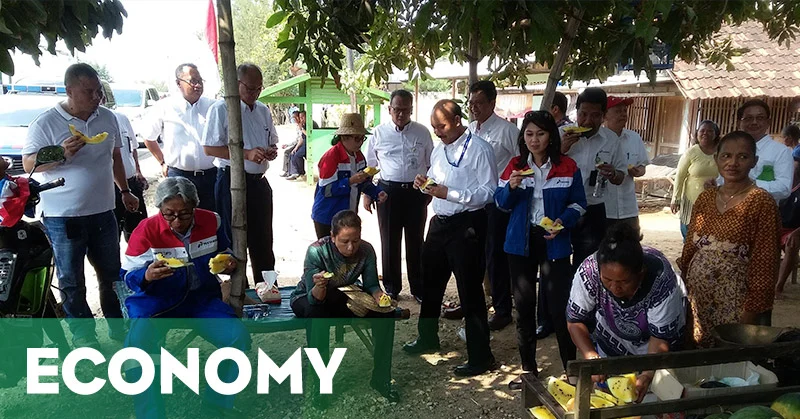
The industrial landscape of Tuban in East Java has long been defined by its heavy manufacturing, agricultural prowess, and strategic coastal location. On a brisk Wednesday morning in November 2015, this multifaceted identity was on full display as high-ranking government officials and energy sector executives converged on the region. Prior to conducting a formal, high-stakes inspection of the dormant PT Trans Pacific Petrochemical Indotama (TPPI) refinery, then-State-Owned Enterprises (SOE) Minister Rini Soemarno, alongside then-Pertamina President Director Dwi Soetijpto and a high-profile entourage, paused to engage with local residents. In an unexpected moment of cultural and communal warmth, the leadership delegation stopped at a roadside stall to sample locally grown Tuban watermarks, highlighting the intersection of macro-level national energy policies and the everyday lives of the rural communities hosting critical national infrastructure.
This vignette preceded one of the most critical energy sector interventions of the era: the reactivation of the TPPI petrochemical complex. While the gesture involving local fruit offered a humanizing touch to an otherwise bureaucratic and industrial itinerary, the overarching mission of the presidential delegation underscored Indonesia’s urgent quest for energy security, macroeconomic stabilization, and domestic self-sufficiency in refined petroleum products.
Chronology and Delegation Details
The sequence of events on Wednesday, November 11, 2015, was meticulously structured to balance grassroots engagement with rigorous technical oversight. President Joko Widodo, popularly known as Jokowi, led the official working visit to the Tuban facility, accompanied by a heavy contingent of economic and energy policymakers.
The core delegation included State-Owned Enterprises Minister Rini Soemarno, Pertamina President Director Dwi Soetijpto, Pertamina Vice President of Corporate Communication Wianda Pusponegoro, and the Director General of Oil and Gas at the Ministry of Energy and Mineral Resources, IGN Wiratmaja Puja.
Before the formal arrival of President Jokowi at the primary plant gates, members of the advance ministerial and corporate party walked through the surrounding neighborhoods. The unexpected presence of top government officials and the heads of the nation’s largest energy conglomerate drew considerable attention from local residents. Spontaneous interactions unfolded as citizens approached the delegation for photographs and informal exchanges.
Capitalizing on the pause in the itinerary, the officials stopped at a modest local establishment operated by a resident who doubled as a fruit vendor, selling agricultural produce harvested directly from farms adjacent to the TPPI perimeter. Minister Rini Soemarno actively encouraged her colleagues to sample the local harvest, remarking on the high quality of the fruit produced by Tuban farmers.
"Come on, try the watermelon first. This watermelon is delicious," Minister Soemarno told the entourage and gathered onlookers at the site in Tuban. Following this brief respite, the delegation reconstituted its ranks to proceed with the primary objective of the day: assessing the physical and operational readiness of the TPPI refining complex.
Strategic Background of the TPPI Facility
To fully understand the gravity of the November 2015 presidential inspection, one must examine the turbulent history of the PT Trans Pacific Petrochemical Indotama facility. Situated in Tasikharjo, Jenu district, Tuban regency, the complex was conceived as a monumental private-public venture designed to bolster Indonesia’s domestic petrochemical and refining capacities. Spanning hundreds of hectares along the strategic coastline of the Java Sea, the plant was engineered to produce a wide array of petrochemical products, including paraxylene, orthoxylene, benzene, heavy aromatic fractions, and crucially, finished fuels such as gasoline and automotive diesel oil.
However, despite its immense strategic potential, the facility was plagued by chronic financial distress, complex debt restructurings, shareholder disputes, and management changes for over a decade. By the late 2000s and early 2010s, the refinery experienced extended periods of dormancy or severe under-capacity utilization. The prolonged shutdown of the facility cost the Indonesian state dearly, forcing the country to rely heavily on expensive imported refined products to meet surging domestic demand.
The dependency on fuel imports not only strained the national trade balance and exacerbated the current account deficit but also exposed Southeast Asia’s largest economy to severe vulnerability against global crude oil price volatility. For decades, the governance of Indonesia’s downstream oil and gas sector had grappled with the inefficient supply chain structure managed by the notorious state oil trading subsidiary, Petral, which was eventually dissolved under the Jokowi administration as part of sweeping governance reforms. In this context, bringing the TPPI plant back onstream was not merely a localized corporate objective; it was a cornerstone of national economic sovereignty.
Intervention by the Jokowi Administration and Pertamina
Upon assuming office in late 2014, President Joko Widodo’s administration made energy independence a central pillar of its national development agenda. The revitalization of idle state-owned assets became an immediate priority for Minister Rini Soemarno and the newly appointed board of directors at PT Pertamina (Persero), led by Dwi Soetijpto.
Pertamina’s intervention in TPPI was executed through a complex financial and operational rescue plan. Through its subsidiary, PT Pertamina Patra Niaga, and subsequent debt-to-equity conversions involving state receivables, Pertamina gradually assumed operational control of the facility. The legal and financial maneuvering allowed the state-owned enterprise to secure feedstock supplies—primarily condensate—and initiate the massive overhaul required to restart units that had sat idle in corrosive coastal conditions for years.

The November 2015 inspection served as a critical milestone to verify that the technical preparations met safety, environmental, and operational standards prior to the official commercial restart. By integrating the refinery into Pertamina’s integrated supply chain, the state oil company aimed to slash Indonesia’s costly reliance on foreign gasoline traders.
Economic Implications and Downstream Sector Impact
The reactivation of the Tuban petrochemical and refining complex yielded profound immediate and long-term implications for the Indonesian economy. From a macroeconomic standpoint, the facility’s return to operational status drastically altered the nation’s balance of payments regarding fuel imports.
At full capacity, the TPPI refinery was capable of processing approximately 100,000 barrels of crude oil or condensate per day. This output accounted for a significant fraction of Indonesia’s national gasoline consumption, injecting millions of liters of domestically refined fuel into the distribution network managed by Pertamina. The reduction in import volumes translated to substantial foreign exchange savings for Bank Indonesia and relieved downward pressure on the Indonesian rupiah during periods of global financial tightening.
Furthermore, the integration of TPPI into domestic petrochemical supply chains provided a reliable, local source of raw materials for downstream manufacturing industries, such as plastics, textiles, and packaging. Prior to the restart, local plastic and chemical manufacturers were entirely beholden to international market prices and shipping logistics for imported intermediates like paraxylene and benzene.
Local Socioeconomic Dynamics
While the high-level policy discussions focused on national energy security and fiscal ledgers, the presence of national leaders in Tuban also highlighted the socio-economic symbiosis between mega-industrial projects and agrarian-coastal communities.
The informal interaction where ministers and corporate executives paused to consume locally harvested watermelons served as a symbolic reminder of the dual economic reality in regions hosting critical infrastructure. Tuban has historically maintained a robust agricultural and fisheries sector alongside its heavy industrial footprint. The proximity of local farms to the perimeter of a multi-billion-dollar petrochemical plant illustrates the spatial negotiation that occurs when national strategic projects are planted within rural economies.
Local leaders and community representatives frequently emphasize that large-scale industrial developments must deliver tangible benefits to the indigenous population, ranging from employment opportunities and local business partnerships to environmental safeguards. The casual engagement by Minister Soemarno and other officials helped bridge the psychological gap between the technocratic elite in Jakarta and the citizens directly impacted by the industrial transformation of their homeland.
Official Responses and Stakeholder Perspectives
Reactions from government officials, industry analysts, and corporate leaders following the November 2015 visit underscored a unified optimism regarding the nation’s downstream capabilities.
Pertamina management repeatedly stressed that the revitalization of TPPI demonstrated the state’s engineering and managerial competence in rescuing distressed strategic assets without relying entirely on foreign bailouts. Executives pointed out that integrating the facility required unprecedented cross-agency coordination between the Ministry of State-Owned Enterprises, the Ministry of Energy and Mineral Resources, regulatory bodies, and financial institutions.
Energy economists praised the pragmatic approach of utilizing state-owned enterprises to absorb and restructure non-performing industrial assets, viewing it as a superior alternative to prolonged liquidation processes that waste valuable national infrastructure. However, analysts also offered cautionary perspectives, noting that sustained success would depend heavily on transparent governance, consistent crude feedstock procurement agreements, and insulation from political interference in operational decision-making.
Conclusion and Legacy of the 2015 Inspection
The impromptu watermelon-tasting session by Minister Rini Soemarno and her delegation outside the gates of the TPPI refinery in Tuban on November 11, 2015, remains a vivid snapshot of political theater intersecting with grassroots reality. Yet, beneath the lighthearted moments captured by journalists on the ground lay a rigorous, high-stakes national mission.
The successful restart of the TPPI facility marked a watershed moment for Indonesia’s energy sector. It signaled a decisive shift away from passive dependency on volatile international fuel markets and toward aggressive domestic asset optimization. By reclaiming control over a vital refining and petrochemical complex, the Indonesian government laid the groundwork for enhanced energy resilience, fiscal stabilization, and industrial self-reliance—a legacy that continues to resonate within the nation’s downstream petroleum landscape years later.