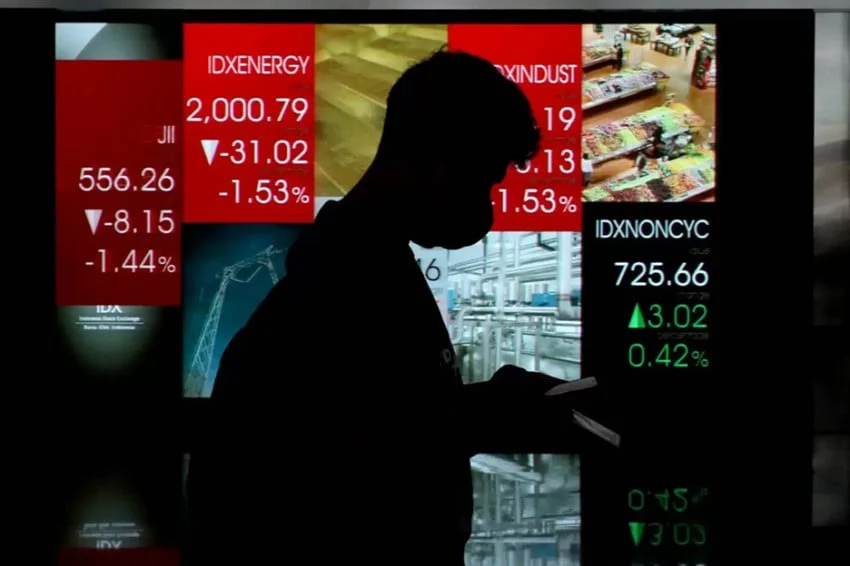
The Jakarta Composite Index (IHSG) concluded the final trading session of the week on Friday, September 25, 2026, in negative territory, succumbing to persistent selling pressure that dragged the benchmark index down by 56.72 points, or 0.90%, to settle at the 6,241 level. The day’s performance capped off a volatile week for the Indonesian equity market, reflecting a cautious investor sentiment that dominated the trading floor throughout the session. Market breadth was decisively bearish, with data from the Indonesia Stock Exchange (IDX) revealing that 587 stocks declined, significantly outpacing the 122 stocks that managed to close in the green, while 254 stocks remained unchanged.
Trading Dynamics and Volume Analysis
The total transaction value for the session reached Rp9.3 trillion, with a total volume of 26.2 billion shares changing hands. This level of liquidity indicates active repositioning by institutional and retail investors as they adjusted their portfolios ahead of the weekend. The decline was widespread across major indices, signaling a systemic shift in risk appetite. The LQ45 index, which tracks the 45 most liquid stocks on the exchange, fell by 0.34% to 621, while the Jakarta Islamic Index (JII) posted a sharper decline of 0.92% to 372. Similarly, the IDX30 and MNC36 indices mirrored this downward trend, shedding 0.33% and 0.44% respectively.
The breadth of the sell-off was notable, as almost every primary sector recorded losses. Investors witnessed a comprehensive retreat across energy, non-cyclical consumer goods, financial services, property, raw materials, transportation, industrial, cyclical consumer goods, infrastructure, healthcare, and technology sectors. The synchronized decline suggests that the bearish sentiment was not localized to a specific industry but rather reflected broader macroeconomic concerns or a reaction to regional market trends that pressured emerging market equities throughout the day.
Chronology of the Trading Day
The trading session began with a degree of optimism, as the index initially showed signs of resilience. However, the momentum failed to sustain itself as the morning session progressed. By midday, selling pressure intensified, particularly in the banking and energy sectors, which carry significant weight in the index calculation. As the afternoon session commenced, the index struggled to recover, eventually dipping further into the red as profit-taking activities accelerated. The final minutes of trading saw no significant recovery, resulting in the closing figure of 6,241. This trajectory stands in contrast to the earlier part of the week, where the index had shown brief windows of stability before succumbing to the current downward cycle.
Performance Highlights: Top Gainers and Losers
Despite the prevailing bearish atmosphere, several individual stocks managed to decouple from the broader market trend, posting significant gains. PT Martina Berto Tbk (MBTO) emerged as one of the session’s top performers, rallying 34.64% to close at Rp206. Similarly, the Reksa Dana Syariah Indeks Simas ETF JII saw a substantial gain of 32.81% to reach Rp85, and PT Hotel Sahid Jaya International Tbk (SHID) recorded an impressive increase of 24.83% to finish at Rp905. These outliers often reflect idiosyncratic news or specific investor interest in niche sectors, independent of the macro-level sell-off.
Conversely, the top losers list featured stocks that faced heavy liquidation. PT Citatah Tbk (CTTH) led the decliners with a 14.96% drop to Rp108, followed closely by PT Wahana Inti Makmur Tbk (NASI), which also fell 14.96% to close at Rp199. PT Olympus Strategic Indonesia Tbk (NATO) rounded out the bottom three, dropping 14.92% to Rp1,055. The sharp decline in these specific equities reflects high volatility and the risks associated with speculative trading during periods of market correction.
Market Context and Economic Implications
The decline in the IHSG on Friday must be viewed through the lens of recent market volatility. Earlier in the week, the index had experienced significant pressure, with a prior session seeing a massive sell-off involving 487 stocks. These fluctuations are often attributed to a combination of global monetary policy shifts, inflationary pressures, and domestic economic data releases that influence investor confidence.
Analysts suggest that the current market landscape is characterized by a "wait-and-see" approach. Investors are closely monitoring the central bank’s stance on interest rates and the government’s fiscal strategy for the remainder of the year. The widespread nature of the sectoral decline on Friday indicates that institutional investors are likely de-risking their portfolios to mitigate potential exposure to unforeseen market volatility over the weekend.
Furthermore, the performance of the IDX30 and LQ45 indices—which represent the blue-chip companies—suggests that even large-cap stocks are not immune to the current selling pressure. When these bellwether stocks underperform, it often signals a lack of confidence in the immediate outlook for corporate earnings, potentially leading to a broader correction in the market if the trend continues into the coming week.
Expert Perspectives on Market Volatility
While official statements from market regulators are often limited to technical monitoring, market observers and analysts emphasize the importance of distinguishing between temporary price corrections and fundamental shifts in the economy. The current volatility is frequently linked to the global macroeconomic environment, where rising bond yields and currency fluctuations often draw capital away from emerging markets like Indonesia.
Financial analysts noted that while the 0.90% decline is significant, it remains within the expected range of market volatility for an emerging economy. The focus for investors remains on upcoming earnings reports, which will provide a clearer picture of how domestic corporations are navigating rising operational costs and shifts in consumer demand. A robust performance in these upcoming reports could serve as a floor for the index, preventing further slides in the weeks ahead.
Broader Impact and Future Outlook
The closure of the market in the red marks a challenging end to the trading week. For retail investors, the key takeaway is the importance of diversification and long-term investment strategies. The sharp swings in stocks like MBTO and SHID underscore the high-risk, high-reward nature of individual equity trading in a volatile environment, while the overall index decline serves as a reminder of the impact of macro factors on the market as a whole.
Looking ahead, the market’s trajectory will likely be influenced by several key variables:
- Global Macroeconomic Data: International economic indicators, including inflation reports from major economies and interest rate decisions by central banks, will continue to play a pivotal role in dictating the flow of foreign capital into the Indonesian market.
- Domestic Corporate Performance: As the reporting season approaches, the market will look for signs of margin resilience and revenue growth among blue-chip companies. Positive surprises here could help restore investor confidence.
- Currency Stability: The stability of the Rupiah remains a critical factor for foreign investors. Any significant depreciation against the US dollar could exacerbate selling pressure, as foreign funds tend to repatriate capital during periods of currency weakness.
- Regulatory Developments: Any changes in government policy regarding trade, taxation, or sector-specific incentives will be scrutinized by the market as potential catalysts for growth or contraction.
In conclusion, the Jakarta Composite Index’s performance on September 25, 2026, serves as a reflection of the current cautious sentiment permeating the Indonesian stock market. While the broad-based decline was undeniably discouraging for many market participants, the resilience of individual stocks and the historical patterns of the index suggest that market cycles are a natural part of the investment landscape. As stakeholders look toward the next trading week, the focus will shift to whether the market can find a sustainable base and initiate a rebound, or if the current pressure will persist as investors continue to navigate a complex and rapidly changing global economic environment. With 26.2 billion shares traded and a total value of Rp9.3 trillion, the underlying liquidity remains sufficient to support trading activity, even as market participants remain vigilant in the face of ongoing economic uncertainties.