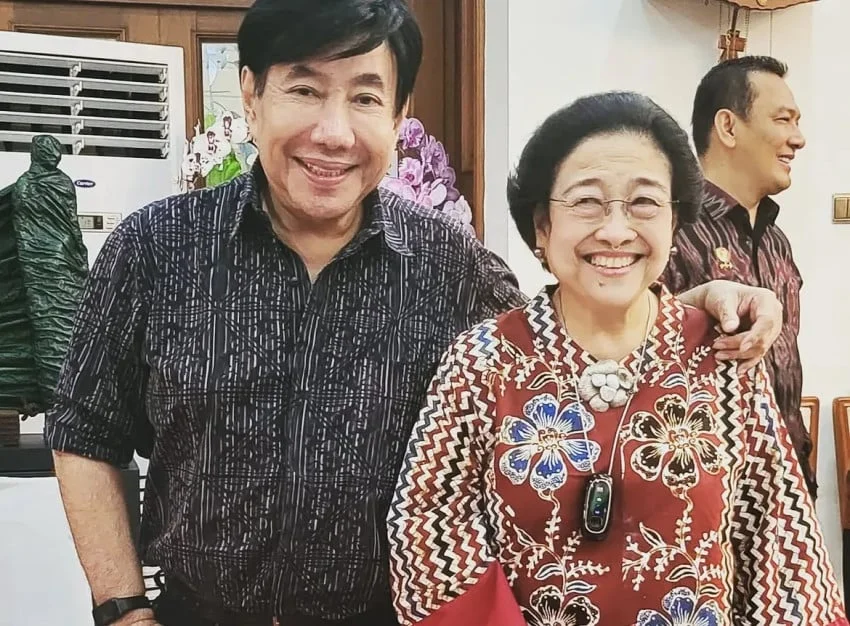
The Indonesian political landscape and cultural community are currently closely monitoring the health updates of Guruh Soekarnoputra, a prominent cultural figure, artist, and senior politician from the Indonesian Democratic Party of Struggle (PDI-P). Guruh, who is the younger brother of PDI-P General Chairperson and former Indonesian President Megawati Soekarnoputri, as well as the youngest son of Indonesia’s founding father and first president, Sukarno, is reportedly in critical condition. He is currently receiving intensive medical treatment at Siloam Hospital Semanggi in Jakarta, where a team of medical specialists is closely monitoring his vital signs following a sudden decline in his health status.
The news of his critical condition has prompted an outpouring of concern, well wishes, and prayers from political colleagues, cultural practitioners, and the broader Indonesian public. As family members, party loyalists, and admirers await further updates from the medical team, the situation has also cast a spotlight on Guruh’s extensive legacy as a guardian of traditional Indonesian arts and a veteran legislator.
Confirmation from Political Colleagues and Family Representatives
The alarming news regarding Guruh Soekarnoputra’s health was officially confirmed by close associates within the Indonesian Democratic Party of Struggle (PDI-P) on Friday, September 25, 2026. Guntur Romli, a prominent PDI-P politician, verified the reports of Guruh’s critical condition when contacted by members of the media. Romli conveyed an earnest appeal to the general public, asking for collective prayers and spiritual support for the swift recovery of the veteran artist and lawmaker.
"It is true, please keep him in your prayers. We are also holding joint prayer sessions for Mas Guruh. We kindly ask the people of Indonesia to pray for the recovery of Mas Guruh Soekarnoputra," Romli stated to journalists.
Echoing these sentiments, PDI-P Secretary-General Hasto Kristiyanto also came forward to address the media, confirming the seriousness of Guruh’s medical condition. Hasto emphasized the profound respect and affection the party holds for Guruh, not only as a senior political figure but as a vital pillar of the party’s cultural identity. "Please offer your prayers, hoping that he receives the grace of healing from God," Hasto remarked.
Further details regarding his hospitalization were corroborated by Didi Mahardika, a representative of the extended family. Didi revealed that Guruh’s health had been on a noticeable downward trajectory over the past year, marked by recurring medical complications associated with aging. According to family statements, Guruh experienced a critical moment of unresponsiveness while under the direct care of attending physicians at the hospital, prompting the medical team to elevate his treatment protocol to intensive care.
Chronology of Medical Treatment and Deteriorating Health
To understand the current medical crisis, it is essential to examine the chronology of Guruh Soekarnoputra’s health struggles in the months leading up to his admission to Siloam Hospital Semanggi. Medical disclosures from family and associates indicate that Guruh’s health has required increasingly vigilant oversight over the past twelve months.
Prior to his transfer to Siloam Hospital Semanggi, Guruh spent approximately four weeks undergoing intensive medical treatment at Medistra Hospital, another premier healthcare facility in Jakarta. During his tenure at Medistra Hospital, attending physicians implemented a comprehensive therapeutic regimen to manage his underlying health conditions. For a brief period, the treatment appeared to yield positive results, with medical reports noting slight improvements in his overall stability and responsiveness.
However, despite the dedicated efforts of the medical personnel at Medistra Hospital, Guruh’s underlying health vulnerabilities ultimately led to a relapse. As his condition began to deteriorate once again, medical consultants recommended a transfer to a specialized intensive care unit equipped to handle complex geriatric and critical care scenarios. Consequently, he was moved to Siloam Hospital Semanggi, where he remains under round-the-clock observation by a multidisciplinary team of medical specialists.
The timeline of his recent hospitalizations underscores the fragile nature of his health, culminating in the current critical juncture where he reportedly lost consciousness during medical procedures, necessitating emergency intensive interventions.
A Life Dedicated to Indonesian Arts, Culture, and Politics
Guruh Soekarnoputra was born in Jakarta on January 13, 1953, as the youngest child of President Sukarno and First Lady Fatmawati. Growing up in the epicenter of Indonesia’s nascent political and cultural revolution, Guruh carved out a distinct identity not merely as a political scion, but as one of Indonesia’s most visionary artists, choreographers, and cultural nationalists.
Throughout his prolific career, Guruh dedicated his life to preserving, promoting, and modernizing traditional Indonesian performing arts. He founded several groundbreaking cultural troupes and artistic organizations, most notably Swara Mahardika in 1977. Under his leadership, Swara Mahardika revolutionized the presentation of Indonesian traditional music, dance, and theater, blending indigenous cultural elements with contemporary theatrical staging. His artistic productions, such as the legendary musical Badai Pasti Berlalu (collaborating with legendary musicians like Eros Djarot and Chrisye), remain monumental milestones in the history of Indonesian popular culture and music.
In addition to his immense cultural contributions, Guruh followed in the footsteps of his family by entering public service and national politics. As a senior cadre of the Indonesian Democratic Party of Struggle (PDI-P), he served multiple terms as a member of the People’s Representative Council (DPR RI), representing his constituents with a strong focus on cultural preservation, national education, and the development of the creative economy. His political stance has consistently aligned with the foundational nationalist ideology of Marhaenism espoused by his father, making him a revered figure among party loyalists and traditionalists alike.
Broader Implications and Public Reaction
The critical health status of Guruh Soekarnoputra carries significant emotional and political resonance within the Indonesian sociopolitical landscape. As a direct descendant of President Sukarno, Guruh represents a living link to the generation that fought for and established the Republic of Indonesia. Any medical crisis involving members of the Sukarno family invariably draws intense national attention, reflecting the enduring sentimental and historical attachment that many Indonesians hold toward the nation’s founding lineage.
Furthermore, within the internal dynamics of the PDI-P, Guruh’s illness serves as a poignant reminder of the aging demographic of the party’s pioneering leadership generation. As senior figures face health challenges associated with advanced age, the party faces the ongoing task of ensuring a smooth transition of institutional memory and ideological continuity to younger generations of leaders.
The public reaction across social media platforms and traditional news outlets has been overwhelmingly sympathetic. Citizens, cultural figures, fellow artists, and political leaders from across the political spectrum have expressed solidarity with the Soekarno family, setting aside partisan differences to offer messages of hope and healing. Cultural institutions and arts organizations across the archipelago have similarly initiated collective prayer gatherings, acknowledging Guruh’s monumental role in shaping the modern identity of Indonesian arts and entertainment.
As medical teams at Siloam Hospital Semanggi continue their rigorous efforts to stabilize his condition, the nation waits with bated breath. The coming days will be critical as family members, political allies, and the wider Indonesian public monitor official bulletins regarding Guruh Soekarnoputra’s health trajectory, hoping for a miraculous recovery for one of the nation’s most cherished cultural icons.