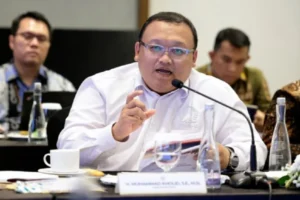
JAKARTA — The ongoing debate surrounding the handling of civil disobedience and public protests in Indonesia has once again taken center stage following critical remarks from prominent political observer Ray Rangkuti. Speaking at a public discussion in Menteng, Central Jakarta, Rangkuti emphasized that strict adherence to standard operating procedures (SOPs) alone is insufficient to curb police brutality and safeguard civilian lives during demonstrations. Instead, he argued that law enforcement officers must deeply internalize and practice core human rights principles to fundamentally transform how crowd control is executed on the ground.
The discourse, which addresses systemic issues of state power, institutional violence, and accountability, highlights a persistent tension between maintaining public order and protecting constitutional rights. Rangkuti’s observations arrive at a sensitive juncture for Indonesia’s democracy, where the frequency of public demonstrations over economic policies, labor rights, and anti-corruption measures has frequently intersected with violent crackdowns, resulting in injuries and, in severe cases, preventable fatalities.
Beyond Rules: The Need for Value-Based Law Enforcement
During the event titled September Hitam (Black September) Discussion, hosted by the Central Jakarta branch of the Catholic Student Association of the Republic of Indonesia (PMKRI), Rangkuti dissected the limitations of relying purely on legalistic frameworks to govern police behavior. He pointed out that while comprehensive rulebooks and Standard Operating Procedures (SOPs) exist within the Indonesian National Police (Polri) and other security apparatuses, these regulations frequently fail to translate into disciplined, protective fieldwork.
"Actually, there are SOPs. When it comes to the law, the rules are abundant, but why do they leave so little mark in practice? Because rules often remain just rules, and if they can be bypassed, they are bypassed," Rangkuti told journalists on the sidelines of the forum.
According to Rangkuti, the root cause of excessive force during protests lies in the mechanistic approach to law enforcement, where regulations are viewed as bureaucratic hurdles rather than moral imperatives. When officers view protocols merely as administrative guidelines rather than ethical boundaries, violations become easier to justify under the pressure of crowd management.
To combat this, Rangkuti advocated for a paradigm shift that transcends written protocols. He stressed that law enforcement agencies must cultivate an institutional culture rooted in human rights values, humanitarian vision, and ethical restraint.
"Therefore, we must speak of something above mere rules: values and vision. If we instill human rights values comprehensively, law enforcement officers will not be so quick to use physical force, nor will they act carelessly in arresting individuals without clear legal status, proper evidence, and due process," Rangkuti elaborated.
The Broader Context of Public Demonstrations in Indonesia
Public protests are a cornerstone of Indonesia’s post-reformasi democracy, serving as a primary outlet for public grievance against government policies, legislative decisions, and socio-economic inequalities. However, the management of these demonstrations has historically been fraught with controversy. Civil society organizations, human rights watchdogs, and legal aid institutions have repeatedly documented instances of disproportionate force, arbitrary arrests, and intimidation directed at student activists, laborers, and journalists.
The "September Hitam" movement itself serves as a poignant reminder of historical and contemporary human rights violations in Indonesia. Historically associated with a month of remembrance for unsolved human rights abuses—such as the murder of human rights defender Munir Said Thalib and various student crackdowns—the forum provided a critical platform to evaluate the current state of civil liberties under the administration.
In recent years, major legislative reforms, controversial employment laws, and anti-corruption commission (KPK) revisions have triggered nationwide mobilization. While the constitution guarantees freedom of assembly and expression under Article 28E of the 1945 Constitution, the practical reality on the streets often reflects a securitized approach to dissent. Clashes between security forces and protesters frequently result in tear gas deployment, water cannons, physical altercations, and mass detentions.
Chronology of Concerns and Legislative Scrutiny
The discourse on the use of force during protests is not isolated to academic circles or non-governmental organizations; it is a recurring subject of national legislative oversight. Over the past decade, several critical milestones have shaped the dialogue on police reform and crowd control in Indonesia:
- The 2019 Reformasi Dikorupsi Protests: A massive wave of student-led demonstrations across major Indonesian cities protesting controversial revisions to the Corruption Eradication Commission (KPK) law and the Criminal Code (KUHP). The demonstrations resulted in widespread clashes, hundreds of injuries, and the deaths of several university students, sparking intense national outrage over police tactics.
- The 2020 Omnibus Law (UU Cipta Kerja) Demonstrations: Labor unions and student groups mobilized nationwide against the passage of the Job Creation Law. Human rights groups reported numerous arbitrary arrests of journalists, legal observers, and peaceful demonstrators, alongside documented instances of physical abuse by law enforcement personnel in detention facilities.
- Ongoing Institutional Evaluations (2021–2026): Civil society coalitions, including KontraS (Commission for the Disappeared and Victims of Violence) and LBH Jakarta, have continuously published reports highlighting patterns of impunity within security institutions, urging systemic structural reforms rather than superficial disciplinary actions.
- Recent Security Statements: The complex dynamics of public unrest were further highlighted by high-level government reactions. Notably, state officials and security leaders, including figures like Prabowo Subianto in various security assessments, have pointed to the dual nature of large-scale unrest—acknowledging genuine public grievance while simultaneously cautioning against the infiltration of opportunistic actors, criminal networks, and narcotics mafias aiming to exploit peaceful protests for anarchic ends.
The Dilemma of Impunity and Institutional Accountability
A central theme of the PMKRI public discussion was the persistent issue of impunity. Impunity occurs when perpetrators of human rights violations—including security personnel who deploy excessive or lethal force—escape legal accountability, disciplinary action, or public scrutiny.
Legal experts and human rights advocates note that when officers involved in brutality face internal administrative sanctions rather than transparent public trials, public trust in the justice system erodes. This lack of accountability creates a dangerous precedent, signaling to personnel on the ground that aggressive tactics carry minimal long-term professional consequences.
Rangkuti’s commentary directly challenges this status quo by emphasizing that systemic reform cannot rely solely on punitive measures after a tragedy occurs. Preventive ethics—grounded in rigorous human rights training, psychological evaluations for riot police units, and clear command responsibility—must precede operational deployment.
Data and Insights from Human Rights Monitors
Data compiled by independent civil society watchdogs over the years illustrate the tangible human cost of inadequate crowd control mechanisms. According to reports from organizations such as the Indonesian Legal Aid Foundation (YLBHI) and KontraS:
- Hundreds of protesters are routinely injured annually during high-tension demonstrations, suffering trauma from blunt force, chemical irritants, and projectiles.
- Documented cases of arbitrary detention frequently involve violations of the Indonesian Criminal Procedure Code (KUHAP), where individuals are held beyond statutory limits without immediate access to legal counsel.
- The rate of criminal prosecution for law enforcement officers implicated in excessive violence remains disproportionately low compared to the volume of civilian complaints filed with oversight bodies such as the National Police Commission (Kompolnas) and the National Commission on Human Rights (Komnas HAM).
These statistics underscore the urgency of Rangkuti’s recommendations. Without a fundamental transformation in how security forces perceive civil dissent—shifting the operational mindset from treating protesters as security threats to viewing them as citizens exercising constitutional rights—the cycle of violence and subsequent public distrust will persist.
Official Responses and the Balance of Public Order
In response to persistent criticisms from civil society, the leadership of the Indonesian National Police has repeatedly stated its commitment to internal reform, human rights compliance, and professional standards during public operations. Polri leadership has often emphasized that operational guidelines explicitly prohibit the use of lethal force during peaceful assemblies and mandate adherence to proportionality and necessity.
Furthermore, internal divisions within the National Police, such as the Internal Affairs Division (Propam), are tasked with investigating ethical breaches and procedural violations by personnel. However, transparency and the independence of these internal investigations remain subjects of intense debate among legal scholars and civil rights activists, who frequently advocate for an independent external oversight body with subpoena and prosecution powers.
Balancing the maintenance of public order with the preservation of human rights remains one of the most delicate challenges for modern democratic states. Law enforcement agencies face the dual obligation of protecting public infrastructure, preventing property destruction, and ensuring public safety while simultaneously safeguarding the unhindered expression of political and social grievances.
Implications for Indonesia’s Democratic Future
The insights shared by Ray Rangkuti at the ‘September Hitam’ forum point to a broader philosophical question regarding the maturation of Indonesia’s democracy. As the nation continues to navigate complex social, political, and economic transformations, the relationship between the state and its citizenry will largely be defined by how the government handles dissent.
When state apparatuses rely on heavy-handed tactics, intimidation, and the marginalization of civil liberties, the social contract between the government and the public frays. Conversely, when law enforcement agencies operate with empathy, rigorous adherence to human rights standards, and deep institutional respect for constitutional freedoms, democratic institutions are strengthened.
The integration of human rights values into the daily operational philosophy of police and security forces is no longer merely an idealistic goal for human rights activists; it is an urgent institutional necessity. As Rangkuti concluded, transforming the culture of law enforcement requires moving beyond the text of regulations into the realm of shared human values—ensuring that every officer recognizes that the ultimate duty of the state is to protect, rather than infringe upon, the lives and dignity of its citizens.