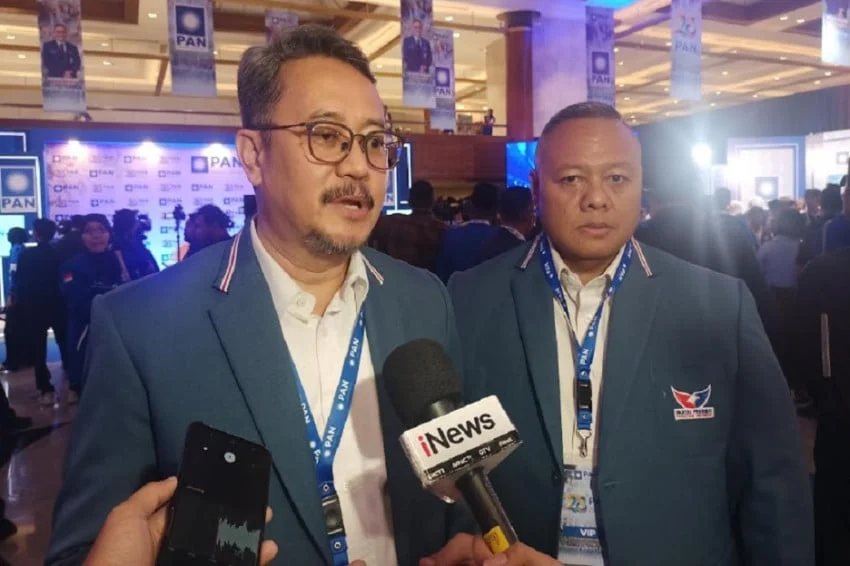
JAKARTA — The Secretary-General of the Central Executive Board (DPP) of the Perindo Party, Ferry Kurnia Rizkiyansyah, officially extended warm congratulations to the National Mandate Party (PAN) on the occasion of its 28th founding anniversary. Speaking on behalf of the Perindo leadership, Rizkiyansyah underscored the importance of forging deeper collaboration between political entities, particularly in initiatives aimed at direct public assistance and community empowerment.
The statement was delivered following Rizkiyansyah’s attendance at the high-profile commemoration of PAN’s 28th anniversary, held at the Jakarta International Convention Center (JICC) in Senayan, Jakarta. The celebratory gathering brought together prominent political figures, coalition leaders, and high-ranking state officials to mark nearly three decades of PAN’s presence in the Indonesian political landscape.
Aligning Visions for Grassroots Impact
During the event, the Perindo Secretary-General specifically highlighted and commended the central theme chosen by PAN for its 28th anniversary: "Bantu Rakyat Gerak Cepat" (Helping the People with Swift Action). According to Rizkiyansyah, this guiding motto closely mirrors the foundational ideology and ongoing struggle of the Perindo Party, which has consistently prioritized grassroots welfare, economic inclusivity, and responsive social assistance.
"On behalf of our Chairperson and the entire Perindo family, I extend my heartfelt congratulations to PAN on its 28th anniversary. Twenty-eight years is a remarkable milestone, and we must remember that PAN is a party born out of the reform era, having walked a long and significant path in shaping Indonesia’s modern democracy," Rizkiyansyah stated.
He further emphasized that the Perindo Party maintains an open-door policy regarding inter-party cooperation. Perindo is fully prepared to collaborate with any political organization, including PAN, to serve as a tangible solution provider for the pressing challenges faced by ordinary citizens. This collaborative spirit, Rizkiyansyah noted, extends far beyond routine political alignment or legislative coordination; it encompasses strategic, synchronized actions designed to boost the national economy from the grassroots level upward.
Historical Context and the Evolution of PAN in Indonesia’s Reform Era
To fully understand the significance of PAN’s 28th anniversary, it is essential to contextualize the party’s origins within Indonesia’s broader modern political history. Founded in the wake of the 1998 Reformasi movement—which ended the three-decade authoritarian rule of President Suharto—PAN emerged as a progressive, reform-minded political vehicle. Spearheaded initially by prominent intellectual and reform figure Amien Rais alongside a coalition of academics, activists, and civil society leaders, the party positioned itself as an advocate of moral politics, democratization, and decentralization.
Over the past twenty-eight years, PAN has transitioned from an opposition voice to a crucial component of various ruling coalitions, demonstrating institutional resilience and adaptability. Surviving multiple electoral cycles and navigating the complex thresholds of Indonesia’s electoral system, the party has consistently maintained a stable legislative presence in the People’s Representative Council (DPR). The 28th anniversary serves not only as a celebration of longevity but also as a strategic reflection point for the party’s leadership as they prepare for future legislative and executive contests.
The JICC Anniversary Gala: A Gathering of National Leaders
The anniversary gala at the JICC in Senayan was more than a celebratory milestone; it served as an important barometer of political alliances and national solidarity. The event drew key figures from across the political spectrum, reinforcing ties among coalition partners and highlighting the cooperative dynamics currently defining the national government under President Prabowo Subianto.
Among the high-profile attendees was President Prabowo Subianto himself, whose presence added substantial gravity to the proceedings. In his address to the gathered cadres and dignitaries, President Prabowo reflected on political loyalty, shared struggles, and the enduring bonds forged among reform-minded nationalists. "I am here today in the midst of loyal comrades-in-arms," Prabowo remarked, drawing loud applause from the audience and underscoring the solidarity binding the coalition parties together.
The presence of opposition and allied leaders alike—including representatives from the Perindo Party—demonstrated a growing consensus regarding the necessity of cross-party cooperation in addressing post-pandemic economic recovery, inflation, and global supply chain pressures. By attending the gala, Perindo signaled its commitment to constructive political dialogue and collaborative governance, transcending narrow partisan boundaries in the interest of national stability.
Economic Implications and the Call for Grassroots Sinergy
Rizkiyansyah’s call for strengthened synergy between Perindo and PAN touches upon a critical vulnerability in contemporary Indonesian politics: the risk of disconnect between political elites and the daily economic struggles of the working class. While macroeconomic indicators frequently point toward steady national growth, millions of Indonesian households continue to navigate inflationary pressures, formal and informal job market fluctuations, and rising costs of basic commodities.
By emphasizing economic upliftment as a primary vector for inter-party cooperation, Perindo is advocating for a shift in how political coalitions operate. Rather than focusing exclusively on electoral arithmetic and power-sharing arrangements, political parties are increasingly pressured by the electorate to demonstrate practical utility through synchronized social programs, micro, small, and medium enterprise (MSME) support, and localized welfare interventions.
Economic analysts note that collaboration between mid-sized and large political parties can yield significant policy advantages if channeled effectively through local legislative networks. Parties like Perindo, which historically maintains strong roots in media and retail-level economic advocacy, and PAN, with its extensive network of religious and community-based constituents, possess complementary strengths. Joint initiatives targeting MSMEs—which account for the vast majority of Indonesia’s GDP and employment—could serve as a practical testing ground for this proposed synergy.
Political Analysis: The Strategic Utility of Cross-Party Cooperation
From a broader political science perspective, Rizkiyansyah’s public overture reflects a sophisticated understanding of Indonesia’s multipolar presidential system. In a system characterized by fragmented legislative representation and coalition governments, political survival and policy efficacy depend heavily on coalition maintenance and inter-party diplomacy.
By publicly lauding PAN’s anniversary theme of swift grassroots action, Perindo positions itself not as a political competitor vying for the same ideological niche, but as a constructive partner willing to pool resources for common social goals. This strategy serves multiple purposes:
- Brand Reinforcement: It reinforces Perindo’s core public identity as a party focused on economic pragmatism and humanitarian assistance.
- Coalition Goodwill: It builds diplomatic goodwill with PAN and its broader coalition partners, potentially opening doors for future electoral cooperation at both the national and regional levels.
- Constructive Discourse: It shifts the media narrative away from cynical political maneuvering and toward substantive public service delivery.
Looking Ahead: The Road to Future Electoral Cycles
As Indonesia looks toward future regional and national democratic exercises, the relationships forged and reinforced during events such as PAN’s 28th anniversary will undoubtedly shape the contours of political alliances. The willingness of party leaders to engage in open dialogue, cross-party praise, and collaborative planning suggests a maturing political culture where pragmatic problem-solving increasingly takes precedence over rigid ideological divides.
For the Perindo Party, the messaging delivered by Secretary-General Ferry Kurnia Rizkiyansyah at the JICC marks a continuation of an inclusive political strategy. By extending a hand of partnership to PAN, Perindo has reiterated that the ultimate metric of political legitimacy in Indonesia today is not merely electoral victory, but the tangible, measurable improvement of the people’s daily lives. As both parties navigate the complexities of the national political arena, the realization of this proposed synergy will depend heavily on translating these diplomatic overtures into concrete, joint grassroots actions in the months and years to come.