The journey of George Tawlon Manneh Oppong Ousman Weah remains one of the most remarkable and improbable narratives in modern political and sporting history. Long before he assumed the presidency of Liberia in December 2017, Weah was already a global icon, etching his name into the annals of football history as the first and only African player to win both the FIFA World Player of the Year and the prestigious Ballon d’Or in 1995. Transitioning from the electrifying turf of Europe’s elite football stadiums to the complex, post-conflict political arena of his West African homeland, Weah’s trajectory represents a profound convergence of athletic excellence and national leadership. His election victory marked a historic milestone for Liberia, symbolizing a peaceful democratic transition and offering a war-weary populace a leader who transcended ethnic divisions through sheer national reverence and a populist platform centered on grassroots empowerment.
The Early Life and Rise of a Monrovia Prodigy
Born on October 1, 1966, in the Clara Town district of Monrovia, Liberia, Weah’s formative years were defined by modest beginnings and an unyielding passion for football. Raised largely by his paternal grandmother, Emma Klonh Wleh, in a densely populated and economically challenged neighborhood of the capital, Weah discovered the game on the sandy lots and improvised pitches of Monrovia. Long before he wore the colors of European giants, he honed his natural athleticism, balance, and vision playing barefoot with makeshift balls.
His raw talent soon caught the attention of local talent scouts, leading to stints with several Liberian clubs, including Invincible Eleven, Mighty Barolle, Bongrange Bonguine, and Young Survivors from Claretown. It was during his time with the youthful squad of Young Survivors—a team famously operating without a formal coach—that Weah’s leadership qualities began to manifest. Displaying remarkable tactical maturity and goal-scoring prowess, he spearheaded the club’s remarkable ascent into Liberia’s top-flight domestic division.
International Breakthrough: From Cameroon to the French Riviera
Weah’s exceptional performances on domestic soil soon attracted regional attention. In 1987, he made his first major professional leap when he signed a three-year contract with Tonnerre Yaoundé, one of Cameroon’s most storied football institutions. The transition from the Liberian league to the rigorous standards of Cameroonian professional football proved seamless for the young striker. In his debut season, Weah played a pivotal role in guiding Tonnerre to the Cameroonian championship, instantly validating the faith placed in him by the club’s management.
His exploits in Central Africa did not go unnoticed by European scouts. Jean-Claude Bouquet, a prominent talent spotter, brought tapes of Weah’s matches to the attention of Arsène Wenger, then the manager of AS Monaco. Recognizing the unique physical and technical attributes of the young forward—who combined imposing height and physical strength with extraordinary acceleration and precise finishing—Wenger brought Weah to France in 1987.
At just 22 years of age, Weah adapted rapidly to the tactical demands of the French Division 1. Over five seasons with AS Monaco, spanning from 1987 to 1992, Weah established himself as one of the most feared strikers in European football. During his tenure in the principality, he netted 57 goals in all competitions and helped Monaco secure the prestigious Coupe de France in 1991. Under Wenger’s mentorship, Weah refined his positional awareness and tactical discipline, transforming from a raw, instinctive talent into a complete modern forward capable of dismantling the most stubborn defenses.
Conquering European Football: PSG, AC Milan, and Historic Accolades
Building upon his success at Monaco, Weah transferred to Paris Saint-Germain (PSG) in 1992, entering a golden era of his career. In the French capital, Weah’s reputation skyrocketed. His blistering pace, exceptional ball control, and clinical finishing made him a fan favorite at the Parc des Princes. During his tenure with PSG, Weah captured another Coupe de France title, a French league championship, and played a central role in leading the club to the semi-finals of the UEFA Champions League in the 1994–1995 season. Across 123 appearances for the Parisian club, he tallied 37 goals and numerous assists, cementing his status as a continental superstar.
In the summer of 1995, Italian powerhouse AC Milan secured Weah’s signature in a high-profile transfer. It was within the tactical crucible of Serie A that Weah reached the absolute zenith of his individual career. Playing alongside world-class teammates under legendary managers, Weah was instrumental in Milan’s domestic campaigns, capturing the Serie A titles in the 1995–1996 and 1998–1999 seasons.
His time in Italy was punctuated by moments of individual brilliance that remain etched in football lore. Most notably, during a match against Hellas Verona in September 1996, Weah collected the ball deep inside his own penalty area following a corner kick, dribbled past virtually the entire opposing team across the length of the pitch, and slotted the ball into the back of the net—a solo effort widely regarded as one of the greatest goals in the history of the sport.
The culmination of his athletic achievements arrived in late 1995 when he was awarded the FIFA World Player of the Year, the Ballon d’Or, and the African Footballer of the Year simultaneously. To date, Weah remains the only African footballer to win the Ballon d’Or, a testament to his transcendent impact on the global game. Following his glittering spell with AC Milan, Weah enjoyed brief stints in the English Premier League with Chelsea and Manchester City, as well as a period in the United Arab Emirates with Al-Jazira, before officially hanging up his boots in 2003.
The Transition from Sports Icon to Political Activist
Even as he was scaling the heights of global sport, Weah remained acutely conscious of the devastating civil conflict ravaging his homeland. The First Liberian Civil War (1989–1996) and the Second Liberian Civil War (1999–2003) inflicted profound human suffering, displacing hundreds of thousands and destroying the nation’s infrastructure. Throughout the conflict, Weah used his personal wealth and global platform to advocate for peace, fund humanitarian relief efforts, and serve as a UNICEF Goodwill Ambassador, utilizing football as a tool to promote education, health, and social cohesion among impoverished youth.
Following his retirement from professional football in 2003, Weah decided that his next challenge would be in public service. Recognizing that symbolic philanthropy was insufficient to address the systemic structural failures of the Liberian state, he formally entered politics. In 2005, just two years after the conclusion of the second civil war, Weah announced his candidacy for the presidency of Liberia under the banner of the Congress for Democratic Change (CDC).
Political Evolution and the 2017 Electoral Triumph
Weah’s initial foray into national politics in 2005 revealed both his immense popular appeal and his initial political vulnerabilities. Running against veteran economist and former World Bank official Ellen Johnson Sirleaf, Weah won the first round of the presidential election. However, facing criticism from opponents regarding his formal educational background—critics pointed to his lack of a university degree at the time—Weah was ultimately defeated by Sirleaf in the runoff election.
Demonstrating a long-term commitment to public service rather than treating politics as a transient ambition, Weah systematically prepared himself for future leadership. He temporarily relocated to the United States to complete his high school education and subsequently earned a bachelor’s degree in business administration from DeVry University, followed by a master’s degree in public administration from Keller Graduate School of Management in 2011.
Returning to the political frontline, Weah ran for the vice presidency in 2011 on a joint ticket with Winston Tubman, which was again unsuccessful. Undeterred, he contested a senatorial seat for Montserrado County in 2014, securing a decisive victory that established his legislative credentials and cemented his political base in the country’s most populous region.
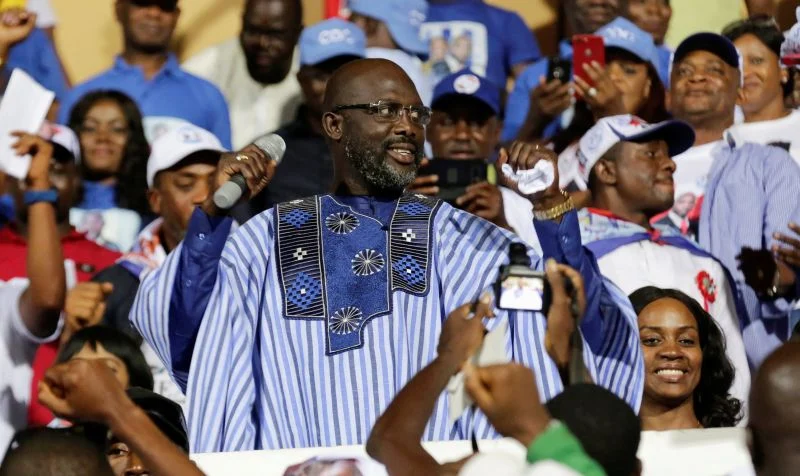
By 2017, the political landscape had shifted. With President Ellen Johnson Sirleaf constitutionally barred from seeking a third term, Weah positioned himself as the standard-bearer for change. Running as the presidential candidate of the Coalition for Democratic Change (CDC), Weah campaigned on a populist platform centered on youth empowerment, educational reform, infrastructure development, and anti-corruption measures. His message resonated deeply with a young demographic that made up the vast majority of Liberia’s population—many of whom had no living memory of stable democratic governance prior to the post-war era.
In the October 2017 general election, Weah won a plurality of the vote in the first round. In the subsequent runoff election held in December 2017, he secured a resounding victory over his opponent, Vice President Joseph Boakai, capturing more than 60 percent of the vote. The peaceful transfer of power marked a historic milestone for Liberia: it was the first democratic transition of power from one elected president to another in the country since 1944.
Domestic and International Reactions to the Presidency
The election of George Weah elicited widespread international acclaim and domestic jubilation. Citizens poured into the streets of Monrovia, celebrating not only the victory of a national hero but also the resilience of Liberia’s fragile democratic institutions. International observers, including delegations from the European Union, the African Union, and the Carter Center, praised the electoral process for its transparency and adherence to democratic norms, despite logistical challenges during the initial voting phases.
Congratulatory messages poured in from global leaders, sporting bodies, and international organizations. FIFA President Gianni Infantino and legendary figures from the world of football expressed immense pride in seeing one of their own ascend to the highest office of a sovereign nation. Analysts noted that Weah’s victory demonstrated the transformative power of celebrity in modern politics, while also highlighting the unique expectations placed upon leaders who emerge from outside traditional political establishments.
Governance Challenges and Socioeconomic Implications
Upon assuming office in January 2018, President George Weah inherited a nation facing severe economic headwinds, high rates of youth unemployment, underdeveloped public infrastructure, and deep-seated institutional corruption. The Liberian economy remained heavily reliant on commodity exports, particularly rubber and iron ore, leaving it vulnerable to external price shocks. Furthermore, the lingering socioeconomic scars of the civil wars and the devastating West African Ebola virus epidemic of 2014–2016 continued to strain public health and financial systems.
During his presidential tenure, Weah’s administration prioritized infrastructural development, notably the construction of paved roads, expansion of electricity grids, and the implementation of free tuition policies for undergraduate students in public universities to expand educational access. However, his administration also faced sustained criticism from domestic civil society organizations and international financial institutions regarding the pace of economic reform, management of public debt, and efforts to curb high-level corruption.
Despite these governing complexities, Weah’s presidency underscored a profound chapter in Liberian history. By navigating the transition from the football pitches of Europe to the executive mansion in Monrovia, George Weah transformed his unmatched athletic legacy into a vehicle for civic engagement and national leadership. His life story—rising from the sandy fields of Clara Town to the global stage and ultimately to the presidency—remains a powerful testament to ambition, resilience, and the evolving nature of political leadership in the twenty-first century.