South Korea has firmly established itself as one of the premier global tourism destinations, drawing millions of international visitors annually, with a particularly significant surge from Southeast Asian nations, including Indonesia. This remarkable boom in the country’s tourism sector is largely attributed to the unprecedented global popularity of the "Hallyu" wave, or the Korean Wave. Korean dramas, films, and music have successfully permeated international markets, showcasing meticulously crafted cinematic backdrops that seamlessly blend ultra-modern urban architecture with rich cultural heritage. For travelers eager to step directly into the scenes of their favorite television programs, South Korea offers an array of meticulously preserved historical sites and cutting-edge urban landscapes that cater to diverse aesthetic and cultural preferences.
The Phenomenon of Hallyu Tourism and Economic Impact
The intersection of entertainment media and tourism has proven to be a powerful economic catalyst for the Republic of Korea. Over the past decade, the Korean government, through the Korea Tourism Organization (KTO), has actively leveraged Hallyu to revitalize regional economies and urban centers. According to tourism analytics, international arrivals have consistently sought out locations featured prominently in popular series, transforming ordinary city streets, libraries, and cultural districts into iconic landmarks. This trend not only bolsters the hospitality and retail sectors but also fosters a deeper cross-cultural appreciation among global travelers who wish to experience firsthand the daily lifestyles depicted in Korean media.
Metropolitan Vibrancy: Experiencing the Nightlife and Modernity at Geonbae
For travelers seeking to immerse themselves in the high-energy pulse of contemporary South Korean urban life, metropolitan districts offer an electrifying atmosphere. Among the notable urban hotspots is Geonbae, a vibrant thoroughfare characterized by its dense concentration of modern bars, pubs, and dining establishments. Flanked on both sides by illuminated storefronts and neon signage, Geonbae epitomizes the sleepless nature of South Korea’s nightlife.

Historically, South Korea’s nightlife districts have evolved from traditional drinking houses into sophisticated hubs of modern social interaction, heavily featured in contemporary romance and slice-of-life dramas where characters unwind after demanding workdays. Geonbae remains perpetually crowded with a dynamic mix of local residents—ranging from young corporate professionals to university students—and international tourists. Urban planners note that such districts play a crucial role in the country’s nocturnal economy, providing secure, walkable environments that operate well into the early hours of the morning. Visitors frequenting these areas are encouraged to observe local etiquette while sampling traditional drinking culture, which often pairs local spirits like soju with various regional culinary delights.
Theatrical Heritage and Creative Expression in Daehakro
Shifting from commercial nightlife to the epicenter of artistic expression, Daehakro stands out as a monumental cultural corridor. Translating literally to "University Street," Daehakro is a 1.6-kilometer stretch located in Jongno-gu, Seoul, historically anchored by the former campus of Seoul National University before its relocation. Today, Daehakro functions as South Korea’s equivalent to Broadway in New York City or London’s West End.
The district’s timeline as a cultural hub dates back to the 1970s and 1980s, when it gradually transformed into a sanctuary for indie artists, experimental theater troupes, and avant-garde musicians. Currently, Daehakro boasts over 150 small-to-medium-sized theaters hosting a continuous rotation of theatrical plays, musicals, comedies, and street performances. This dense concentration of performing arts venues makes it the highest-density theater district in Asia. Cultural analysts emphasize that Daehakro is vital for nurturing domestic talent and providing independent production houses with a viable platform. For international visitors, strolling down Daehakro offers a rare glimpse into South Korea’s vibrant grassroots artistic community, far removed from the commercialized pop culture mainstream, yet deeply influential in shaping the nation’s contemporary identity.
Architectural Marvels and Modern Knowledge Hubs: Starfield Library
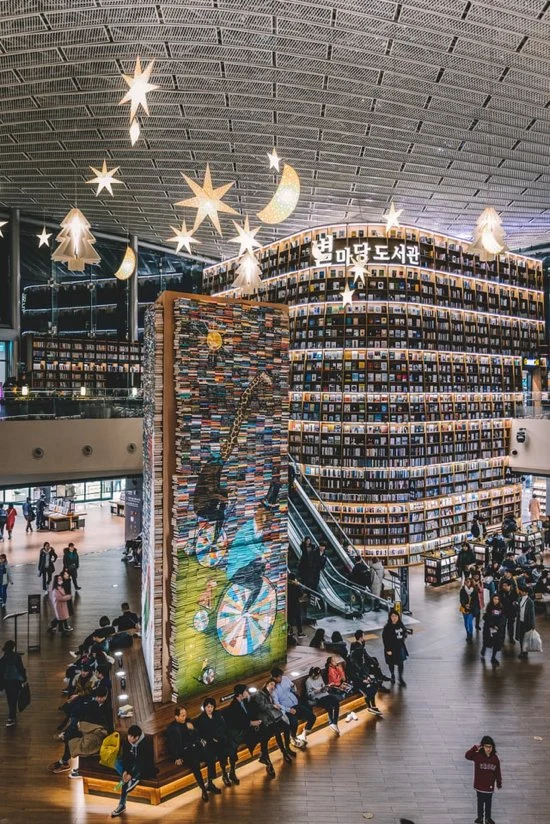
In stark contrast to open-air theater districts and bustling bar streets, modern South Korean urban design frequently integrates monumental indoor public spaces that redefine architecture. A prime example is the Starfield Library, located at the heart of the COEX Mall in Gangnam-gu, Seoul. Opened in May 2017, this expansive open-public library spans 2,800 square meters and has quickly become an architectural marvel and a mandatory stop for literary enthusiasts and photography buffs alike.

The defining structural feature of the Starfield Library is its three towering, 13-meter-high bookshelves that soar toward a glass ceiling, bathing the interior in natural sunlight during the day and offering a dramatic illuminated ambiance at night. The facility houses over 50,000 books, magazines, and an extensive digital catalog, covering a wide array of subjects including humanities, travel, hobbyist literature, and foreign publications. Unlike traditional research libraries characterized by strict silence and restricted access, Starfield Library is designed as an open cultural lounge. It regularly hosts public lectures, book readings, poetry recitals, and classical music concerts. Urban development experts view spaces like the Starfield Library as innovative responses to modern commercial architecture, successfully merging retail environments with accessible public intellectual spaces to enhance community engagement.
Broad Implications for International Travelers and Future Tourism Trends
The diverse appeal of destinations such as Geonbae, Daehakro, and the Starfield Library illustrates the multifaceted nature of contemporary South Korean tourism. By successfully preserving its historical narratives while simultaneously investing in futuristic urban infrastructure, South Korea has managed to sustain its competitive edge in the global travel market.
Industry forecasts suggest that Hallyu-inspired tourism will continue to evolve, with an increasing emphasis on sustainable travel, local community integration, and lesser-known regional destinations beyond Seoul. Tourism boards and travel agencies advise prospective visitors to plan their itineraries carefully, taking into account seasonal variations—such as the vibrant foliage of autumn or the cherry blossoms of spring—which significantly enhance the visual appeal of these urban landscapes.
Ultimately, exploring South Korea extends far beyond sightseeing; it represents an immersive journey into a society that harmonizes rapid technological advancement with a profound respect for arts, culture, and communal spaces. Whether one is navigating the neon-lit alleys of Geonbae, experiencing a live theatrical production on Daehakro, or reading beneath the soaring shelves of the Starfield Library, travelers are afforded a genuine connection to the dynamic narratives that continue to captivate a global audience.