
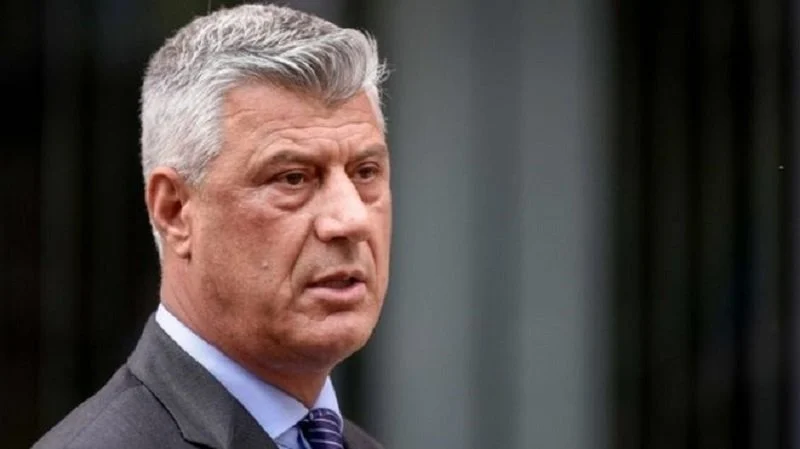
The Kosovo Specialist Chambers (KSC), a specialized court based in The Hague, Netherlands, delivered a landmark verdict on Wednesday, September 16, 2026, sentencing former Kosovo President Hashim Thaci to 25 years in prison. The ruling marks a significant moment in the legal reckoning of the Balkans, as Thaci, once a celebrated guerrilla leader and a key architect of Kosovo’s independence from Serbia, was found guilty of four counts of war crimes. These charges stem from his tenure as the supreme commander of the Kosovo Liberation Army (KLA) during the brutal conflict in the late 1990s.
The verdict concludes a protracted legal battle that has tested the fragile political stability of Kosovo and stirred deep-seated tensions regarding the nation’s history. Alongside Thaci, three other former senior commanders of the KLA—Jakup Krasniqi, Kadri Veseli, and Rexhep Selimi—also received prison sentences, underscoring the court’s determination to hold the military leadership of the era accountable for actions taken against political rivals and perceived collaborators during the struggle for sovereignty.
The Crimes and the Court’s Findings
Presiding Judge Charles Smith, delivering the judgment in a somber courtroom, outlined the findings of the court, which centered on the systemic violence orchestrated during the conflict. Thaci, now 58, was found guilty of murder, torture, and illegal detention. The KSC specifically cited the systematic elimination of 96 individuals, whom the KLA labeled as political opponents or collaborators with Serbian security forces.
While the prosecution had sought harsher penalties, the trial chamber did offer a partial reprieve by acquitting the defendants of six counts of crimes against humanity. The judges concluded that the prosecution failed to provide sufficient evidence to meet the high threshold required to prove that these acts were part of a "widespread and systematic attack" against the civilian population. Despite this, the conviction on war crimes charges remains a monumental blow to the political legacy of a man who served as the face of Kosovo on the international stage for over two decades.
The courtroom atmosphere was tense as the sentences were read. Thaci, maintaining his composure in a dark suit and tie, stood silently as the 25-year sentence was pronounced. His co-defendants received varying terms: Jakup Krasniqi was sentenced to 25 years, Kadri Veseli to 18 years, and Rexhep Selimi to 13 years, with credit for time already served in pre-trial detention.
A Timeline of Conflict and Prosecution
The roots of this legal saga trace back to the 1998–1999 Kosovo War, an ethnic conflict that saw the Kosovo Albanian population fight against the forces of Slobodan Milošević’s Serbia. The conflict, which ended following a NATO intervention, resulted in the eventual declaration of Kosovo’s independence in 2008—a move recognized by many Western nations but vehemently opposed by Serbia and its allies.
The KSC, established in 2015 to investigate allegations of crimes committed by KLA members between 1998 and 2000, operates under Kosovo law but is staffed by international judges and prosecutors to ensure impartiality and protect witnesses. The timeline of this specific case is as follows:
- 1998–1999: The Kosovo War; Thaci serves as the political leader and a key commander of the KLA.
- 2008: Kosovo declares independence; Thaci becomes a dominant political figure, eventually serving as Prime Minister and President.
- 2011: A Council of Europe report alleges that KLA leaders were involved in organ trafficking and other war crimes, triggering international scrutiny.
- 2015: The Kosovo Specialist Chambers are formally established in The Hague to handle cases related to the conflict.
- November 2020: Thaci resigns from the presidency following the confirmation of his indictment by the KSC. He surrenders to authorities and is transferred to The Hague.
- April 2023: The trial against Thaci and his co-defendants officially commences.
- September 16, 2026: The court delivers its verdict, sentencing Thaci to 25 years in prison.
The Sociopolitical Context in Kosovo
To understand the weight of this verdict, one must understand the status of the KLA in the eyes of the Kosovar public. For the vast majority of ethnic Albanians in Kosovo, the KLA is not a criminal organization but a liberation force that fought against the brutal oppression of the Milošević regime. Hashim Thaci, often referred to by his wartime nom-de-guerre "Snake," is viewed by many as a national hero who secured the nation’s freedom.
This dichotomy between "liberator" and "war criminal" has created a volatile public atmosphere. Following the announcement of the verdict, Kosovar Minister of Foreign Affairs Glauk Konjufca issued a stinging critique, calling the judgment "horrifying" and arguing that it causes irreparable harm to the state of Kosovo. Proponents of this view argue that the court unfairly targets the victims of the war (the Kosovo Albanians) while ignoring the atrocities committed by Serbian forces during the same period.
Conversely, human rights organizations and legal experts suggest that the KSC serves a vital function in regional reconciliation. By establishing individual criminal responsibility, the court aims to strip away the myth of the "hero" and acknowledge the suffering of all victims, including those killed by their own countrymen in the pursuit of political dominance.
Analytical Implications and Regional Stability
The conviction of Thaci carries profound implications for Kosovo’s domestic politics and its ongoing dialogue with Serbia. Since his arrest in 2020, Kosovo has seen a shift in its political landscape, with a rise in anti-establishment movements that have distanced themselves from the "war-time generation" of leaders.
- Normalization of Relations: The verdict is unlikely to ease the frozen conflict between Pristina and Belgrade. While the trial was intended to address past grievances, it has deepened the sense of victimhood in Kosovo, which may complicate the European Union-led normalization talks.
- Legal Precedent: This case serves as a benchmark for international justice in post-conflict states. The reliance on the KSC, rather than a domestic court, underscores the difficulty of prosecuting former resistance leaders in their own countries, where they often enjoy significant political protection.
- Regional Stability: Analysts warn that the nationalist fervor sparked by the verdict could lead to civil unrest. However, the move toward European integration for both Kosovo and Serbia remains a powerful incentive for both sides to avoid large-scale destabilization.
The Road Ahead
The legal process is not yet fully exhausted. Following the announcement, the defense teams for Thaci, Krasniqi, Veseli, and Selimi immediately signaled their intent to appeal the verdict. Under the rules of the Kosovo Specialist Chambers, the appeals process could take several months, if not years, as the defense seeks to challenge the interpretation of evidence and the sentencing guidelines used by the trial chamber.
As the dust settles in The Hague, the long-term impact of this ruling remains to be seen. For the families of the 96 individuals whose deaths led to this conviction, Wednesday’s verdict provides a long-awaited acknowledgment of their loss. For Kosovo as a nation, the event marks a painful but perhaps necessary chapter in its transition from a battle-hardened territory into a mature, law-abiding state.
Whether this verdict will ultimately lead to a more stable future or ignite further discord remains the central question for the Balkan region. For now, the sentencing of Hashim Thaci stands as a stern reminder that the passage of time does not grant immunity from the consequences of wartime actions, and that the path to peace is often paved with difficult, and often deeply divisive, legal truths.
