
Merauke Regency in South Papua is witnessing a strategic shift in how local governance interacts with its traditional roots. The Office of National Unity and Political Affairs (Badan Kesbangpol) of Merauke Regency has formally initiated a comprehensive push to strengthen indigenous customary institutions, ensuring they transition from reactive conflict-resolution agents into proactive, permanent strategic partners in regional development and social order.
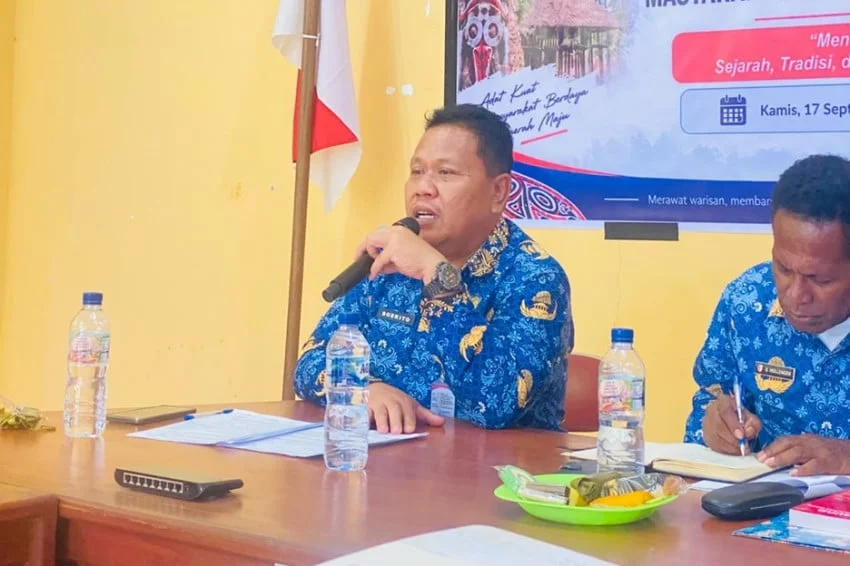
This policy direction was front and center during a focused stakeholder discussion held at the Kesbangpol meeting room in Merauke. The high-level dialogue, themed “Strengthening, Protection, and Participation of Indigenous Law Communities in Regional Development,” was organized in collaboration with the Merah Pusaka Stratejik Indonesia (MPSI) Foundation. The convening brought together government officials, civil society organizers, and customary leaders to evaluate how traditional authorities can be better integrated into the administrative architecture of Indonesia’s southernmost regency.
The Strategic Imperative of Customary Leadership in Papua
At the core of the Merauke administration’s new stance is a pragmatic recognition of sociological reality: customary leaders and traditional institutions wield profound, enduring social influence at the grassroots level. While formal bureaucratic structures operate through top-down policy execution, indigenous leaders hold the moral and cultural authority necessary to resonate deeply with local populations.
Head of the Merauke Kesbangpol, Sukito, emphasized during the forum that traditional authorities should no longer be treated as mere firefighters—summoned only after social friction has erupted into open conflict. Instead, they must be woven into the fabric of daily governance, serving as crucial bridges for communication, social cohesion, and development support.
"Security and community comfort are fundamental prerequisites for any development initiative to succeed," Sukito stated during the proceedings. While acknowledging that Merauke currently enjoys a relatively stable and conducive security climate, he underscored that regional authorities cannot afford complacency. Potential social issues must be identified and addressed at their inception through continuous, institutionalized dialogue involving the government, the citizenry, and customary figureheads.
Shifting from Reactive Response to Early Detection
A key takeaway from the MPSI-backed forum is the redefinition of what constitutes effective conflict mitigation. According to the Kesbangpol leadership, preventing social upheaval does not exclusively rely on physical infrastructure projects or heavy-handed security operations. Rather, the cornerstone of regional stability lies in acute sociological observation—the ability to read early warning signs of discontent, maintain open channels of communication, and foster inclusive public spaces for dialogue before minor grievances escalate.
This proactive philosophy aligns with Merauke’s broader administrative strategy. Over recent years, the regional government has steadily expanded its multi-stakeholder engagement framework. Kesbangpol has actively maintained robust communication networks with a diverse array of community elements, ranging from registered mass organizations and indigenous councils to the Interfaith Harmony Forum (FKUB), the Community Early Vigilance Forum (FKDM), and the National Integration Forum (FPK).
By integrating customary institutions more formally into this existing participatory matrix, the Merauke government hopes to create a resilient social safety net capable of absorbing the socioeconomic shocks accompanying rapid regional development.
Background and Context: Development and Customary Rights in South Papua
To fully understand the weight of the discussions in Merauke, one must examine the broader geopolitical and developmental context of South Papua. Following the formal enactment of the new autonomous provinces in Papua, Merauke has found itself designated as a central hub for major national strategic projects, including large-scale agricultural optimization initiatives and infrastructure expansions aimed at bolstering national food security.
While these national projects bring economic investment and physical modernization, they frequently intersect with traditional land use, customary rights (hak ulayat), and indigenous livelihoods. In many regions across the Papuan archipelago, rapid economic transition without adequate local consultation has historically served as a catalyst for friction between corporate entities, state actors, and indigenous communities.
By proactively strengthening indigenous institutions, the Merauke Regency government is attempting to preemptively address these structural vulnerabilities. Empowering customary leaders with formal consultative channels ensures that indigenous communities retain a voice in spatial planning, resource allocation, and cultural preservation, thereby mitigating potential friction points before they materialize into industrial or social disputes.
Chronology of the Policy Evolution
The integration of customary institutions into Merauke’s governance framework is the culmination of a gradual institutional evolution rather than an overnight policy shift.
Phase one of this trajectory involved basic security coordination, where traditional leaders were briefed on regional security updates primarily during moments of heightened tension or electoral cycles.
Phase two, spanning recent years, saw the establishment of structured forums such as the FKUB and FKDM, which formally institutionalized dialogue between civil authorities and community representatives.
The current initiative, marked by the mid-September forum hosted by the MPSI Foundation at the Kesbangpol office, represents phase three: the structural elevation of customary law communities from consultative participants to recognized, strategic co-architects of regional development. This phase focuses on legal protection, institutional capacity-building, and embedding traditional governance frameworks into municipal planning documents.
Broader Implications for Regional Stability and Local Governance
The implications of Merauke’s policy shift extend far beyond local administration, offering a potential model for regional governance across Eastern Indonesia.
From an economic standpoint, creating a predictable, stable, and socially harmonious investment climate is vital for regional growth. Investors—ranging from agricultural enterprises participating in corporate social responsibility (CSR) programs to infrastructure developers—benefit immensely from operating in an environment where potential land and social disputes are mediated by respected traditional authorities long before they disrupt operations.
From a socio-cultural standpoint, this approach honors the constitutional recognition of indigenous law communities (masyarakat hukum adat) as stipulated under Indonesian law. By granting customary institutions a recognized seat at the policy-making table, the government validates indigenous identity and safeguards local heritage against the pressures of rapid modernization.
Furthermore, the integration of customary networks into early-warning mechanisms enhances public safety at a fraction of the cost required for reactive security interventions. When traditional leaders are equipped with the information, resources, and institutional backing to resolve internal disputes using customary mediation (musyawarah adat), minor neighborhood disagreements or land boundary disputes are resolved locally, keeping the judicial and penal systems from becoming overburdened.
Future Outlook and Next Steps
As the Merauke Kesbangpol moves forward following the MPSI forum, the primary challenge will lie in implementation: translating high-level policy discussions into actionable legal frameworks, clear standard operating procedures, and sustained financial or administrative support for customary councils.
Stakeholders have emphasized that empowering indigenous institutions requires more than symbolic gestures; it demands capacity-building, transparent communication protocols, and a genuine willingness from state officials to share decision-making space with traditional authorities.
With Merauke continuing to balance national strategic mandates with local cultural preservation, the success of this initiative will be measured by the region’s long-term social stability and the sustained inclusion of indigenous voices in the trajectory of South Papua’s development. Through persistent dialogue, proactive early detection, and the elevation of customary leadership, Merauke is charting a steady course toward inclusive and resilient regional governance.
