
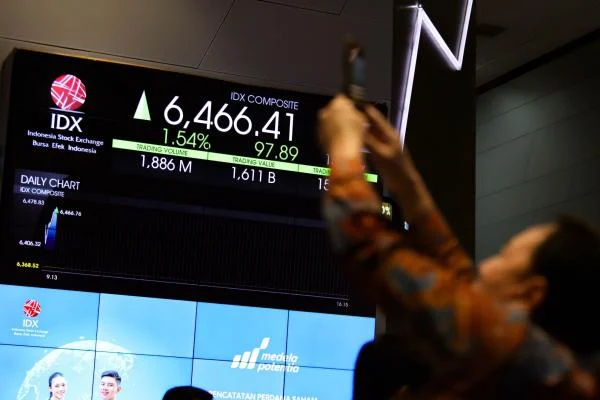
The Jakarta Composite Index, widely known as the Indeks Harga Saham Gabungan (IHSG), successfully closed in positive territory during the final trading session on Thursday, September 17, 2026. Demonstrating resilience amid shifting regional and global macroeconomic sentiments, the benchmark index advanced by 25.58 points, or 0.40 percent, to settle at the 6,462 level. This positive momentum reflected strong participation from retail and institutional investors alike, characterized by robust trading volumes and widespread gains across a majority of the market sectors listed on the Indonesia Stock Exchange (IDX).
Comprehensive Market Statistics and Trading Activity
Thursday’s trading session was marked by an energetic market breadth, signifying healthy buying interest across diverse asset classes within the exchange. Out of the total equities traded, 407 stocks recorded gains, 255 stocks experienced corrections, and 301 stocks remained stagnant, reflecting a balanced yet predominantly bullish market sentiment.
Market liquidity remained strong throughout the session, with total transaction values reaching Rp13.8 trillion. This substantial turnover was generated through the exchange of approximately 27.3 billion shares across various boards. The sheer volume of transactions underscores ongoing investor confidence in the underlying fundamentals of Indonesian corporations, even as global markets navigate inflationary pressures and fluctuating monetary policies.
Major benchmark indices on the Indonesia Stock Exchange mirrored the upward trajectory of the main index. The LQ45 index, which tracks the 45 most liquid and highly capitalized stocks, crept up by 0.22 percent to close at 648. Similarly, the Jakarta Islamic Index (JII), focusing on Sharia-compliant securities, edged higher by 0.02 percent to finish at 392.
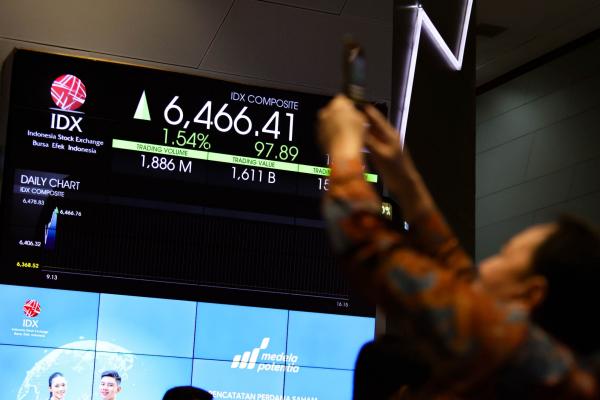
Broader market gauges also posted encouraging figures. The IDX30 index advanced by 0.36 percent to reach 360, while the MNC36 index recorded a 0.27 percent gain, closing the day at 282. These consistent, albeit modest, increases across multiple sub-indices highlight a synchronized recovery rather than a rally driven by a single heavyweight sector.
Sectoral Performance: Energy and Financials Lead the Charge
A closer look at sectoral indices reveals a dominant green wave across the board. Out of the eleven primary sectors monitored on the IDX, ten closed in positive territory, while only a single sector succumbed to selling pressure.
The sectors that successfully ended the day in the green zone included energy, non-cyclical consumer goods, financials, properties, basic materials, transportation, industrial, technology, cyclical consumer goods, and infrastructure. Financial institutions and energy counters served as the primary pillars supporting the IHSG, driven by steady corporate earnings reports and favorable commodity price outlooks.
Conversely, the healthcare sector stood out as the sole laggard, closing the session in the red. Analysts attribute the minor pullback in healthcare stocks to routine profit-taking following short-term rallies earlier in the week, alongside shifting defensive allocations by institutional portfolios.
Top Gainers and Top Losers of the Session
Individual stock movements provided significant excitement for market participants, with several lesser-known and mid-cap equities experiencing sharp volatility.

Leading the top gainers list was PT Arkayana Lestari Grup Tbk (AYLS), which skyrocketed by 34.69 percent to close at Rp198 per share. Close behind was PT Andalan Sakti Primaindo Tbk (ASPI), registering an impressive surge of 24.51 percent to finish at Rp635. Rounding out the top three performing equities was PT Dana Brata Luhur Tbk (TEBE), which climbed 18.73 percent to reach Rp1,965 per share. These substantial gains were largely attributed to speculative buying and company-specific corporate updates that caught the attention of growth-oriented investors.
On the flip side, the top losers board featured equities that faced heavy profit-taking and downward selling pressure. PT Asia Sejahtera Mina Tbk (AGAR) suffered the steepest decline among common stocks, plunging 14.62 percent to Rp2,160. It was followed by the Reksa Dana Indeks Simas ETF IDX30, which fell 14.52 percent to Rp106. Additionally, logistics provider PT Satria Antaran Prima Tbk (SAPX) dropped 12.02 percent, closing the day at Rp322 per share.
Background Context and Recent Market Trajectory
The rebound on Thursday follows a period of notable volatility within the Indonesian capital market. Earlier in the week, specifically during the trading session on Tuesday, September 15, 2026, the market experienced a downturn where 332 stocks slumped into the red zone, dragging the IHSG down to close at 6,461.
Market observers noted that the earlier contraction was primarily driven by external uncertainties, including cautious stances adopted by global central banks and foreign capital outflows from emerging markets. However, the ability of the IHSG to recover and hold above the 6,460 support level by Thursday demonstrates underlying domestic market resilience. Analysts have pointed out that strong domestic consumption, robust retail investor participation, and favorable quarterly economic indicators continue to provide a vital cushion against external shocks.
Expert Analysis and Broader Implications
Financial analysts reviewing Thursday’s market action emphasize that the consolidation phase currently experienced by the IHSG is a normal part of the broader market cycle. While global headwinds—such as geopolitical tensions and fluctuating currency exchange rates—continue to cast a shadow over emerging market economies, Indonesia’s macroeconomic fundamentals remain relatively stable.

The high transaction value of Rp13.8 trillion indicates that liquidity within the domestic financial system is adequate to support active trading. Institutional investors appear to be engaging in selective stock-picking, focusing on companies with solid balance sheets, sustainable dividend payouts, and strong exposure to domestic economic growth drivers such as infrastructure development and consumer spending.
Looking ahead, market participants are advised to closely monitor upcoming macroeconomic data releases, including domestic inflation figures, trade balance reports, and central bank interest rate decisions. These indicators will heavily influence market direction in the remaining weeks of the third quarter of 2026. While short-term volatility is expected to persist, the capacity of the IHSG to maintain its position above crucial psychological thresholds offers a cautiously optimistic outlook for investors navigating the Indonesian bourse.
