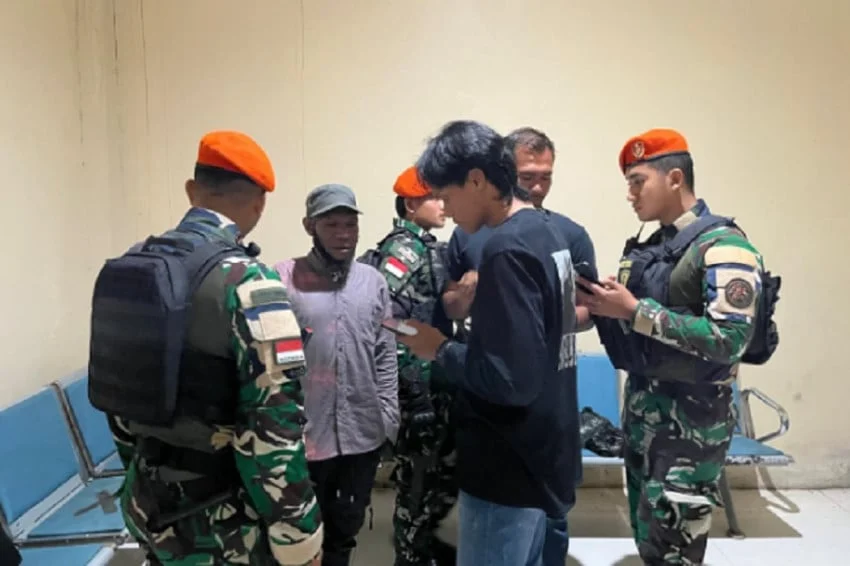
A joint security operation involving the 462nd Commando Battalion of the Indonesian Air Force (Yon 462 Pasgat) and the Mandala Task Force of the Indonesian National Armed Forces Operations Command (Koops TNI Habema), operating under the direct command of the Joint Regional Defense Command III (Kogabwilhan III), has successfully apprehended Abdon Kisamdu, the Deputy Battalion Commander of the West Papua National Liberation Army-Free Papua Organization (TPNPB-OPM) Kodap 35 Bintang Timur. The high-profile arrest took place at Nop Goliat Dekai Airport in Yahukimo Regency, Highland Papua province, on Saturday, September 19, 2026, at precisely 14:59 WIT (Eastern Indonesia Time).
The capture of Kisamdu represents a significant tactical breakthrough in ongoing security and stabilization efforts across Indonesia’s easternmost provinces. Kisamdu had long been designated as a primary fugitive on the Wanted List (DPO) issued by the Indonesian National Police (Mabes Polri) due to his direct involvement in numerous violent incidents, armed assaults, and destabilization campaigns attributed to separatist factions operating in the Highland Papua region.
Precision Operation at Nop Goliat Dekai Airport
The successful apprehension was the result of intelligence-led planning and rigorous inter-agency coordination. According to official briefings, the operation commenced when command elements received actionable intelligence regarding Kisamdu’s travel itinerary. He was tracked boarding a scheduled commercial flight, specifically a Trigana Air Passenger flight (PK-YSC, Boeing 737-500), which was inbound to Dekai from a regional transit hub.
Anticipating the arrival of the high-value target, security personnel from the Yon 462 Pasgat and the Satgas Mandala Koops TNI Habema executed a swift containment protocol. Troops secured all primary access and exit points of Nop Goliat Dekai Airport to prevent any potential escape or armed resistance.
As the aircraft touched down and passengers began disembarking, joint security personnel intercepted Kisamdu the moment he stepped onto the tarmac. Without offering significant physical resistance—largely due to the overwhelming tactical advantage and rapid deployment of the security forces—Kisamdu was immediately detained. To ensure public safety and maintain operational security, he was swiftly escorted to a secure isolation facility within the airport complex for initial interrogation and documentation.
Confession and Seizure of Evidence
During the initial debriefing conducted by military intelligence officers at the airport, Kisamdu made critical admissions regarding the purpose of his clandestine journey to Yahukimo. The suspect explicitly confessed that he had traveled to Dekai to orchestrate and finalize a transaction for the procurement of a substantial cache of illicit firearms.
Kisamdu revealed plans to meet with an unidentified arms broker or supplier located in the Kali Seng area of Yahukimo Regency, Highland Papua. The objective of acquiring these military-grade weapons was to replenish the armaments of the TPNPB-OPM Kodap 35 Bintang Timur faction, thereby enhancing their tactical capabilities for future armed confrontations against state security forces and civilian populations.
To corroborate these statements, military personnel conducted an immediate forensic inspection of Kisamdu’s personal electronic devices. A thorough examination of the suspect’s mobile gadget yielded undeniable digital evidence, including text messages, encrypted chat logs, and call records detailing ongoing negotiations, pricing agreements, and logistical coordination for the illegal arms purchase. This trove of digital intelligence has since been handed over to specialized investigators for further analysis, potentially uncovering broader illicit trafficking networks operating across the provincial borders.
Official Statements and Strategic Assessment
The Commander of the Joint Regional Defense Command III (Pangkogabwilhan III), Lieutenant General TNI Lucky Avianto, formally addressed the media following the successful execution of the operation. He underscored the gravity of the intercepted transaction and commended the vigilance and discipline of the participating military units.
"Abdon Kisamdu terkonfirmasi berada di pesawat Trigana Pax PK-YSC Jenis B737-500, yang akan mendarat pada Pukul 14.59 WIT. Sesaat setelah turun dari pesawat, personel TNI langsung menangkap lalu mengamankan Abdom Kisamdu ke salah satu ruang isolasi Bandara Nop Goliat Dekai Yahukimo. Yang bersangkutan mengaku akan memborong senjata api untuk kelompoknya," stated Lt. Gen. Lucky Avianto, highlighting the precise mechanics of the apprehension.
The Pangkogabwilhan III commander further elaborated on the catastrophic potential of the thwarted arms deal. He emphasized that the successful interception averted a severe escalation of violence in a region that has already suffered immensely from separatist-driven atrocities.
"Tidak dapat terbayangkan apabila yang bersangkutan dapat menyelesaikan transaksi pembelian senjata api tersebut, mengingat TPNPB-OPM Kodap 35 Bintang Timur tercatat telah melakukan serangkaian aksi kekerasan dan tindak kriminal di wilayah Kabupaten Pegunungan Bintang, Provinsi Papua Pegunungan," Lt. Gen. Lucky Avianto added, stressing the relentless reign of terror historically inflicted by Kisamdu’s faction upon local communities.
Background Context: Kodap 35 Bintang Timur and Regional Threat Matrix
To fully comprehend the strategic significance of arresting Abdon Kisamdu, it is essential to examine the operational profile of the TPNPB-OPM Kodap 35 Bintang Timur. This specific armed faction operates primarily within the rugged, mountainous terrain of Bintang Mountains (Pegunungan Bintang) Regency and surrounding districts within Highland Papua. Over recent years, Kodap 35 has been linked to numerous systematic attacks against infrastructure projects, government outposts, security personnel, and unarmed civilians.
Military analysts and intelligence reports indicate troubling operational linkages and ideological alignments between the leadership of Kodap 35 and other notorious insurgent groupings within the Papua region. Specifically, Ananias Ati Mimin, the primary leader of the TPNPB-OPM Kodap 35 Bintang Timur, maintains a close ideological and strategic alignment with Egianus Kogoya, the commander of the West Papua National Liberation Army’s Third Ndugama Regional Defense Command.
Egianus Kogoya remains one of the most wanted insurgent commanders in Indonesia, infamous for orchestrating high-profile acts of terror, including the kidnapping of foreign airmen, attacks on construction workers, and brutal targeted killings of civilians. Most notably, Kogoya’s faction was identified as the primary perpetrator behind the cold-blooded murder of Aris Sanda, an innocent civilian working as a travel vehicle driver, along the strategic Trans Wamena-Nduga roadway. The ideological synergy between figures like Ati Mimin, Kogoya, and operational deputies like Abdon Kisamdu illustrates a coordinated network of violence designed to instill fear, disrupt regional governance, and derail infrastructure development intended to benefit the indigenous population of Papua.
Implications for Security and Future Counter-Insurgency Operations
The neutralization of Abdon Kisamdu carries profound implications for the operational stability of Highland Papua. By cutting off a key logistics and procurement coordinator, Koops TNI Habema and Kogabwilhan III have delivered a crippling blow to the command-and-control structure of the TPNPB-OPM Kodap 35 Bintang Timur.
1. Disruption of Illicit Supply Chains
The primary vulnerability of armed insurgent groups in remote regions lies in their dependency on external supply lines for ammunition, firearms, and logistical support. Kisamdu’s arrest exposes how separatist elements attempt to exploit commercial aviation and remote trading posts to funnel weapons into conflict zones. The seizure of digital evidence from Kisamdu’s device is expected to yield leads that will enable security forces to dismantle the broader underground trafficking ring operating in Yahukimo and surrounding regencies.
2. Deterrence and Morale Shift
The detention of a high-ranking DPO fugitive at a major regional transit hub demonstrates the expanding intelligence reach and operational readiness of state security apparatuses. This serves as a significant morale booster for military and police personnel operating under challenging geographical conditions, while simultaneously inducing strategic panic within the ranks of the TPNPB-OPM, demonstrating that flight networks and safe havens are increasingly compromised.
3. Protection of Civilian Lives
With ongoing military operations spearheaded by Koops TNI Habema—which were recently intensified following a series of brutal attacks that left three civilian residents dead at the hands of OPM elements—the focus remains firmly on civilian protection. The removal of an active procurement officer diminishes the faction’s capacity to execute retaliatory or offensive operations, thereby safeguarding local communities, public servants, and developmental workers striving to improve socioeconomic conditions in Highland Papua.
Conclusion and Next Steps
Following his capture at Nop Goliat Dekai Airport, Abdon Kisamdu is slated to undergo comprehensive joint interrogations involving military investigators, intelligence units, and the Indonesian National Police. Due to his status as a long-standing fugitive on the national police DPO, he will face formal criminal charges related to illegal arms trafficking, association with terrorist and separatist organizations, and complicity in acts of violence resulting in loss of life.
The successful operation underscores the effectiveness of the integrated command structure under Kogabwilhan III and the proactive posture of task forces like Koops TNI Habema and Yon 462 Pasgat. As investigations unfold, state authorities anticipate uncovering further details regarding underground financial networks and external supporters sustaining armed separatism in Papua, paving the way for sustained peace, law enforcement, and regional development.