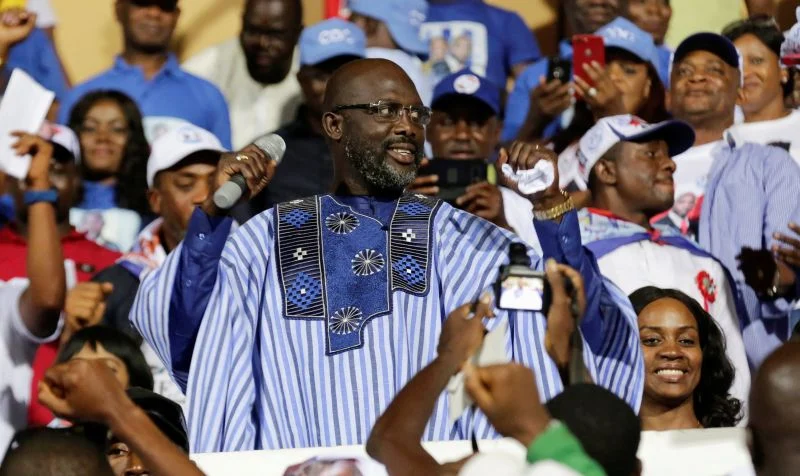
The journey of George Tawlon Manneh Oppong Ousman Weah from the dusty football pitches of Monrovia to the hallowed halls of the presidency is a narrative of extraordinary achievement, resilience, and a profound commitment to his homeland. In December 2017, following a distinguished career that saw him crowned the world’s best footballer, Weah officially transitioned from global sporting icon to the elected President of Liberia, marking a historic moment for both the man and the nation. His unparalleled success on the football field, marked by stints with legendary clubs such as AC Milan, Manchester City, and Chelsea, laid the foundation for a remarkable second act in the realm of politics, a path he embarked upon after hanging up his boots.
The Rise of a Liberian Talent
Born on October 1, 1966, in Monrovia, Liberia, George Weah’s innate talent for the beautiful game was evident from a young age. Growing up in the capital city, his early footballing days were spent honing his skills on the sandy fields, a testament to the raw passion that fueled his burgeoning career. Before gracing international stages, Weah played for several local Liberian clubs, including Invincible Eleven, Mighty Barolle, Bongrange Bonguine, and Young Survivors of Claretown. It was with Young Survivors, a team that famously operated without a coach, that he first showcased his leadership and ability to elevate a team, guiding them to the top division during his teenage years.
His precocious talent soon attracted attention beyond Liberia’s borders. In 1987, at the age of 17, Weah was signed by Tonnerre Yaoundé, a prominent club in Cameroon. His immediate impact was undeniable, as he helped the team clinch the league title in his debut season, signaling the arrival of a significant footballing force. This success in Cameroon was a crucial stepping stone, providing him with the experience and exposure necessary for the next phase of his career.
European Stardom and Global Recognition
The trajectory of Weah’s career took a dramatic upward turn when he was scouted by AS Monaco, a French Ligue 1 club. At just 22 years old, he made the move to France in 1987, embarking on a five-season spell (1987-1992) that saw him become a formidable presence in European football. During his time with Monaco, Weah netted an impressive 57 goals, showcasing his predatory instincts and clinical finishing. His contributions were instrumental in Monaco’s success, including their victory in the French Cup in 1991, a significant domestic honor.
Weah’s electrifying pace, exceptional ball control, and pinpoint accuracy in front of goal quickly endeared him to fans and garnered the attention of elite clubs across Europe. His relentless work ethic and uncompromising technical ability led to a lucrative contract with Paris Saint-Germain (PSG) in 1992. At PSG, Weah truly cemented his status as a world-class player. He was a key figure in the team that achieved remarkable success, leading PSG to a French Cup title, the Ligue 1 championship, and a memorable semi-final appearance in the 1995 UEFA Champions League. His prolific scoring record in France, with 37 goals and 3 assists in 123 appearances in Ligue 1, further underscored his attacking prowess.
The pinnacle of his European club career arrived in 1995 when AC Milan, one of Italy’s most storied football clubs, secured his services from PSG for a substantial transfer fee. His five-year tenure at the San Siro (1995-2000) was nothing short of spectacular. Weah played a pivotal role in AC Milan’s Serie A title triumphs in 1996 and 1999, adding further silverware to his illustrious career. During his time in Italy, he continued to impress, scoring 51 goals and providing 1 assist in 114 appearances. His extraordinary performances in 1995 were recognized with the sport’s most prestigious individual accolades: he was named the FIFA World Player of the Year and received the Ballon d’Or in 1996, becoming the first and only African player to achieve these honors. This period marked the zenith of his footballing journey, solidifying his legacy as one of the greatest players of his generation.
Transition to Politics and Presidential Aspirations
Following his illustrious football career, which also saw him play for Chelsea and Manchester City in England before brief stints in the United Arab Emirates and the United States, George Weah turned his attention to the political landscape of his native Liberia. His decision to enter politics was not sudden but rather a gradual progression, fueled by a desire to contribute to the development and well-being of his country. Liberia had endured a protracted period of civil war and political instability, and Weah, as a national hero, felt a deep responsibility to offer his leadership and vision for a better future.
His political journey began with an unsuccessful bid for the presidency in 2005, where he lost to Ellen Johnson Sirleaf. Undeterred by this initial setback, Weah continued to engage in public service and political activism. He served as Liberia’s Peace Ambassador and later as a Senator for Montserrado County, demonstrating his sustained commitment to public life and his growing understanding of the nation’s governance. These experiences provided him with invaluable insights into the challenges facing Liberia and the complexities of its political system.
The 2017 Presidential Election: A Landmark Victory
The 2017 presidential election presented George Weah with another opportunity to lead Liberia. The election was keenly contested, with Weah, representing the Coalition for Democratic Change (CDC), facing Vice President Joseph Boakai of the Unity Party. The campaign was characterized by extensive grassroots mobilization and a focus on issues such as poverty reduction, job creation, and improving education and healthcare services. Weah’s campaign resonated with a significant portion of the Liberian populace, many of whom saw him as an incorruptible figure with a genuine desire to serve the common people.
After a preliminary round of voting that did not yield an outright winner, a run-off election was scheduled. The anticipation surrounding the final results was palpable, with international observers closely monitoring the process. On December 29, 2017, the National Elections Commission of Liberia officially declared George Weah the winner of the presidential election, securing approximately 61.5% of the vote. His victory was met with widespread jubilation across Liberia and garnered significant international attention, heralding a new era for the West African nation.
A New Chapter for Liberia: Challenges and Hopes
George Weah’s inauguration as President of Liberia on January 22, 2018, marked a historic transition of power, the first time in over 70 years that Liberia witnessed a peaceful transfer of power from one democratically elected president to another. His presidency began with immense public expectations. Liberia, one of the poorest countries in the world, faced formidable challenges, including widespread poverty, high unemployment rates, a struggling economy, and a dilapidated infrastructure.
Weah’s administration has prioritized several key areas, including economic diversification, anti-corruption measures, and investments in education and healthcare. His background as a global icon has also opened doors for increased international engagement and potential foreign investment. However, the path to sustainable development and prosperity for Liberia is arduous and requires sustained effort, effective governance, and the continued support of the international community.
The implications of George Weah’s ascension to the presidency extend beyond Liberia’s borders. His story serves as an inspiration for aspiring leaders and individuals from humble beginnings worldwide, demonstrating that with talent, dedication, and perseverance, even the most ambitious goals can be achieved. His transition from a celebrated athlete to a head of state underscores the potential for individuals to contribute to society in diverse capacities and highlights the growing influence of prominent figures in shaping national destinies.
As President Weah navigates the complexities of governance, his leadership will be crucial in steering Liberia towards a more stable and prosperous future. The world watches with keen interest as this former footballing legend embarks on the most important game of his life, aiming to score a victory for his nation on the grand stage of development and progress. His presidency represents not just a political shift, but a potent symbol of hope and the transformative power of individual ambition coupled with a deep-seated love for one’s country.