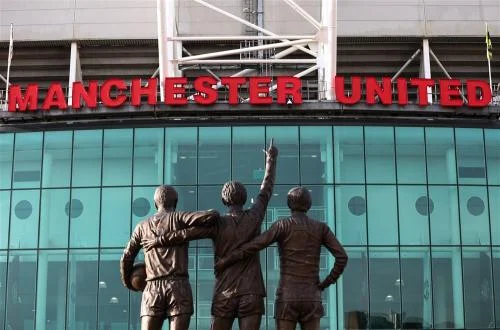
A consortium of Qatari investors is reportedly preparing to submit an initial bid for Manchester United, a move that could significantly reshape the landscape of elite football and exacerbate existing concerns about economic inequality within the sport. This potential acquisition marks the third major English Premier League club to fall under the purview of wealthy Middle Eastern investment groups, reinforcing football’s status as a coveted trophy asset for the ultra-rich and a vehicle for national ambition.
The development, first reported by Bloomberg News, indicates that officials from the Qatar Investment Authority (QIA), the emirate’s sovereign wealth fund, are actively involved in the preparatory stages of a proposal. This collaboration reportedly involves local family offices, underscoring the strategic importance Qatar places on such high-profile international assets. As of Tuesday, February 14, 2023, Manchester United’s shares saw a notable increase on the New York Stock Exchange, valuing the club at approximately $3.9 billion USD (equivalent to roughly Rp 59.8 trillion), a figure that reflects its immense global brand and commercial appeal.
The financial muscle behind a Qatari bid appears formidable. While British billionaire Jim Ratcliffe, founder and majority shareholder of Ineos Group Holdings Plc, has publicly expressed interest and is reportedly working with financial giants Goldman Sachs Group Inc. and JPMorgan Chase & Co. on his potential offer, his estimated wealth of $13.4 billion USD (approximately Rp 203 trillion) pales in comparison to the QIA’s staggering $450 billion USD (approximately Rp 6,826 trillion) in assets under management. This vast financial reservoir suggests that if Qatar officially backs a takeover, it would be exceptionally difficult for any other party to compete on financial grounds alone. The personal interest of the Emir of Qatar, Sheikh Tamim bin Hamad Al Thani, a known Manchester United supporter, further amplifies the likelihood of a serious pursuit.
UEFA Regulations and the "Multi-Club Ownership" Dilemma
A significant hurdle that any Qatari acquisition of Manchester United would need to overcome pertains to UEFA’s stringent regulations regarding multi-club ownership. UEFA’s rules explicitly prohibit clubs with a majority owner in common from competing in the same major European tournaments. Qatar Sports Investments (QSI), an entity already backed by the Qatari state, currently owns French Ligue 1 club Paris Saint-Germain (PSG). The prospect of two clubs of such magnitude and global significance potentially being barred from elite competitions like the Champions League could be a deal-breaker for both fan bases and the governing bodies of football.
The crucial question for UEFA will be whether the Qatari entities involved in a potential Manchester United acquisition are deemed sufficiently independent from QSI. This assessment will be critical, particularly given that Nasser Al-Khelaifi, the chairman of QSI, also holds a position on UEFA’s executive committee, the very body responsible for setting and enforcing these regulations. The precedent set in previous multi-club ownership cases, such as the one involving Red Bull GmbH’s ownership of RB Leipzig (Germany) and Red Bull Salzburg (Austria), where UEFA ruled that no single person or entity controlled both clubs, will likely be a focal point of scrutiny. In 2018, these two clubs were permitted to compete in the Champions League after UEFA determined they met the independence criteria, though the circumstances surrounding the Qatar situation present a potentially more complex scenario.
Reinforcing the Trend of State-Backed Football Investment
The potential Qatar takeover of Manchester United is not an isolated event but rather a continuation of a trend where state-backed entities from oil-rich nations are increasingly acquiring and influencing top-tier football clubs. In 2021, Saudi Arabia’s Public Investment Fund (PIF) acquired Newcastle United, injecting significant capital and ambition into the club. Similarly, Abu Dhabi United Group, an investment firm owned by the ruling family of Abu Dhabi, has controlled Manchester City since 2008, transforming them into one of Europe’s dominant forces. The recent acquisition of Chelsea by an American consortium led by Todd Boehly, replacing Russian oligarch Roman Abramovich, also highlights the shifting tides of ownership in the Premier League, though the Qatari move represents a different model of state-backed investment.
If successful, a Qatari acquisition would place two of the world’s top five revenue-generating clubs – Manchester United and Paris Saint-Germain – under the umbrella of investors linked to the Qatari state. This concentration of power and financial influence is likely to stir considerable debate across Europe, where football officials are already grappling with the disruptive impact of the Premier League’s immense spending power on the financial sustainability of regional leagues.
Financial Fair Play and the Shifting Power Dynamics
The era of unrestrained spending, epitomized by QSI’s acquisition of Neymar for a then-world record €222 million in 2017 and Kylian Mbappé for €180 million the following year at PSG, may face new constraints. The Premier League’s recent decision to charge Manchester City with over 100 alleged breaches of its financial rules, including accusations related to "Financial Fair Play" (FFP) regulations, signals a potential shift in how financial compliance is enforced within the league. While Manchester City, owned by Abu Dhabi, has been a subject of scrutiny, Newcastle United, under Saudi ownership, has thus far exercised more measured spending compared to its heavily invested counterparts.
The Glazer family, Manchester United’s current owners, has reportedly been seeking a valuation of $6 billion USD (as reported by Bloomberg News last year) for the club. This valuation implies an enterprise value to EBITDA ratio exceeding 60 times, a figure that, while high, reflects Manchester United’s unparalleled global brand recognition and massive fan base, despite a relative dip in on-field success over the past decade. For many disillusioned Manchester United fans who have long blamed the Glazer ownership for mounting debt and underinvestment, the prospect of a Qatari takeover offers a glimmer of hope for restoring the club to its former financial and competitive glory, potentially placing it on par with its financially resourced rivals.
Historical Context and Future Implications
The potential Qatari investment in Manchester United comes at a time when the global football market is increasingly characterized by mega-deals and the growing influence of sovereign wealth funds. This trend raises fundamental questions about the future ownership models of major sports franchises and the delicate balance between commercial interests and sporting integrity.
The history of Manchester United is one of unparalleled success and global adoration. Founded in 1878 as Newton Heath LYR Football Club, it officially became Manchester United in 1902 and has since amassed a record 20 English league titles, 12 FA Cups, and three European Cups/Champions League titles. The club’s commercial empire extends far beyond the pitch, with a global brand that resonates across continents, supported by millions of loyal fans. However, the Glazer family’s controversial leveraged buyout in 2005, which saddled the club with significant debt, has been a persistent source of fan discontent, fueling calls for new ownership.
The timing of this potential bid is also significant. Following the controversy surrounding the 2022 FIFA World Cup in Qatar, which saw extensive scrutiny over human rights issues and the country’s readiness to host such a global event, a successful acquisition of a club as iconic as Manchester United could serve as a powerful public relations move, aiming to enhance Qatar’s international image and soft power through the universally popular medium of sport.
The implications of a Qatari takeover are far-reaching. Economically, it could lead to further investment in infrastructure, player acquisitions, and commercial ventures, potentially bolstering Manchester United’s competitiveness. However, it also intensifies the debate around the financial sustainability of football. Critics argue that such massive injections of capital from state-backed entities can distort market competition, create an uneven playing field, and prioritize commercial gains over the traditional values of the sport. The challenges posed by UEFA’s multi-club ownership rules will be a critical test case, potentially setting precedents for how such complex ownership structures are managed in the future.
Furthermore, the takeover could ignite renewed calls for greater transparency and regulation in football ownership. The ongoing investigations into financial irregularities at Manchester City highlight the increasing pressure on football authorities to ensure fair play and prevent financial doping. As sovereign wealth funds continue to play a more prominent role in global sports, the long-term impact on the competitive balance and financial health of football leagues worldwide remains a subject of intense discussion and concern among fans, clubs, and governing bodies alike. The coming months will undoubtedly be crucial in determining the future trajectory of Manchester United and, by extension, the evolving financial architecture of global football.