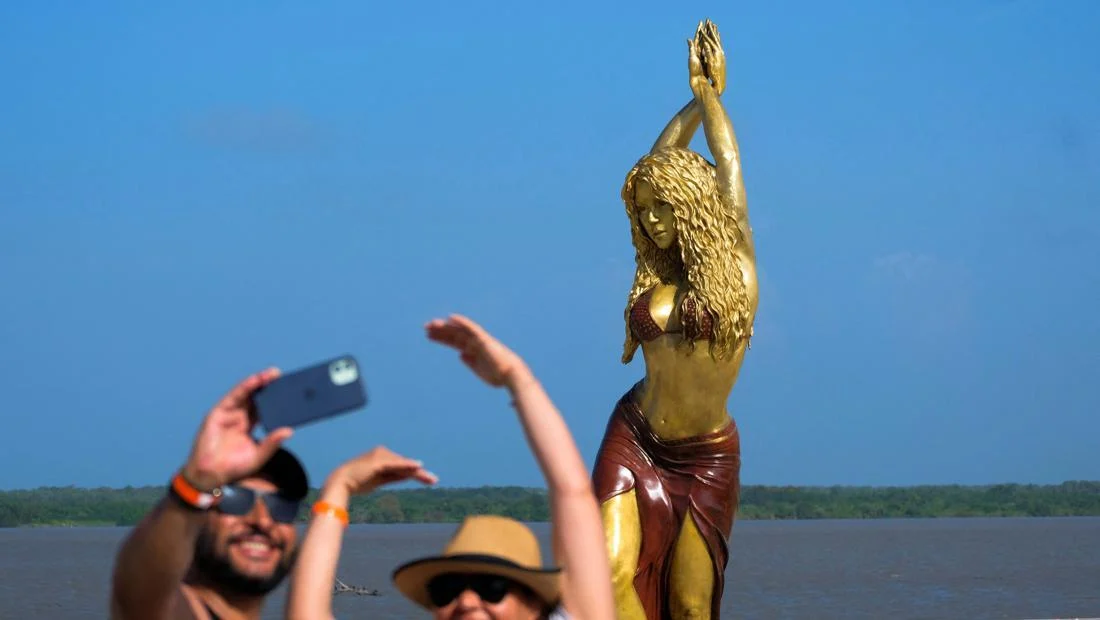
The city of Barranquilla, a vibrant port town on Colombia’s Caribbean coast, has long been celebrated for its kaleidoscopic Carnival and its rich musical heritage, but in recent years, it has become a site of pilgrimage for fans of one of the world’s most successful musical exports. In an era where pop culture often moves at a lightning-fast pace, the enduring legacy of Shakira Isabel Mebarak Ripoll has been solidified—quite literally—in bronze. Standing at a staggering 6.5 meters tall, a new monument dedicated to the "Queen of Latin Music" now overlooks the Magdalena River, serving as a testament to her global influence, her technical artistry, and her unwavering connection to her roots. This monumental tribute, unveiled in late 2023, represents more than just a likeness of a celebrity; it is a symbol of regional pride and a recognition of a career that has spanned over three decades, bridging the gap between Middle Eastern dance traditions and Latin American pop-rock.
The Symbolic Power of the Barranquilla Monument
The statue, which has quickly become a central fixture of Barranquilla’s tourism landscape, was the result of an ambitious artistic project led by the renowned Colombian sculptor Yino Márquez. Cast in bronze and weighing approximately six tons, the monument captures Shakira in the midst of her most iconic performance style. The figure is depicted in a state of rhythmic motion, with her arms raised toward the sky and her hips swiveled in a manner that instantly evokes her 2006 global smash hit, "Hips Don’t Lie." This specific posture was chosen not merely for its aesthetic appeal but because it represents the fusion of cultures that Shakira embodies—her Lebanese heritage through belly dance and her Colombian identity through movement.
The technical execution of the statue involved a team of over 30 workers and students from the District School of Arts (EDA), who spent five months meticulously crafting the piece. One of the most striking features of the monument is the skirt, which was fashioned from aluminum. The artist designed the lower portion of the garment to resemble the churning waves of the Caribbean Sea and the flow of the Magdalena River. By integrating these geographical elements, the statue anchors Shakira to the physical landscape of her birthplace, suggesting that her talent is a natural force emerging from the very soil and water of Barranquilla.
At the base of the statue, a metal plaque offers a poetic summary of her impact: "A heart that composes, hips that do not lie, an unmatched talent, a voice that moves masses, and bare feet that march for the good of children and humanity." This inscription highlights the multi-faceted nature of her career, acknowledging her as a songwriter, a performer, and a humanitarian.
A Legacy of Performance: From Local Talent to Global Stages
The unveiling of the monument coincides with a period of renewed global visibility for Shakira. Her recent appearances at major international sporting events have reaffirmed her status as a "perennial" performer who transcends demographic boundaries. Most notably, her presence at high-profile halftime shows—including the recent events surrounding major football tournaments—has drawn millions of viewers. While her repertoire has evolved over the years, incorporating modern reggaeton and electronic influences, her core performance style remains rooted in the fluid hip movements and belly dance techniques that first brought her to international prominence.
Journalistic analysis of her performance career reveals a unique trend: Shakira has become the unofficial face of global sports entertainment. Since her performance of "Hips Don’t Lie" at the 2006 FIFA World Cup in Germany, followed by the iconic "Waka Waka (This Time for Africa)" in 2010 and "La La La" in 2014, she has maintained a consistent presence at the intersection of music and athletics. These performances are not merely entertainment; they are calculated displays of soft power for Colombia, showcasing a modern, creative, and successful image of the nation to billions of viewers. The recent focus on her performance of "Dai Dai" alongside Burna Boy further emphasizes her ability to collaborate across genres and continents, maintaining relevance in an increasingly fragmented music industry.
Chronology of Recognition: A Tale of Two Statues
The 2023 monument is not the first time Barranquilla has sought to honor its most famous daughter. To understand the depth of the city’s relationship with Shakira, one must look back at the chronology of her public recognition:
- 1977–1990: Shakira is born and raised in Barranquilla, beginning her career as a child performer in local festivals.
- 1991–1995: The release of her early albums, Magia and Peligro, followed by the breakthrough success of Pies Descalzos, which established her as a force in the Spanish-speaking world.
- 2001: The release of Laundry Service marks her successful "crossover" into the English-language market, making her a household name globally.
- 2006: At the height of her "Hips Don’t Lie" fame, the city of Barranquilla inaugurated its first statue of Shakira. This 4.8-meter iron sculpture, located near the Estadio Metropolitano, depicted a younger Shakira playing an acoustic guitar. It reflected her image as a singer-songwriter and a rock-influenced artist.
- 2023: The inauguration of the new 6.5-meter bronze statue at the Gran Malecón. This second monument reflects a more mature and globally recognized version of the artist, focusing on her dance and her status as a cultural icon.
The transition from an iron statue with a guitar to a bronze statue in a dance pose mirrors the evolution of Shakira’s brand—from a regional folk-rock prodigy to a global pop titan. The city’s decision to commission a second, larger monument underscores the fact that her influence has not waned but has instead deepened over the decades.
Humanitarian Contributions and the "Pies Descalzos" Effect
While the world often focuses on her musical achievements, the Colombian government and the citizens of Barranquilla frequently cite her humanitarian work as her most significant contribution. The inscription on the monument’s base mentioning "bare feet that march for the good of children" is a direct reference to her Pies Descalzos (Bare Feet) Foundation.
Founded in 1997, when Shakira was only 20 years old, the foundation has been instrumental in building schools and providing educational resources to displaced and underprivileged children in Colombia. In Barranquilla specifically, the foundation has constructed state-of-the-art educational centers in some of the city’s most vulnerable neighborhoods, such as La Playa and El Bosque. Data from the foundation indicates that thousands of students have benefited from these facilities, which provide not only traditional education but also nutritional support and psychological services.
This philanthropic pillar is crucial to her public perception in Colombia. Unlike many global stars who maintain a distant relationship with their homelands, Shakira has consistently reinvested in the social infrastructure of Barranquilla. This has created a sense of mutual loyalty; the city honors her with monuments not just because she is famous, but because she has actively participated in the city’s development and the welfare of its future generations.
Economic and Touristic Impact on Barranquilla
The strategic placement of the new statue on the Gran Malecón—a scenic boardwalk along the Magdalena River—is no coincidence. Local government officials, including former Mayor Jaime Pumarejo, have been vocal about the role of the monument in the city’s urban renewal and tourism strategy. Since the unveiling, the Gran Malecón has seen a significant uptick in foot traffic, with both domestic and international tourists flocking to the site to take photographs with the "Shakira Statue."
Economic analysts suggest that "celebrity tourism" is a growing sector for Barranquilla. By branding itself as the "Home of Shakira," the city is able to diversify its appeal beyond the annual four-day Carnival. The presence of the monument serves as a permanent landmark that anchors the city’s identity to a globally recognized brand. This has led to increased investment in local hospitality, guided tours, and merchandise, providing a steady stream of revenue for the local economy.
Broader Implications: Cultural Soft Power and the Latin Explosion
The elevation of Shakira to a monumental figure in her hometown reflects a broader shift in how Latin American culture is perceived on the world stage. For decades, international headlines regarding Colombia were often dominated by narratives of conflict and instability. Figures like Shakira, alongside other icons like Gabriel García Márquez and Fernando Botero, have played a pivotal role in shifting that narrative toward one of creativity, resilience, and cultural excellence.
Shakira’s ability to maintain a career at the highest level for over 30 years is a rarity in the pop music landscape. Her success paved the way for the current "Latin Explosion" in the music industry, opening doors for contemporary artists like J Balvin, Karol G, and Maluma—many of whom are also from Colombia. The statue in Barranquilla is, in many ways, a monument to this entire movement. It represents the moment when Latin music stopped being a "niche" or "world music" category and became the dominant force in global popular culture.
Conclusion: A Living Legend in Bronze
As the sun sets over the Magdalena River, the bronze curves of Shakira’s monument catch the light, standing as a permanent reminder of what a girl from Barranquilla can achieve. The statue is a bridge between the past and the future—a tribute to the history of a young girl who dreamed of singing, and an inspiration for the next generation of Colombian artists who see in her a blueprint for global success.
Through her music, her dancing, and her philanthropy, Shakira has woven herself into the fabric of Colombian identity. The 6.5-meter bronze figure in Barranquilla is more than a tourist attraction; it is a profound statement of gratitude from a city to its most famous daughter. It confirms that while her career may take her to the world’s biggest stages, her heart—and her legacy—remains firmly rooted in the soil of Barranquilla. In the world of music, trends may come and go, but as the monument suggests, the impact of Shakira is enduring, solid, and undeniably iconic.