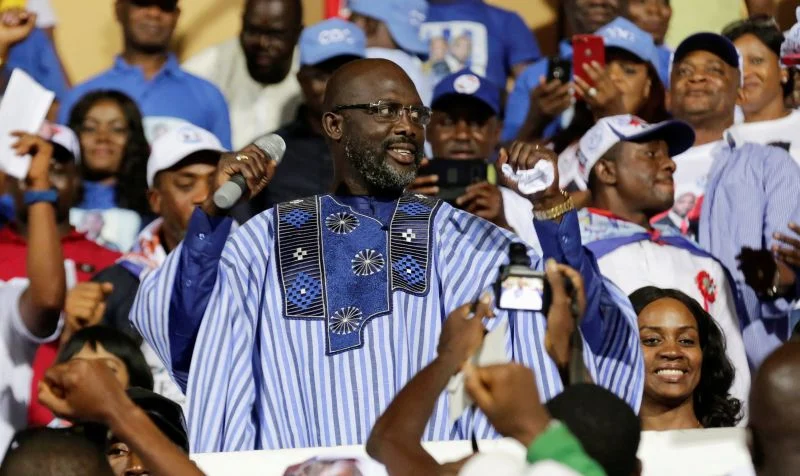
Liberia’s journey to electing George Weah as its president in December 2017 marked a remarkable transition for a nation grappling with its past and aspiring towards a brighter future. Weah, a globally recognized football legend, ascended to the highest office after a storied career on the pitch that saw him crowned FIFA World Player of the Year in 1995, a testament to his extraordinary talent and dedication. This unprecedented shift from international sports stardom to national leadership captured the world’s attention, symbolizing hope and a fresh start for many Liberians.
Born George Tawlon Manneh Oppong Ousman Weah on October 1, 1966, in Monrovia, Liberia, his early life was shaped by the vibrant, if often challenging, environment of his homeland. The dust of Monrovia’s makeshift pitches was the initial canvas for his burgeoning footballing genius. His formative years were spent honing his skills with local clubs such as Invincible Eleven, Mighty Barolle, Bongrange Bonguine, and the Young Survivors of Claretown. Even without formal coaching, Weah’s innate talent propelled the Young Survivors team from obscurity to the top division, signaling his potential for greatness.
The international stage beckoned in 1987 when, at the age of 20, Weah signed a three-year contract with Tonnerre Yaoundé in Cameroon. His impact was immediate, contributing significantly to the club’s triumph in the top-tier league. This success caught the eye of European clubs, and in 1988, AS Monaco of France’s top division secured his signature. During his five seasons with Monaco, from 1988 to 1992, Weah blossomed into a formidable attacking force, netting an impressive 57 goals. His contributions extended beyond individual brilliance, as he also helped Monaco clinch the French Cup in 1991. His electrifying pace, exceptional ball control, and pinpoint accuracy made him a fan favorite and a constant threat to opposing defenses.
Weah’s relentless work ethic and undeniable technical prowess earned him a lucrative move to Paris Saint-Germain (PSG) in 1992. At PSG, his reputation as a world-class striker solidified. He was instrumental in leading the Parisian club to a Coupe de France victory, a Ligue 1 title, and a memorable semi-final appearance in the UEFA Champions League in 1995. Over 123 appearances in the French league, Weah scored 37 goals and provided 3 assists, further cementing his status as one of Europe’s most potent forwards.
The pinnacle of his club career arrived in 1995 when Italian giants AC Milan acquired him from PSG. In Serie A, the league renowned for its defensive rigor, Weah continued to excel. He was a key figure in AC Milan’s Scudetto victories in 1996 and 1999. During his five-year tenure at the San Siro, he amassed 51 goals and 1 assist in 114 appearances. It was during this period that his individual accolades reached their zenith: in 1995, he was bestowed the prestigious FIFA World Player of the Year award, followed by the Ballon d’Or in 1996, becoming the first and only African player to win both prestigious honors. His triumphant spell at Milan underscored his ability to adapt and thrive in the most competitive footballing environments.
Following his illustrious football career, which also included stints with Manchester City and Chelsea in England, Weah transitioned his focus to public service. His political journey began in earnest, aiming to leverage his global influence and deep connection with the Liberian populace to address the nation’s persistent challenges. He contested the presidency in 2005, narrowly losing to Ellen Johnson Sirleaf, Africa’s first elected female head of state. Undeterred, Weah continued his political engagement, serving as a Senator for Montserrado County from 2015 to 2018.
The 2017 presidential election presented Weah with another opportunity to lead Liberia. The campaign was characterized by his populist appeal, promising to combat corruption and poverty, issues that have plagued the nation since its civil wars. His slogan, "Hope," resonated deeply with a population yearning for change and stability. Weah’s opponent in the runoff election was Joseph Boakai, the incumbent Vice President. The election, however, was marred by delays and disputes, with the National Elections Commission (NEC) initially postponing the runoff.
Election Timeline and Key Events
- October 10, 2017: The first round of the presidential election is held. No candidate secures the required 50% plus one vote for an outright victory. George Weah emerges as the frontrunner with approximately 38.4% of the vote, followed by Joseph Boakai with 28.8%.
- November 2017: The Supreme Court of Liberia orders the National Elections Commission (NEC) to postpone the runoff election, scheduled for November 7, due to allegations of fraud and irregularities filed by the Unity Party, Boakai’s party.
- December 2017: Following investigations and legal proceedings, the Supreme Court clears the way for the runoff.
- December 26, 2017: The presidential runoff election takes place. George Weah of the Coalition for Democratic Change (CDC) wins decisively, securing 61.5% of the vote. Joseph Boakai receives 38.5%.
- January 22, 2018: George Weah is inaugurated as the 25th President of Liberia.
The election results were a clear mandate for change, reflecting a desire among Liberians for a new direction. Weah’s victory was celebrated across the country, with many seeing it as a symbolic reclaiming of national pride and potential. His supporters viewed his background as an outsider to traditional politics as a strength, believing he could bring fresh perspectives and a commitment to serving the people rather than vested interests.
Background Context: Liberia’s Post-Conflict Landscape
Liberia’s political landscape in 2017 was still heavily influenced by the devastating civil wars that spanned from 1989 to 2003. These conflicts left the nation in ruins, with widespread destruction of infrastructure, a collapse of the economy, and deep societal divisions. The subsequent years under President Ellen Johnson Sirleaf saw efforts to rebuild and establish democratic institutions, but challenges such as endemic corruption, widespread poverty, and high unemployment persisted.
The election of George Weah occurred at a critical juncture. Liberia was transitioning from one democratically elected president to another, a significant achievement for a nation that had endured decades of instability. However, the underlying issues of governance, economic development, and social inequality remained pressing concerns. Weah’s campaign promised to address these head-on, drawing upon his personal narrative of overcoming adversity and his global recognition to inspire confidence.
Analysis of Implications
George Weah’s election carried significant implications, both domestically and internationally.
Domestic Implications:
- Hope and Expectations: Weah’s presidency brought a wave of optimism. His supporters expected tangible improvements in their living standards, job creation, and a more equitable distribution of national resources. The challenge for his administration would be to meet these high expectations amidst limited resources and entrenched systemic issues.
- Combating Corruption: Corruption has been a persistent problem in Liberia, hindering development and eroding public trust. Weah’s commitment to tackling corruption was a central theme of his campaign. His administration’s success in this area would be crucial for attracting investment and ensuring effective governance.
- Economic Development: Liberia’s economy is heavily reliant on natural resources and foreign aid. Weah’s administration faced the task of diversifying the economy, creating sustainable employment opportunities, and fostering an environment conducive to business growth.
- National Unity: While the election was largely peaceful, the legacy of civil conflict meant that fostering national unity remained a priority. Weah, as a unifying figure with broad appeal, had the potential to bridge divides and promote reconciliation.
International Implications:
- African Leadership: Weah’s rise as a global sports icon turned head of state offered a compelling narrative of African achievement and potential. It underscored the growing influence of former athletes and celebrities in political arenas worldwide.
- Foreign Investment and Aid: Liberia’s ability to attract foreign investment and secure continued international aid would be influenced by the perceived stability and effectiveness of Weah’s government. His international profile could be an asset in this regard.
- Democratic Progress: Liberia’s successful democratic transition, culminating in Weah’s election, served as an example for other nations grappling with post-conflict recovery and democratic consolidation in Africa.
Official Responses and International Reactions
Following the announcement of his victory, George Weah expressed gratitude to the Liberian people and pledged to serve them diligently. He emphasized his commitment to unity and development. "I am humbled and deeply honored by the trust the Liberian people have placed in me," Weah stated shortly after the results were declared. "This is a victory for all Liberians, and together we will work to build a better nation."
Leaders from various African nations and international organizations extended congratulations to President-elect Weah. The United Nations, which had a significant peacekeeping presence in Liberia for many years, welcomed the peaceful conclusion of the electoral process. International bodies like the African Union and the Economic Community of West African States (ECOWAS) also lauded Liberia’s commitment to democratic principles.
The journey of George Weah from the dusty fields of Monrovia to the presidential palace represents a profound narrative of ambition, resilience, and the enduring power of hope. His presidency signifies not just a change in leadership but a potential turning point for Liberia, a nation striving to overcome its past and build a prosperous future. The world watched with keen interest as the former football maestro embarked on his most challenging and consequential match yet: leading his country.