The Misano World Circuit Marco Simoncelli has long stood as one of the most unpredictable and captivating venues on the premier class calendar. Nestled on the Adriatic coast in Italy, the circuit has consistently delivered high-stakes racing, intense rivalries, and unpredictable weather conditions that have forever altered championship campaigns. As the MotoGP paddock reflects on the rich history of the San Marino Grand Prix, a retrospective look at the most dramatic events reveals why this Italian classic remains etched in motorsport lore. From chaotic flag-to-flag encounters dictated by sudden downpours to heart-stopping photo finishes separated by fractions of a second, Misano has provided the backdrop for some of the most memorable chapters in modern motorcycle racing history.
Historical Context and Significance of the Misano World Circuit
The Misano World Circuit, officially named in honor of the late Marco Simoncelli, has a storied past that dates back to the early 1970s. Initially built as a short track, it underwent extensive modernizations to meet the stringent safety and logistical demands of the modern MotoGP era. Located in the heart of Italy’s "Motor Valley," the circuit is surrounded by a passionate fanbase that treats the Grand Prix not merely as a sporting event, but as a cultural celebration.
The track layout itself—characterized by a mix of fast sweeping corners, heavy braking zones, and tight hairpins—demands absolute precision from riders and flawless engineering from teams. Because of its coastal location, Misano is frequently subjected to microclimates where sunny skies can transform into torrential downpours within a matter of minutes. This meteorological volatility has historically served as the catalyst for some of the championship’s most chaotic strategic battles, most notably in the realm of flag-to-flag races where tactical decision-making in the pit lane often outweighs sheer machine performance on the tarmac.
Chronology of Iconic Misano Dramas
Over the decades, the San Marino Grand Prix has hosted championship-defining moments. While the event’s history spans numerous legendary encounters, certain editions stand out for their sheer unpredictability and dramatic shifts in momentum. Among these, the races from 2012 and 2015 perfectly encapsulate the volatile nature of racing at Misano.
The 2012 San Marino Grand Prix: Title Implications and Unprecedented Debuts
The 2012 race weekend at Misano began with high tension and immediate drama even before the red lights went out. Dani Pedrosa, then riding for the factory Repsol Honda team and locked in a fierce battle for the World Championship crown, suffered a catastrophic setback on the grid. Due to a technical issue that stalled his machine, the Spanish veteran was forced to start the race from the absolute back of the grid.
As the field roared away from the line, Pedrosa’s attempts at a miraculous recovery were abruptly cut short on the opening lap. Contact with Pramac Racing’s Hector Barbera sent Pedrosa tumbling into the gravel trap, effectively ending his race and delivering a devastating blow to his championship aspirations. With his primary title rival out of contention, Yamaha’s Jorge Lorenzo seized the opportunity with a masterclass performance.
Lorenzo crossed the finish line in first place, extending his championship lead to a commanding 38 points and cementing his path toward the 2012 world title. Behind him, Valentino Rossi delivered a joyous result for the partisan Italian crowd by securing second place aboard the Ducati, a rare highlight during a challenging era for the Bologna-based manufacturer. Alvaro Bautista rounded out the podium in third position for Gresini Racing.
Notably, the 2012 event also featured a fascinating cameo that caught the attention of the global motorsport community. British Superbike star Jonathan Rea was called upon by Repsol Honda to make his premier class debut, stepping in as a replacement for the injured Casey Stoner. Handling a machine he had never ridden in competitive conditions, Rea put in a mature and steady ride to cross the finish line in eighth position, earning widespread paddock praise for his adaptability.
The 2015 San Marino Grand Prix: The Ultimate Flag-to-Flag Masterclass
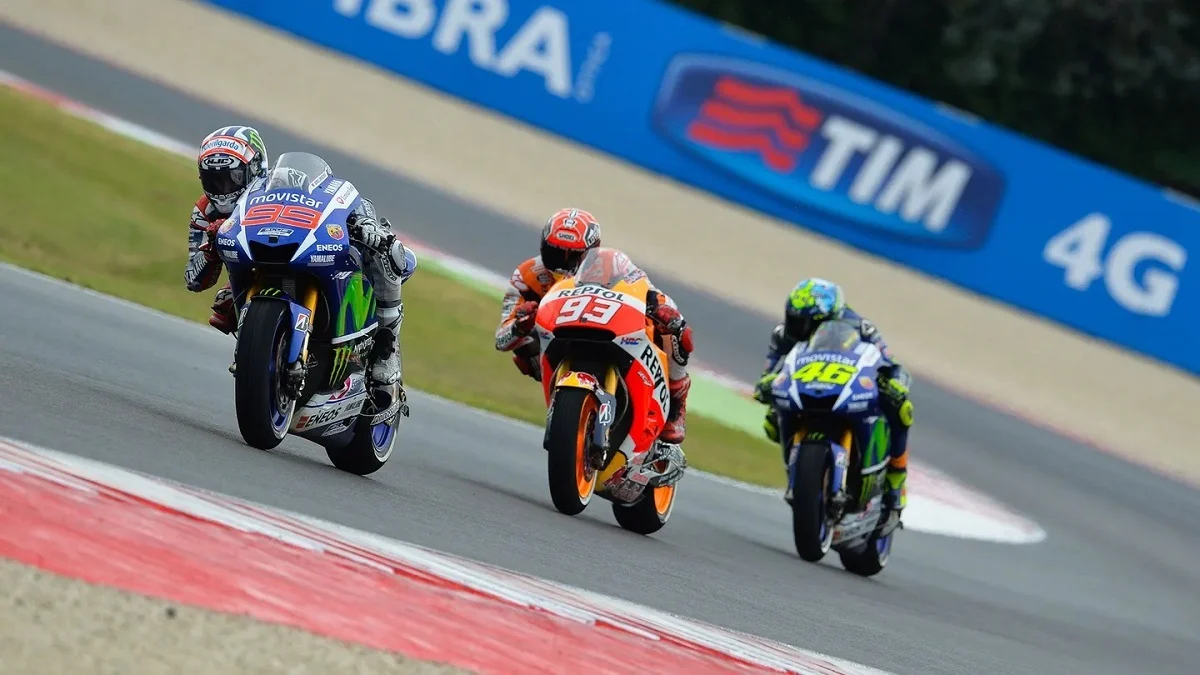
Few races in the modern era match the tactical chaos and weather-induced drama of the 2015 MotoGP San Marino Grand Prix. The event is widely studied by race strategists and remembered by fans as the quintessential flag-to-flag race, featuring not one, but two mandatory machine swaps due to rapidly fluctuating weather conditions.
Jorge Lorenzo, once again showing supreme pace, secured pole position and converted it into an early lead as the race commenced under overcast skies. However, within a matter of laps, a light drizzle began to intensify, transforming the asphalt into a treacherous slippery surface. By Lap 7, the precipitation worsened significantly, prompting the majority of the grid to peel into the pit lane to switch to their secondary motorcycles equipped with wet-weather tires.
The strategic chess match did not end there. As the race progressed, the rain ceased completely, and the intense Adriatic sun rapidly dried the racing line. The damp patches disappeared, leaving riders circulating on overheating wet tires that were rapidly disintegrating on the abrasive dry asphalt. This triggered a frantic second wave of pit stops as riders rushed back into the pit lane to swap back to slick-tired machines.
Amidst the strategic confusion and high-risk gambles, Repsol Honda’s Marc Marquez executed a perfectly timed pit stop sequence. While many of his rivals delayed their transitions or made critical tactical misjudgements, Marquez seized control of the race and powered to a brilliant victory. The podium was completed by a pair of unexpected protagonists: Bradley Smith delivered a phenomenal ride to claim second position for Monster Yamaha Tech 3, while his compatriot Scott Redding fought through the chaos to secure a remarkable third place for the Marc VDS team.
Strategic Analysis and Championship Implications
Races like those witnessed at Misano highlight the multifaceted nature of modern MotoGP. Success at the San Marino Grand Prix requires more than raw riding talent; it demands split-second tactical execution, supreme composure under pressure, and seamless communication between rider and pit wall.
In flag-to-flag scenarios, crew chiefs and telemetry engineers become just as vital as the athletes on the track. A delay of merely two seconds in the pit lane or an mistimed judgment regarding track moisture levels can mean the difference between standing on the top step of the podium and scoring zero points. For championship contenders, Misano has historically served as a high-stakes crucible where a single tactical error can derail an entire season’s hard work, while a calculated gamble can secure an insurmountable points advantage.
Broader Impact on the MotoGP Ecosystem
The dramatic legacy of the San Marino Grand Prix extends far beyond the record books. Events characterized by extreme weather and tactical uncertainty consistently drive high television viewership and generate widespread engagement across global digital platforms. For Dorna Sports, the commercial rights holder of MotoGP, and the Fédération Internationale de Motocyclisme (FIM), venues like Misano validate the sport’s ongoing commitment to unpredictable, highly competitive racing entertainment.
Furthermore, the logistical lessons learned from chaotic events at circuits prone to microclimates continuously influence the safety protocols and regulatory frameworks of the sport. Race direction regularly reviews pit-lane procedures, communication channels, and safety vehicle deployments based on historical data gathered from races such as the 2015 Misano encounter, ensuring that rider safety remains paramount even as teams push the absolute limits of strategic risk-taking.
As the MotoGP championship continues to evolve with advanced aerodynamics, ride-height devices, and increasingly sophisticated electronic control units, the human element—exemplified by bravery in changing weather and tactical cunning on the pit wall—remains the core driving force of the sport. The historical tapestry of the San Marino Grand Prix guarantees that whenever the world’s elite motorcycle racers assemble on the shores of Misano, history, drama, and unforgettable moments will inevitably follow.