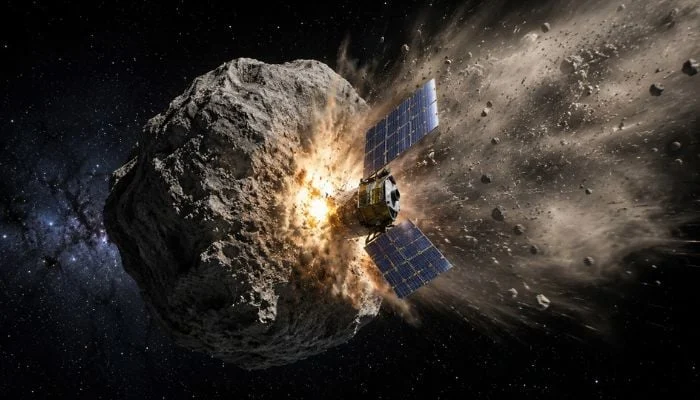
The China National Space Administration (CNSA) is charting a bold course in planetary defense, announcing plans for a groundbreaking mission to alter the trajectory of asteroid 2015 XF261. This ambitious undertaking, potentially launching as early as 2029 or 2030, signifies a significant step forward in China’s commitment to safeguarding Earth from potential extraterrestrial threats. The target, a near-Earth asteroid measuring approximately 30 meters in diameter, possesses the capacity to inflict considerable damage should it deviate from its current celestial path and impact our planet.
This proposed mission represents a crucial development in the global effort to understand and mitigate the risks posed by asteroids. The CNSA’s strategy involves a kinetic impactor approach, deploying a spacecraft designed to collide with 2015 XF261 at an astonishing velocity of around 32,444 kilometers per hour (approximately 20,160 miles per hour). This speed significantly surpasses that of NASA’s groundbreaking Double Asteroid Redirect Test (DART) mission, which successfully nudged the asteroid Dimorphos in 2022 by impacting it at roughly 22,016 kilometers per hour (approximately 13,680 miles per hour). The DART mission itself marked a historic achievement, serving as humanity’s first successful demonstration of altering an asteroid’s orbit through kinetic impact.
A Leap Forward in Planetary Defense Technology
The scientific community views China’s planned mission with keen interest, recognizing its potential to push the boundaries of current planetary defense capabilities. While the DART mission provided invaluable data on the effectiveness of kinetic impactors, the CNSA’s proposed mission introduces a new variable: the impactor’s significantly higher velocity. This raises critical questions for researchers regarding the asteroid’s structural integrity. Scientists are particularly focused on understanding whether such a high-speed collision could not only alter the asteroid’s trajectory but also potentially fragment its physical composition. The precise composition and internal structure of 2015 XF261 are still subjects of ongoing study, making this an area of intense scientific scrutiny.
The success of this mission would not only bolster China’s planetary defense capabilities but also contribute significantly to the collective global knowledge base on asteroid deflection. It promises to offer humanity a more diverse set of strategies for addressing the ever-present threat of near-Earth objects (NEOs), providing more robust options for averting potential future collisions.
Understanding Asteroid 2015 XF261: A Potential Hazard
Asteroid 2015 XF261, identified by its designation, falls into the category of near-Earth asteroids, celestial bodies whose orbits bring them into close proximity with Earth. Objects of this size, approximately 30 meters in diameter, are often referred to as "city-killers." While not capable of causing global devastation on the scale of larger extinction-level impactors, an impact from an object of this size could result in catastrophic local or regional damage. For context, the Chelyabinsk meteor that exploded over Russia in 2013 was estimated to be around 20 meters in diameter and caused widespread damage through its airburst shockwave, injuring over 1,500 people and shattering thousands of windows. An object like 2015 XF261, if it were to directly strike the Earth’s surface, could unleash an energy equivalent to a significant nuclear detonation, depending on its composition and atmospheric entry angle.
The asteroid’s orbit is a crucial factor in assessing its threat level. Scientists continuously monitor NEOs to precisely map their trajectories and predict potential close approaches to Earth. While 2015 XF261 is currently not on a direct collision course, the dynamic nature of celestial mechanics means that gravitational perturbations from other planets or even the Sun can subtly alter its path over time. This underscores the importance of proactive measures and the development of deflection technologies.
A Chronology of Planetary Defense Efforts
The concept of asteroid deflection has moved from the realm of science fiction to tangible scientific endeavor over the past few decades. Key milestones include:
- Early Theoretical Work: Throughout the 20th century, scientists and science fiction writers explored the potential threat of asteroid impacts and brainstormed hypothetical solutions.
- Increased Observational Capabilities: The late 20th and early 21st centuries saw a significant expansion in astronomical surveys dedicated to detecting and cataloging NEOs, such as the Lincoln Near-Earth Asteroid Research (LINEAR) program and the Catalina Sky Survey.
- The DART Mission (2022): This NASA-led mission represented a pivotal moment. Launched in November 2021, the DART spacecraft deliberately impacted the asteroid Dimorphos, a moonlet orbiting the larger asteroid Didymos, on September 26, 2022. The mission’s primary objective was to demonstrate the kinetic impactor technique for deflecting an asteroid. The impact successfully altered Dimorphos’s orbital period around Didymos by 33 minutes, exceeding the mission’s success criteria and proving the viability of this method.
- China’s Proposed Mission (2029-2030): The CNSA’s announcement marks the next significant step, aiming to refine and potentially enhance the kinetic impactor technique with a higher velocity impactor.
The Kinetic Impactor Method: Principles and Challenges
The kinetic impactor method relies on Newton’s third law of motion: for every action, there is an equal and opposite reaction. By striking an asteroid with a fast-moving spacecraft, momentum is transferred, causing a change in the asteroid’s velocity. Even a small change in velocity, applied sufficiently far in advance of a potential impact, can result in the asteroid missing Earth entirely.
The primary challenge for the CNSA’s mission, as highlighted by scientists, lies in the potential for fragmentation. Asteroids are not monolithic bodies; they are often loosely bound aggregates of rocks and dust. A high-velocity impact could, in theory, shatter the asteroid into multiple pieces. While this would still alter the trajectory of the bulk of the material, it could create a "shotgun effect," with smaller fragments potentially still posing a threat, albeit a dispersed one. Understanding the internal structure and cohesive strength of 2015 XF261 is therefore paramount. Advanced remote sensing and impact modeling will be critical to predict the outcome of the collision.
International Collaboration and Implications
The development of planetary defense capabilities is increasingly viewed as an international imperative. While China’s mission is a national endeavor, its success would have global implications. Increased collaboration between space agencies, such as the CNSA and NASA, as well as international bodies like the United Nations Office for Outer Space Affairs (UNOOSA) and the International Asteroid Warning Network (IAWN), is crucial for sharing data, coordinating efforts, and developing comprehensive response strategies.
The implications of China’s planned mission extend beyond just technical advancement. It signals a growing assertiveness and capability in space exploration and defense from China, potentially influencing the global geopolitical landscape in space. As nations continue to invest in space-based assets and technologies, such as asteroid deflection, the need for transparency and cooperation becomes even more critical to ensure that these capabilities are used for the benefit of all humankind.
The successful deflection of an asteroid by a nation would not only be a scientific triumph but also a testament to humanity’s growing ability to proactively manage cosmic risks. It would bolster confidence in our collective ability to face existential threats and ensure a more secure future for our planet. The scientific community will be closely observing the preparations and execution of this ambitious mission, eager to learn from its outcomes and further refine our strategies for planetary defense. The journey to safeguard Earth from cosmic dangers is ongoing, and China’s upcoming mission is set to be a significant chapter in this vital narrative.