South Korea has firmly established itself as one of the premier outbound travel destinations for international tourists, largely driven by the explosive global phenomenon of the "Hallyu" or the Korean Wave. Popularized by internationally acclaimed television dramas, K-pop music, and cinematic masterpieces, the nation’s distinct blend of hyper-modern urban landscapes and deeply preserved traditional culture has captured the imagination of travelers worldwide. Statistics from the Korea Tourism Organization (KTO) indicate a steady, multi-year surge in inbound tourism prior to global travel disruptions, with visitors eager to step inside the living backdrops of their favorite onscreen narratives. Beyond the visual appeal, contemporary South Korea offers a sophisticated infrastructure that seamlessly blends high-tech urbanity with accessible cultural preservation, making it an ideal itinerary for both first-time visitors and seasoned explorers.
The Evolution of South Korea’s Tourism Strategy
For decades, international tourism in South Korea was primarily centered around historical landmarks such as Gyeongbokgung Palace, the Demilitarized Zone (DMZ), and the natural wonders of Jeju Island. However, a significant shift occurred in the early 2010s as the Ministry of Culture, Sports and Tourism began strategically leveraging media content as an economic driver. By investing in urban regeneration projects and pedestrian-friendly zones, municipal governments in Seoul and regional cities transformed everyday streets, neighborhoods, and commercial centers into vibrant cultural hotspots. This deliberate integration of pop culture into public architecture not only revitalized local economies but also redefined the country’s national branding. Today, urban exploration in South Korea is heavily influenced by the desire to experience authentic lifestyle settings depicted in media, pushing districts like Daehakro and commercial hubs into the international spotlight.
Geonbae: The Epicenter of Modern Metropolitan Nightlife
For travelers seeking to immerse themselves in the pulsating energy of modern South Korean nightlife, Geonbae offers an unfiltered look into the country’s metropolitan culture. Situated within Seoul’s bustling commercial matrix, this vibrant street corridor is flanked by an eclectic mix of contemporary bars, microbreweries, and dining establishments that come alive after sunset.
The area’s architectural aesthetic relies on striking neon signage, sleek modern facades, and bustling outdoor seating arrangements that mirror the quintessential late-night drama scenes frequently watched by global audiences. According to local economic reports, districts characterized by high-density entertainment venues play a crucial role in Seoul’s nocturnal economy, contributing significantly to the hospitality sector’s revenue. Geonbae remains perpetually frequented by both local professionals unwinding after a standard workday and international tourists looking to experience the dynamic social fabric of South Korea’s capital. Urban planners note that such districts are intentionally designed to encourage pedestrian flow, fostering an environment where spontaneous social interaction and culinary exploration intersect.

Daehakro: Seoul’s Historic Hub of Arts and Performance
Transitioning from commercial nightlife to creative expression, Daehakro stands as Seoul’s definitive cultural corridor. Spanning approximately 1.6 kilometers, the district functions as South Korea’s artistic equivalent to London’s West End or New York City’s Broadway. The historical roots of Daehakro trace back to the former campus of Seoul National University before its relocation in the 1970s, after which the area naturally transitioned into a sanctuary for independent artists, theater troupes, and avant-garde performers.
Today, Daehakro is home to over a hundred small-to-medium-sized theaters, art galleries, and performance spaces. The streetscape is defined by a unique architectural amalgamation of mid-20th-century institutional buildings and modern creative hubs. Cultural analysts emphasize that Daehakro is vital for preserving grassroots performing arts in a country otherwise dominated by major commercial entertainment conglomerates. Visitors walking down the avenue can encounter live street performances, public art installations, and schedule-packed theatrical productions ranging from traditional pansori adaptations to contemporary experimental dramas. This concentration of artistic energy ensures that Daehakro remains an intellectual and creative anchor within the urban expanse of Seoul.
Starfield Library: Redefining Public Spaces in Commercial Architecture
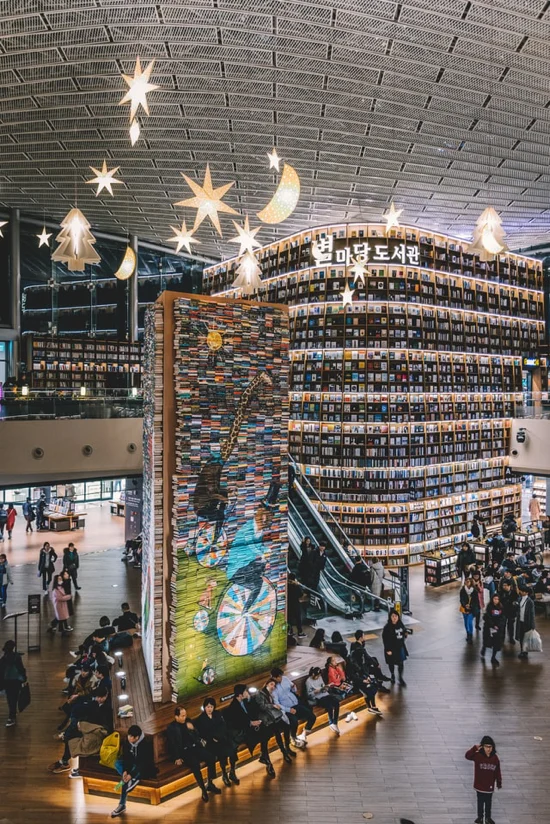
In the realm of modern architectural marvels, the Starfield Library has redefined the concept of public literary spaces within a commercial environment. Located centrally within the COEX Mall in Gangnam, Seoul, this expansive cultural sanctuary spans two stories and features towering, 13-meter-high bookshelves that house over 50,000 volumes, magazines, and digital archives.
Opened to the public as part of a major urban renewal initiative to transform private retail spaces into community-centric hubs, the Starfield Library has quickly become one of the most photographed interior locations in East Asia. Architectural critics praise the design for its utilization of natural light, pouring in through a massive glass glass-domed ceiling that illuminates the open-floor reading desks and gathering spaces below.
Beyond its visual grandeur, the library serves a functional purpose as an intellectual oasis amid Seoul’s hyper-dense financial district. It regularly hosts public lectures, poetry readings, and classical music recitals, bridging the gap between commercial consumerism and accessible public education. Economic impact assessments indicate that the inclusion of large-scale cultural installations within shopping complexes significantly increases visitor dwell time, shifting the modern retail paradigm toward experiential tourism.

Culinary Integration and the Broader Tourist Experience
No exploration of South Korea’s urban landscape is complete without examining its robust culinary ecosystem. The travel experience across districts like Geonbae, Daehakro, and Gangnam is deeply intertwined with gastronomic discovery. Street food vendors, traditional markets, and high-end dining establishments operate in close proximity, offering a comprehensive tasting profile of modern Korean cuisine.
Industry experts note that culinary tourism has become a primary driver for repeat visitors to South Korea. The government’s continued support for global food promotion campaigns has successfully positioned dishes such as Korean barbecue, street-style tteokbokki, and contemporary fusion fare as essential components of the international travel itinerary. This holistic approach—combining visual landmarks, artistic districts, modern architecture, and culinary diversity—ensures that South Korea remains competitive in the global tourism market.
Socioeconomic Implications and Future Outlook
The sustained influx of international travelers visiting cultural and media-inspired landmarks carries profound economic and diplomatic implications for South Korea. Tourism sector analyses consistently demonstrate that media-induced travel yields high economic multipliers, benefiting local small-to-medium enterprises, hospitality providers, and transportation networks. Furthermore, these physical touchpoints allow international visitors to engage directly with South Korean culture beyond the screen, fostering cross-cultural understanding and goodwill.
As municipal authorities continue to invest in sustainable urban development and smart tourism infrastructure, destinations such as Geonbae, Daehakro, and the Starfield Library are expected to evolve further. Future urban planning initiatives aim to enhance pedestrian connectivity between these key cultural nodes, ensuring that visitors can navigate Seoul’s diverse offerings with ease and efficiency. Ultimately, South Korea’s ability to dynamically adapt its urban spaces to meet the expectations of global travelers guarantees its status as a cornerstone of modern international tourism.